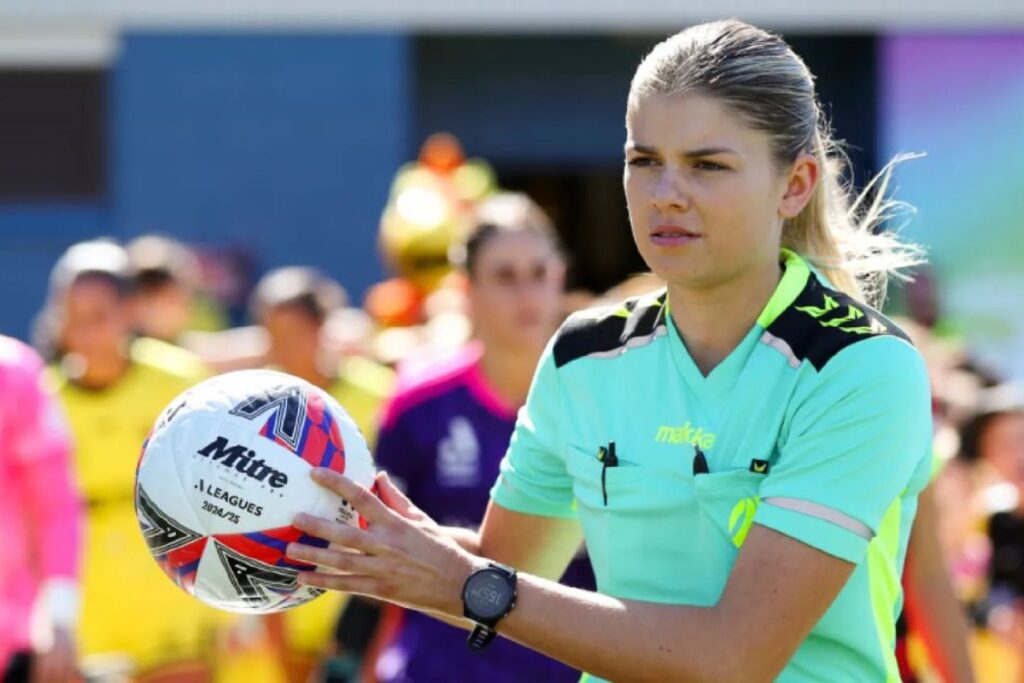
Isabella Mossin awarded Ninja A-League Women Referee of the Year

The youngest recipient since its inception, Mossin will officially receive the award after leading the Ninja A-League Grand Final 2026 on Saturday.


A rapid rise

After debuting in 2023, Mossin has quickly proved quality, composure and confidence as a referee in the Ninja A-League.

As a result of the achievement, Mossin will be the appointed referee for this weekend’s Grand Final between Melbourne City FC and Wellington Phoenix.

After beginning in the North West Sydney Football Association, Mossin then honed her craft with the Football NSW Referee Academy, a journey with foundations truly embedded in youth development and grassroots football.

Thus, Mossin is not just am individual success story, but a symbol of what institutional investment and opportunities can do for young women looking for a pathway to the game.


Celebrating success

The plaudits, unsurprisngly, are arriving from across Australia’s football landscape, with many emphasising the incredible standards set by Mossin since her debut just three years ago.

“This award is testament to Isabella’s hard work and dedication to refereeing, and a great reflection of the next generation of referees coming through the system in Australia,” said A-Leagues CEO, Steve Rosich.

“At just 25 years of age, she has consistently demonstrated composure, leadership, strong decision-making and the ability to perform under pressure in some of the biggest matches in the competition,” highlighted Football Australia Head of Referees, Jon Moss.

“Having someone refereeing their first Ninja A-league Women’s Grand Final at the age of 25 years should inspire all girls and young women referees (and potential referees) and show them that age is not a barrier to talent being recognised within Football Australia refereeing,” said Chair of Football Australia Referee Committee, David Elleray.

Given Mossin’s reputation and experience already at the top level of women’s football in Australia, there is no doubt that she will rise to the occasion this Saturday.

Previous ArticleNext Article

World Cup betting boom presents billion-dollar opportunity, and a growing dilemma, for Australian football

The 2026 FIFA World Cup is expected to become the biggest betting event in sporting history, with more than US$50 billion ($76 billion AUD) expected to be wagered globally across the tournament.

Financial services firm Macquarie estimates around US$500 million will be bet on each match, eclipsing the estimated US$35 billion wagered during the Qatar 2022 World Cup. The jump is driven by the tournament’s expansion from 32 to 48 teams and from 64 to 104 matches, alongside the rapid growth of legal sports betting markets in North America.

While much of the attention has focused on the sheer scale of betting turnover, the figures also underline football’s commercial importance to Australia’s wagering industry.

The World Cup has long been one of the country’s biggest betting events, sitting alongside the Melbourne Cup, AFL Grand Final and State of Origin. With Australia qualifying once again and attracting strong national interest, bookmakers have invested heavily in marketing campaigns designed around football’s month-long global spectacle.

TAB recently launched its nationwide “The Cup at TAB” campaign, positioning venues across Australia as communal destinations to watch World Cup matches, backed by research suggesting 61% of Australians prefer experiencing the tournament with others.

Sportsbet has also rolled out a major World Cup advertising campaign built around football’s global appeal, highlighting just how commercially valuable the tournament has become for Australia’s betting operators.

What about Australian Football?

Unlike Europe’s major leagues, Australian football still relies heavily on sponsorship and broadcast revenue to grow participation, develop professional competitions and improve fan engagement. The increased commercial attention generated during a World Cup inevitably benefits broadcasters, venues, hospitality businesses and wagering companies looking to capitalise on football’s largest audience.

SBS has introduced in-game advertising during FIFA’s mandated hydration breaks for the first time at a World Cup, creating additional commercial inventory during live broadcasts while maintaining uninterrupted match coverage.

Yet football’s commercial success arrives amid mounting political pressure over gambling advertising.

The Albanese Government has proposed significant restrictions on gambling promotions, including banning betting advertisements during most live sport before 8.30pm, prohibiting gambling branding at sporting venues and preventing athletes and celebrities from promoting wagering products. While described as Australia’s biggest gambling advertising reforms to date, critics argue the measures still leave significant loopholes.

What does it mean for football?

As betting companies spend millions attaching themselves to the World Cup, gambling harm advocates argue football’s biggest event also becomes one of the industry’s most effective customer acquisition tools.

Macquarie analysts have warned bookmakers face an additional challenge beyond simply attracting World Cup punters. The industry’s long-term profitability depends on converting casual tournament bettors into year-round customers across football, racing and other sports, as well as higher-margin casino products.

That concern has been repeated by gambling reform organisations, which argue global football tournaments expose younger audiences and first-time bettors to increasingly sophisticated wagering products.

For Australian football administrators, the issue reflects a broader commercial balancing act.

The sport continues to chase greater investment to compete with the AFL and NRL for fans, sponsors and media attention. World Cups generate unprecedented engagement, creating opportunities for broadcasters, pubs, clubs, hospitality operators and betting companies alike.

However, as governments tighten gambling regulations and public scrutiny intensifies, football’s commercial ecosystem may also need to evolve. The 2026 World Cup demonstrates football’s extraordinary economic power beyond ticket sales and broadcasting rights. Billions of dollars will flow through betting markets over the next month, reinforcing football as one of the world’s most commercially valuable sports.

For Australia, the challenge is ensuring that the business generated by football strengthens the game itself, rather than simply enriching industries that surround it.

Football Victoria joins campaign to fight racism in sport

With the launch of the Victorian Government’s Racism Doesn’t Belong in Our Game campaign, Football Victoria joins several sporting organisations in the state to ensure sport remains inclusive and welcoming for all.


About the campaign

Racism Doesn’t Belong in Our Game aims to raise awareness of racism in community sport, uniting organisations and associations like VACSAL, Vicsport, VicHealth and more.

Football Victoria, as the state’s governing body for the beautiful game, will affirm its commitment to ensuring football is a safe and inclusive place for all who play, coach or support by joining the campaign.

It reflects the leadership and guidance of the Centre for Multicultural Youth (CMY) and its CMSport initiative, a service provider with over 30 years of experience in supporting diversity in sports through training, coaching and mentoring, and consulting support.

“It has been fantastic to work with CMSport, CMY and the other sporting codes to bring this campaign to life,” said FV Executive Manager of Equity Growth and Government Relations Karen Pearce via media release.

“The Racism Doesn’t Belong in Our Game campaign started with a pledge from all seven codes to tackle racism, and I really do believe that we can achieve that as a cohesive group pulling toward the same goals.”


Strength in diversity

Australia is an immensely diverse and multicultural nation. According to numbers from the Australian Bureau of Statistics, the population includes 8.8 million people born overseas, representing 32% of the population. 48% have a parent born overseas, while 4% is Indigenous.

It should therefore be expected – and indeed, welcomed – that Australia’s most-participated sport reflects this multiculturalism.

But for many who want to enjoy playing or watching football in their local community, incidents of racism continue to plague their experiences in the game.

“Research tells us over 56% of Victorian community sport have reported experiencing or witnessing racism, a truly alarming number,” Pearce continued.

“We look forward to working together to lower that stat as we try to stamp out racism in sport once and for all.”

Racism Doesn’t Belong in Our Game ultimately embodies not only the goal for all sport going forward, but the best way through which to achieve it.

That is, through unity and championing the diversity which makes Australia a nation to admire.

Most Popular Topics

Editor Picks

Send this to a friend