
The Participation Boom Councils Didn’t Plan For Is Hitting Football Hard

Football in Australia isn’t being held back by passion, participation, or community support. It’s being held back by local government failure. From a CEO perspective, the warning signs are no longer subtle — they’re screaming. Confidence towards councils is collapsing, clubs are done believing the rhetoric, and the people carrying the game every weekend are telling us the same thing: councils don’t understand football, don’t consult properly, and don’t plan for growth. This isn’t opinion anymore. It’s measurable. And it should embarrass every policymaker in the country.

Football in Australia isn’t struggling because of a lack of passion. It isn’t struggling because communities don’t care. And it certainly isn’t struggling because participation is declining.

Football is struggling because, at the local government level, confidence is collapsing. What is more, the people closest to the game can feel it.

Soccerscene’s latest survey on council readiness and football planning shows something deeply confronting: trust in councils is at its lowest point, and clubs no longer believe the rhetoric. Councils frequently speak about “supporting the world game” and “investing in community sport,” but the data tells a different story.

The people building the game every weekend, people such as presidents, coaches, volunteers and administrators, are telling us councils do not understand football demand, do not consult effectively, and do not plan for long-term growth. And that’s not an emotional opinion. It’s now measurable.

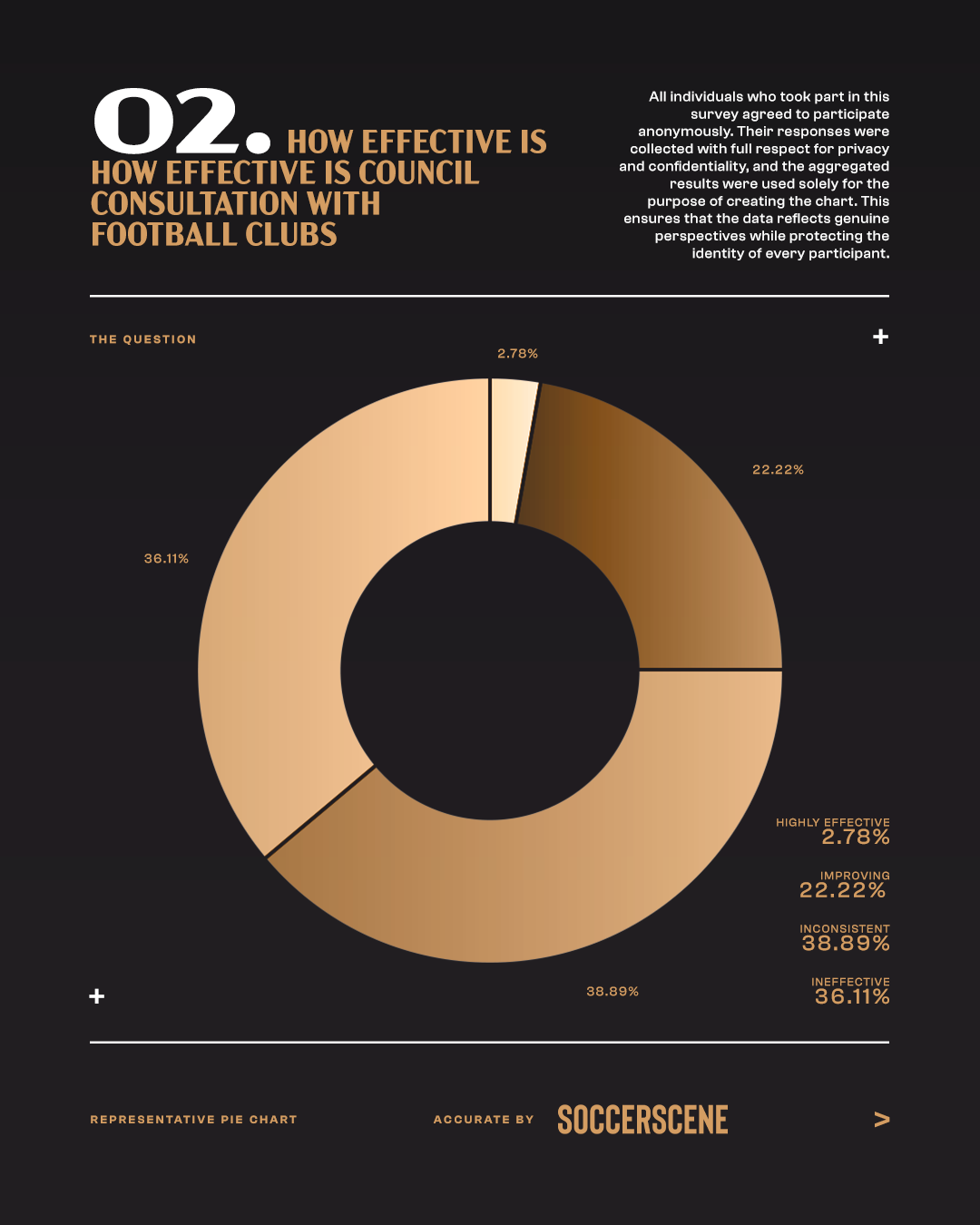
In our survey, over 61% of respondents said their council has limited or no understanding of football participation demand. Consultation outcomes were even worse: 74% said council consultation is inconsistent or ineffective. And when asked if facilities are being planned with long-term growth in mind, the answer should stop every policymaker in their tracks: more than 71% said planning is short-term or non-existent.

Results graphic from Soccerscene’s January industry survey:

This is not a small problem. This is a national warning sign.

Football is not a niche sport. It’s the world’s sport

Councils across Australia are making decisions as if football is still an emerging code, competing for scraps. That thinking is decades out of date.

Football is not only Australia’s largest participation sport in many communities – it is also part of the global economy of sport, the largest sport market on earth, and a cultural engine that connects Australia to Asia, Europe, Africa and the Americas.

When councils underinvest in football infrastructure, they’re not just failing local clubs. They’re failing an entire economic pipeline: participation growth, player development, coaching pathways, community engagement, multicultural integration, women’s sport, health outcomes, events, tourism, and commercial opportunity.

And yet, football is still treated as the code that should “make do”.

The Glenferrie Oval case: a perfect example of the imbalance.

Take the redevelopment of Glenferrie Oval and the historic Michael Tuck Stand in Hawthorn.

This is a major project with a total estimated investment of approximately $30 million, with the City of Boroondara allocating $29.47 million over four years to transform the site into a premier hub for women’s and junior AFL.

Let’s be clear: there is nothing wrong with investing in women’s sport. In fact, it’s essential.

But this investment is also a symbol of something football people have been saying quietly for years: councils understand AFL. Councils prioritise AFL. Councils know how to justify AFL.

They don’t do the same for football, despite its participation scale, multicultural reach, and global relevance.

Across the country, football clubs are being told there is “no funding,” that “planning takes time,” or that facilities “can’t be upgraded yet.” Meanwhile, we see multi-million-dollar grandstands, boutique ovals, and legacy infrastructure funded and delivered for other codes.

Football isn’t asking for special treatment.

Football is asking for fair treatment based on reality.

Councils are stuck in a domestic mindset – while football is global.

Here is the core issue: local councils are making decisions through a domestic sporting lens, while football operates in a global one.

Football isn’t just a Saturday sport. It’s a worldwide industry with elite pathways, commercial frameworks, international investment, and an ecosystem that Australia must compete within.

If councils don’t understand this, they will keep making decisions that shrink our competitiveness.

And this is where the stakes become real.

Australia is not only competing against itself. We are competing against countries like Japan and South Korea, who treat football as a national asset. They don’t leave football infrastructure to fragmented local decision-making without a clear national framework. They invest strategically, align education with delivery, and build systems that create long-term advantage.

We cannot keep pretending we are in the same conversation globally while our local facilities remain stuck in the past.

Clubs are carrying the burden – and it’s breaking the system.

The survey results point to a harsh reality: football clubs feel like they are carrying the weight of growth alone.

When asked what the biggest council-related challenge is, nearly 49% said funding is not prioritised, while others pointed to poor facility design, limited engagement, and slow planning processes.

This isn’t just an inconvenience.

It is creating volunteer burnout, club debt, stagnation in women’s participation, and barriers to junior growth. It is forcing clubs into survival mode – patching up grounds, sharing overcrowded facilities, and trying to grow in spaces that were never designed for modern football demand.

And when planning is short-term, the problem compounds. Councils aren’t just falling behind- they’re building the wrong solutions.

So what do we do? We stop reacting and start leading.

Football cannot keep waiting for councils to “get it” organically. That approach has failed.

What we need now is a national strategic response that is structured, intelligent, and relentless.

This is where football must learn from high-performing football nations  not just on the pitch, but in governance, philosophy, and decision-making.

A powerful example is Korea’s “Made in Korea” project, which was built to identify structural gaps, align stakeholders, and create a unified development philosophy. It wasn’t just a technical framework, it was a national alignment strategy.

Australia needs the off-field equivalent.

A National Football Facilities & Readiness Taskforce.

I believe the time has come to establish a National Football Facilities & Readiness Taskforce, made up of the most capable minds across the game and beyond it.

Not another committee. Not another meeting group.

A taskforce.

It should include leaders from football, infrastructure, urban planning, commercial strategy, government relations, and corporate Australia. We should be selecting the most intelligent and effective people in the country, not based on titles, but based on outcomes.

This taskforce should have one clear mission:

Educate, influence, and reshape how councils plan, consult, and invest in football infrastructure.

Alongside a taskforce, we need long-term strategic working groups embedded across the states, designed to:

educate councils on football participation demand and growth forecasting

standardise best-practice facility design and future-proofing

create consistent consultation frameworks

align football investment with economic, health and multicultural outcomes

build a national narrative that football is an asset rather than a cost

Because right now, the survey shows councils aren’t prioritising football for economic reasons. In fact, only 2.56% of respondents said councils should prioritise football due to economic benefits. This is not because it isn’t true, but because councils haven’t been educated to see football that way.

That is a failure of strategy, not a failure of the game.

This is bigger than facilities – it’s about Australia’s place in the world game.

If we want to be taken seriously as a football nation, we must build a country that treats football seriously.

Not just at elite level.

At local level – where the entire pyramid begins.

The message from the survey is blunt: football’s confidence in councils is collapsing. But within that truth is also an opportunity.

Because when trust hits its lowest point, change becomes possible.

The next step is ours.

We either continue accepting a system that doesn’t understand the world game – or we build one that does.
Previous ArticleNext Article

Manchester City must pay the ultimate price for financial cheating

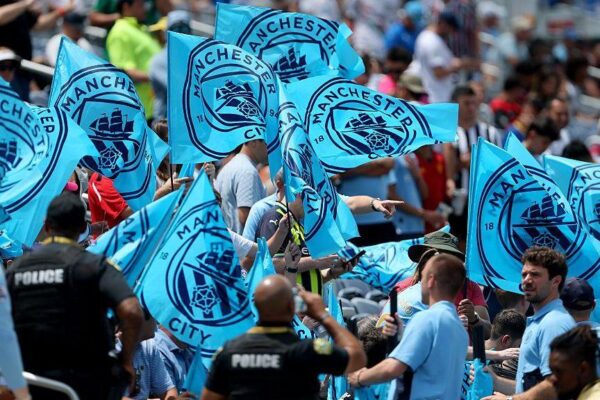
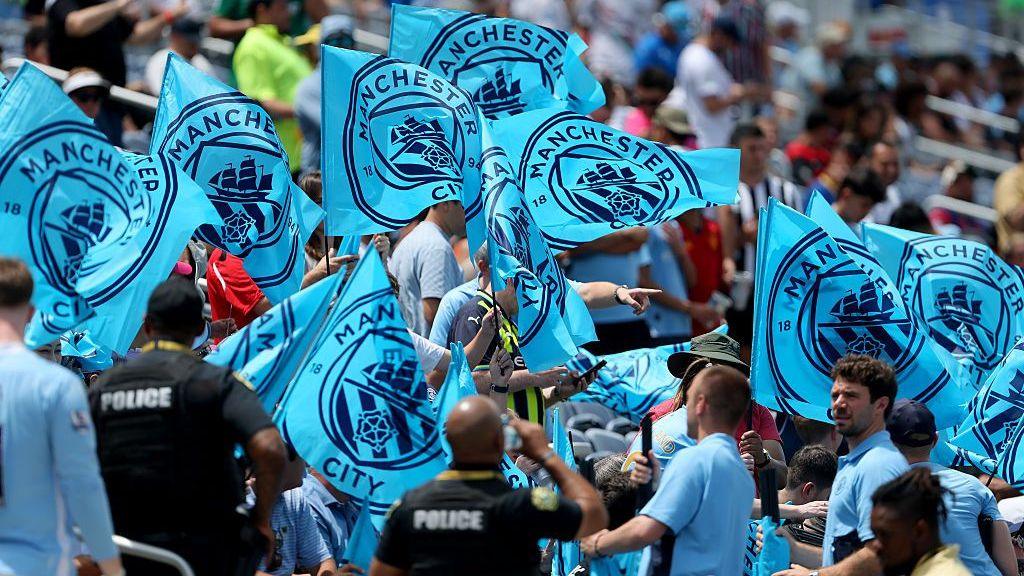
Manchester City’s financial scandal has reached boiling point. On the 29th of September, an independent commission found City guilty of all charges relating to serious breaches of the league’s financial rules across nine seasons, from 2009/10 to 2017/18. The commission also upheld three of four charges concerning the club’s failure to cooperate with the Premier League investigation.

The Premier League says City used sham commercial arrangements and disguised owner funding to inflate revenue and reduce costs by more than $1.7 billion (£900 million). Abu Dhabi United Group funded $1.58 billion (£830.69 million) that appeared in City’s accounts as sponsorship money from Abu Dhabi companies. The commission concluded that City’s accounts concealed the true financial position from auditors and regulators.

The 115 charges cover inaccurate financial information, player and manager payments, financial rules and the investigation itself. City has lodged its appeal against the guilty verdict, but for such a serious sporting scandal, attention has already turned to the potential punishments. In a Premier League era where foreign investment is king and revenues have skyrocketed, we should be asking questions. How did Manchester City get away with this for so long, and how can the punishment act as a deterrent to keep the reputation of football’s biggest league intact?

The hack that exposed the story

The most uncomfortable part of this saga is how the authorities discovered it and how most likely City never would have been exposed. In 2018, German publication Der Spiegel published leaked internal City emails and documents obtained through Football Leaks. Rui Pinto, the Portuguese hacker behind Football Leaks, supplied material that alleged City had disguised owner investment as sponsorship revenue and manipulated arrangements to satisfy financial regulations.

The Premier League investigation began in December 2018. City were formally charged in February 2023, after a four-year investigation, and the hearing finally began in September 2024. That timeline is nothing short of extraordinary; eight years between the leaks being exposed and charges being brought to Manchester City does significant sporting damage.

Man City won eight major titles during the alleged period, including three Premier League titles. Recalling titles in any sport leaves a sour taste in any sports fan’s mouth. The fans of opposing sides given titles feel robbed of the special moment, and Manchester City fans could feel rightfully deceived. But it goes beyond even this as we look at who Manchester City signed during those seasons. Players such as Ilkay Gundogan and Kevin De Bruyne played vital roles in City’s later titles beyond the 2017/2018 season. Would they have joined if this had been uncovered earlier? It’s impossible to say, but it shows how City’s early investment from 2009/10 still contributed to their titles in the 2020’s.

The Premier League’s credibility

That delay is not just embarrassing for City; it damages the Premier League. The league is the most competitive and commercially powerful domestic competition in football. Its rules are supposed to create a framework in which clubs compete on sporting merit while remaining financially sustainable. If a club can allegedly distort its accounts by hundreds of millions of dollars and the process takes years to reach a verdict, despite City’s potential obstruction, every other club has a reason to question whether the system works.

The irony is obvious: if Football Leaks hadn’t shared what they found on Manchester City through its hack, the scheme never would have been uncovered. If financial rules were designed to stop clubs gaining an unfair competitive advantage, then the Premier League may need to change how it investigates how its clubs’ finances are being managed. If anything should be gained from this, it may be that financial regulation needs to be improved as the Premier League and its clubs spend billions.

As for Manchester City, punishment cannot simply be a fine that becomes another operating cost.

Relegation is the only serious answer

If the verdict survives the appeal, Manchester City should be removed from the Premier League and those three aforementioned league titles removed. A fine would be inadequate and, depending on what points deduction City got, would punish the club in one season while leaving the historical record largely intact. Nottingham Forest received a four point deduction for a charge of Profitability and Sustainability rules in 2023-2024. City’s 114 charges will see much greater punishment then that.

Even if City are relegated they would almost be guranteed to be promoted the next season so even that feels like a slap on the wrist. Despite their investment during the nine seasons being questioned their five titles subsequent to that period will be expected to remain in their hands. My solution is to relegate City to the Championship without the potential of promotion for three seasons, one for each title won during that time.

City fans will call that harsh but their is strong reason to come down hard and that’s because this is bigger than Manchester City. Foreign ownership has brought huge investment into English football, but investment cannot mean exemption from the rules. Owners, executives and clubs must know that the Premier League’s financial regulations carry consequences that cannot be negotiated away.

The league has a choice. It can impose a manageable punishment and move on, or it can demonstrate that competitive integrity matters more than the commercial power of its biggest clubs. If City’s appeal fails, the answer should be clear: relegation, a reckoning over the titles and a message to every owner that the Premier League’s rules are not optional.

Australian referee strike ends ahead of new A-League season

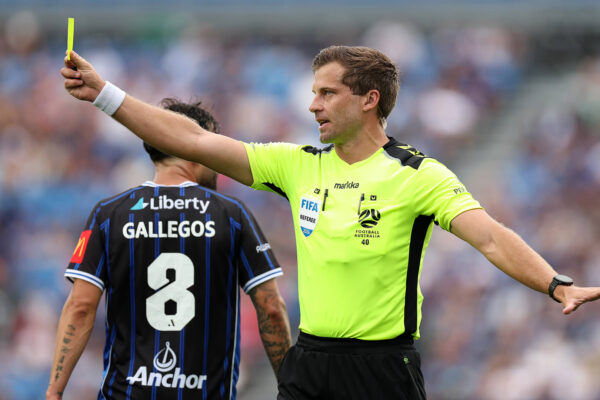
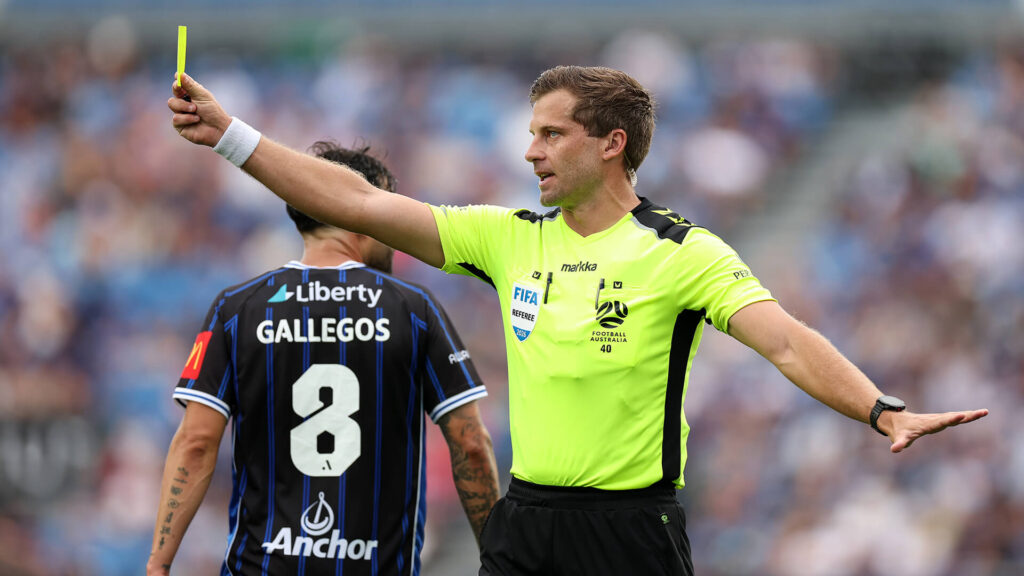
Australia’s referee crisis is over as Football Australia (FA), the Australian Professional Leagues (APL) and the Professional Football Referees Association (PFRA) have reached an agreement ahead of the 2026/27 domestic season.

The deal ends industrial action that began on September 4th. Nearly 100 of Australia’s top referees had refused appointments during the dispute. The agreement provides immediate certainty for officials. It also clears the way for Australia’s top referees to return for the Australia Cup Final this week and the opening rounds of the A-League Men and Women competitions.

Under the new framework, referees will be contracted and employed exclusively by Football Australia. The APL will cover the cost of referees appointed to A-League matches. The arrangement runs through the end of the 2026/27 season. The three organisations will continue discussions on a longer-term structure for elite refereeing in Australia.

The agreement resolves the central dispute between the parties. Football Australia had proposed shifting responsibility for A-League referees to the APL. The referees opposed the move. They raised concerns about employment certainty. They also questioned the independence of referees working under a league controlled by the clubs they officiate.

The dispute had already disrupted Australian football. Singaporean officials were brought in for the Australia Cup semi-final between Sydney FC and Melbourne Victory. Rookie Australian officials also took charge of another Cup fixture during the strike. The crisis therefore moved beyond a contractual disagreement. It affected the delivery of major matches.

The A-League Men season begins on October 16 with the Sydney derby at Allianz Stadium and the A-League Women season will also begin in October. The agreement solves the immediate problem. It does not end the wider debate over refereeing in Australian football.

FA, the APL and the PFRA must now build a sustainable model for elite officials. The strike exposed uncertainty around contracts, funding and governance. Those issues cannot return every time a new season approaches. Australian football can moves forward, but this is an issue that should be reviewed for the sustainability of Australian referees.

Most Popular Topics

Editor Picks

Send this to a friend