





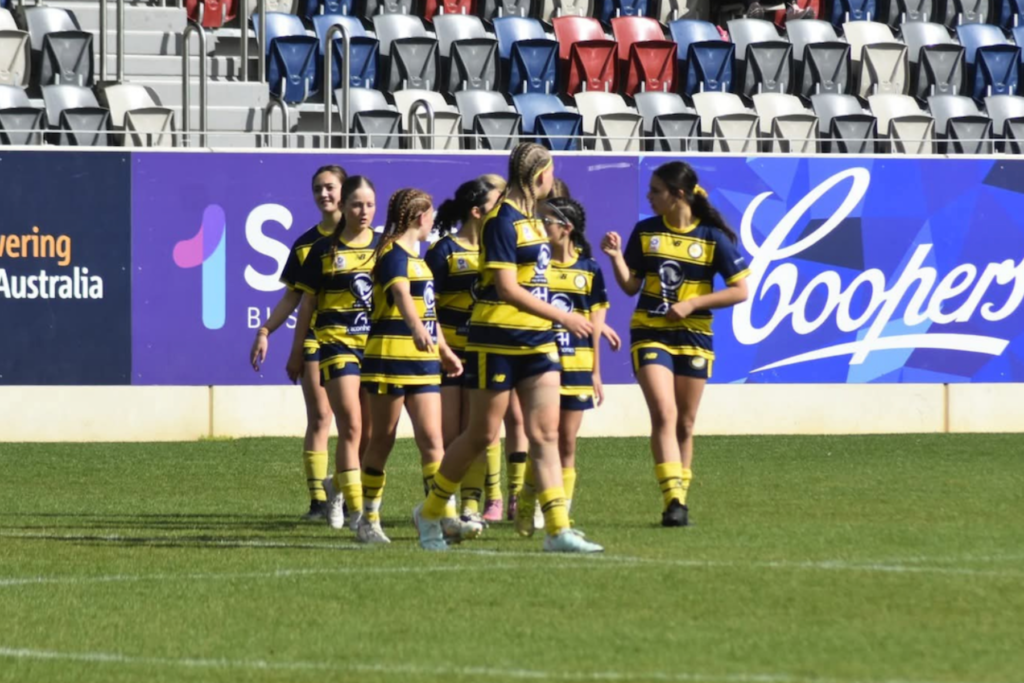
Western Strikers Nominated FSA Club of the Month for Equity Outcomes

Western Strikers SC has been nominated for Club of the Month after a period of deliberate structural investment in its female program that is already producing measurable outcomes, and offering a model for how community clubs can drive participation growth through equity-focused planning rather than passive goodwill.

The nomination recognises a program that has moved beyond surface-level commitment to women’s football and into the kind of structural change that determines whether female players actually stay. Improved lighting across training and match pitches, equitable scheduling, extended training hours and dedicated pitch allocation have addressed the practical barriers that clubs often overlook. It’s conditions that tell players, implicitly or otherwise, whether the game was built for them.


Leadership as Infrastructure

Central to Western Strikers’ approach is a leadership structure that takes female football seriously as a technical and administrative priority. Women’s Coordinator Michelle Loprete and Technical Director Georgia Iannella, a former Matilda, provide the program with both organisational direction and the kind of visible role modelling that shapes whether younger players can picture themselves progressing through the game.

The presence of a former international player in a technical leadership role at a community level isn’t incidental. It signals to junior players that the pathway from their Friday night training session to elite football is real and navigable, and it gives the club’s coaching staff access to experience and credibility that most community programs cannot offer.

That pipeline is already functioning. Western Strikers’ Under-13 to Under-16 girls teams all qualified for finals in the Youth Premier League this season. Under-15 goalkeeper Sian Schopfer made her debut in the Women’s State League team which is a direct product of a club environment designed to move players upward.


The Friday-night model

One of the more quietly significant initiatives at Western Strikers is the scheduling of Friday night women’s matches, with junior girls training beforehand encouraged to stay and watch senior football. The structure is straightforward but its implications are meaningful. Aspiration in sport is not abstract. It’s built through proximity, through watching players a few years older doing what you want to do, in the same kit, at the same club.

The absence of that experience is one of the more consistent reasons girls disengage from football in their mid-teens. When junior female players cannot see where the game goes after their age group, the logical conclusion is that it goes nowhere. Western Strikers’ scheduling decision addresses that directly, at minimal cost, and whose effects are starting to manifest.


The Club Changer framework

The club’s participation in Football South Australia’s Club Changer Program has provided a structured framework for identifying and addressing barriers that might otherwise go unexamined. Pitch allocation, training structures and safety conditions are the kinds of issues that accumulate quietly in club environments; not because of deliberate exclusion but because the default systems were built around male participation and have never been comprehensively reviewed.

The Club Changer Program creates accountability for that review. Western Strikers’ ability to project an additional 146 female players over the next three years is a product of planning rather than optimism.


Industry implications

Western Strikers’ model matters beyond its own membership. At a time when women’s football in Australia is navigating the challenge of converting a participation surge into sustainable long-term growth, the question of what community clubs actually do with increased interest is among the most consequential in the sport.

Record crowds at the AFC Women’s Asian Cup and sustained national visibility have opened the door. Whether players walk through it and stay depends on whether the club on the other side looks anything like Western Strikers
Previous ArticleNext Article

Kansas City Current receive financial backing for stadium expansion

The CPKC Stadium, home to NWSL side KC Current, will see a major financial injection transform its capacity from 11,500 to 18,000.


Leading by example

Amid the excitement, chaos and attention on the FIFA World Cup this summer, the football industry in the US has, once again, come into the spotlight.

But one story which truly represents the progress and development of football in the US is not within the men’s game, but the women’s.

Kansas City Current – a team who privately funded the world’s first purpose-built football stadium for a women’s professional team – is once again leading by example for women’s football in the US.

Only this time, their stadium plans will have the backing not just of the club, but of the Kansas City Council. A recently approved package of AUD 336 million (USD 235 million) will add 6,500 seats to the venue, an expansion which comes as a welcome development for fans who regularly fill the CPKC Stadium to capacity.


Big investment, fast expansion

The CPKC Stadium, however, is little over two years old, having reached its project completion in 2024. But after matches consistently sold out, expansion was always the next step in the inspirational journey of the KC Current.

Co-founders and co-owners, Angie and Chris Long, outlined what the coming investment will mean for both club and community.

“We are proud to continue investing in Kansas City’s future and grateful for the partnership that makes this chapter possible,” the Longs said.

“The success of the Current and the Riverfront benefit our entire community, and we are honoured to help create a lasting legacy for a city that has given so much to us.”

The public funding for the project takes it to AUD 2 billion (USD 1.4 billion). Such financial commitment, of course, reflects the welcome backing from the Kansas City Council.

Yet, more importantly, it shows that women’s football is one of the most rapidly growing industries in the sporting world. In just a few years, the KC Current went from a 3,200 capacity stadium to one which boasts 18,000.

Who knows, in the coming seasons, where this rapid rise will lead to next.

Australian Sports Group unveiled as new owners of Canberra United

The Australian Professional Leagues (APL) has confirmed Canberra United’s new owners will be the Australian Sports Group (ASG), securing the future of the A-League Women’s side with the potential for an A-League men’s team to be introduced for the 2028/2029 season.

The announcement marks a significant milestone for football in the nation’s capital, ending a prolonged period of uncertainty surrounding Canberra United’s future in the Ninja A-League Women competition.

Beyond ensuring the club’s ongoing participation in Australia’s premier women’s domestic league, the acquisition provides a pathway towards the potential introduction of an A-League Men club in Canberra, subject to the completion of regulatory requirements; the club could exercise an exclusive licence agreement in the Australian Capital Territory.

Australian Sports Group has outlined an ambitious vision centred on strengthening football throughout the ACT, with plans to invest in player development pathways, community engagement and football infrastructure while working alongside key stakeholders across the region.

The ownership transition has been welcomed by the Australian Professional Leagues, which described the outcome as an important step in expanding the game’s footprint in Canberra and reinforcing the long-term sustainability of professional football in the region.

Canberra United has long been regarded as one of Australia’s most successful and respected women’s clubs, playing a pivotal role in developing elite players and contributing to the growth of women’s football nationally. The confirmation of new ownership provides greater certainty for players, staff, supporters and commercial partners ahead of the upcoming season.

The licence transfer will continue through Football Australia’s regulatory processes, including the required fit and proper persons assessment, while operational planning for the 2026-27 campaign is already underway with support from both the APL and Capital Football.


Most Popular Topics

Editor Picks

Send this to a friend