



Football Australia Expands Mental Skills Program for Match Officials Amid Sustained Focus on Referee Retention

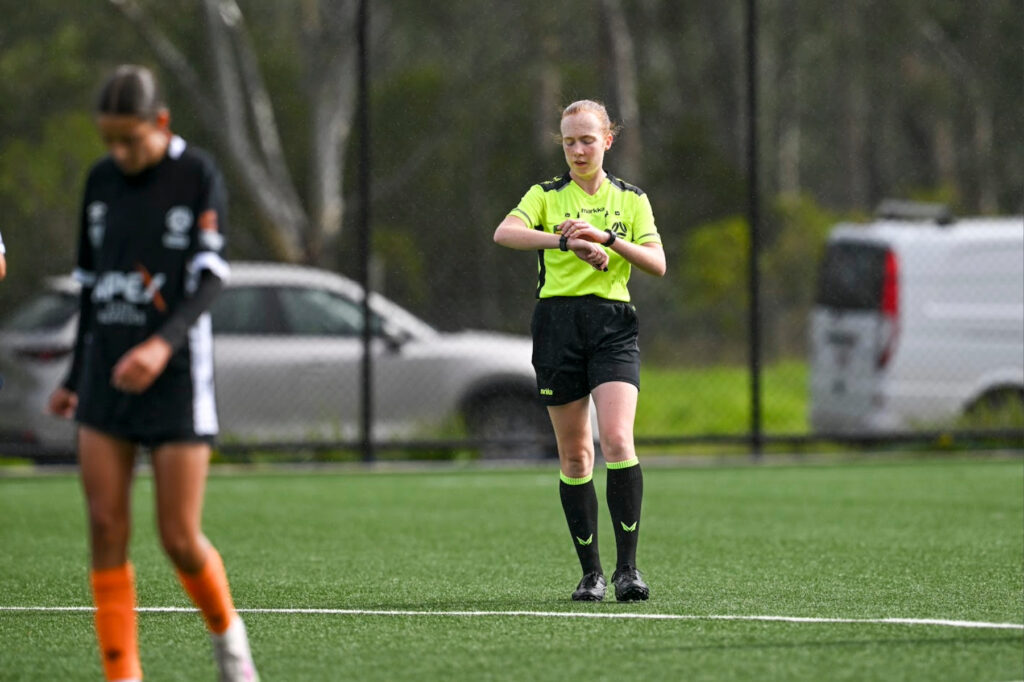
Football Australia has confirmed a second national webinar for match officials, led by sports psychologist Dr Liam Slack, extending a referee development series introduced after strong engagement with an initial session on managing match-day pressure.

The upcoming session, themed “parking with purpose,” will focus on decision-making strategies designed to help referees process on-field calls and reset attention quickly across a match that can present hundreds of individual decisions. Dr Slack, who also consults with The Football Association and the AFC Referee Academy and previously spent over a decade as a performance psychologist with the Professional Game Match Officials Limited in England, brings substantial elite-level experience to a program open to officials at every level, from grassroots to professional.

The theme builds on work Dr Slack has already delivered within Australian officiating. He recently led a session with Football Australia’s National Referee Academy on the same concept, framing the ability to consciously park a decision and refocus on the next phase of play as a trainable skill rather than an innate trait, one that separates officials who reset quickly under pressure from those who don’t. He has also addressed more than 100 Football Australia elite match officials and staff on developing a stronger match-day mentality, an indication of how embedded this psychological framework has become across the officiating pathway rather than remaining a one-off intervention.

The expansion of the webinar series reflects a broader shift in how football administrators are approaching referee attrition. Rather than treating retention purely as a recruitment or pay problem, the program signals an institutional acknowledgment that the psychological demands of officiating, particularly the compounding pressure of split-second decisions under public scrutiny, are a material factor in whether officials remain in the game.

It rests alongside other measures adopted across Australian football in recent years, including visible identification programs for junior referees and structural reviews of referee departments at state federation level, all aimed at the same underlying issue: a shrinking pool of match officials relative to demand.

Football Australia has not detailed metrics for assessing the program’s impact on referee numbers, though the recurring engagement of an internationally credentialed specialist across multiple tiers of the officiating pathway suggests sustained institutional investment in the approach.

Previous Article

How Australian Support for the World Cup Has Changed Since 2022

Sodden, rowdy and 7,000-strong, the crowd that gathered at Federation Square before dawn on Saturday for Australia’s clash with the United States offered a vivid illustration of how much, and how little, has changed in Australian football support since Qatar 2022.

The scenes themselves were familiar: fans queuing from 2am, flares lit during the anthem, a barrier breach as the precinct hit capacity within minutes of opening. But the fact the screening happened at all says something about the shifting institutional weight football now carries in Australia.

Just this May, the Melbourne’s Arts Precinct had decided not to screen Socceroos matches at Fed Square this tournament, citing crowd damage and arrests during a 2022 World Cup screening. Football Australia publicly pushed back, and the Victorian Government ultimately overturned the decision, with security and police presence increased to manage the risk. That a state government intervened to guarantee a public screening reflects how central these gatherings have become to football’s standing in Australia, not just as a peripheral fan event but a piece of cultural infrastructure worth a premier’s political capital.

A Tournament Inherited, Not Just Attended

The scale of public interest now sits on a different foundation than it did in 2022. Football Australia’s most recent National Participation Report recorded an 11% increase in total participation to 1,911,539 people, with women and girls’ participation rising 16% to 221,436. Industry analysis attributes much of that growth to the “Matildas effect” following the home Women’s World Cup in 2023, projecting 407,000 new junior participants by 2027 on the back of that tournament and Football Australia’s broader infrastructure strategy. Whatever happens to the Socceroos in the United States, the crowd at Fed Square this year is drawn from a participation base substantially larger than the one watching from lounge rooms and pubs in Qatar.

That shift shows up in how fans say they’ll engage with this tournament regardless of results. New industry research found 79% of intended Australian viewers plan to keep watching the World Cup even if the Socceroos are eliminated, an 11-point increase on 2022, suggesting interest is becoming less tied to the national team’s results than it once was. The same research found television remains dominant, with 88% of viewers planning to watch on TV, rising above 90 per cent for evening and weekend matches, even as audiences increasingly split their attention across streaming and second screens.

Crowd Behaviour as the Unresolved Question

What hasn’t shifted is the tension over crowd conduct at public screenings, and what it costs football’s civic standing when things go wrong. The Melbourne Arts Precinct’s chief executive was explicit in 2026 that damage and behaviour during 2022 screenings were the basis for initially declining to host watch parties this time, despite trouble-free crowds during the 2023 Women’s World Cup.

Saturday’s flares and barrier breach will likely feed that same debate going into the knockout stages, even as the broader numbers tell a story of a sport with a far deeper public footing than it had four years ago. The Fed Square images from 2022 prompted other Australian cities to scramble together live sites once the Socceroos reached the knockout rounds, reflecting a pattern likely to repeat if Australia progresses from Group D, with Friday’s match against Paraguay now carrying outsized weight for a campaign that began with what fans, by their own description, considered horrible refereeing and a result short of expectations.

Build a home, create a culture: How do we secure the Socceroos as global competitors?

The Socceroos kicked off their World Cup campaign with a convincing 2-0 win over Turkey. It was an important win for their tournament ambitions, but also a statement about their quality on the world stage. It is time that we built a facility to ensure this quality is nurtured, not stifled.

Otherwise, we risk falling behind.


One of four…

Australia’s Men’s National Team currently sits as the 23rd-ranked team in the world in the official FIFA rankings. The Matildas, meanwhile, are the 15th highest-ranked women’s team.

This year is also the sixth consecutive FIFA Men’s World Cup featuring the Socceroos, confirming their position as a regular competitor in the most prestigious tournament in world football.

So why is it, despite these undeniably positive reflections of Australia’s growth in international football, that the Socceroos are still homeless?

At the 2022 FIFA Men’s World Cup in Qatar, Australia was one of four competing teams (a list featuring Denmark, Poland and Senegal) without a national base. In 2024, former Socceroos coach Graham Arnold described the team as “homeless” ahead of the World Cup qualifiers.

But four years on from the tournament’s last edition, the situations remains the same. And the world is taking notice.


A letter to the PM

In April this year, FIFA reportedly wrote to Australian Prime Minister, Anthony Albanese, encouraging the construction of a permanent home for football in the country.

The letter reflects concerns within the governing body that Australia, despite being so present in international football throughout the past 25 years, may fall behind the rest of the pack.

When we look at the talent in the current squad, Australia is by no means an emerging football economy. But commercial and infrastructural limitations in the landscape mean this talent is under-appreciated.

Nevertheless, it is a nation which regularly proves it can compete – and win – on the biggest stage. This we saw only a few days ago.

Which is why the players, coaches and staff representing the nation deserve a permanent facility which reflects, nurtures and inspires talent and competition. The survival of the landscape depends on it.


The investment question

Investment into football – from grassroots to professional levels – continues to be at the crux of national debate on how to secure football’s future in Australia.

In a conversation between Soccerscene and Melbourne-based community club, Sunbury United FC, infrastructure and facility-sharing challenges emphasised common grievances for many grassroots clubs.

The issue, therefore, is spread across the nation’s football pyramid. And prompts an uncomfortable question about future investments:

If even the Socceroos continue to share their current base, Leichhardt Oval, with various teams across rugby league and soccer, how can we ever expect clubs further down the pyramid to avoid similar fates?

The past few years, however, have fortunately seen improved investment into the women’s game in Australia – particularly embodied by the ‘Home of the Matildas’.

The result of a $101.1 million investment by the Victorian Government in collaboration with La Trobe University and the Federal Government, the facility boasts elite training features including premium FIFA-standard pitches, multiple changing rooms, a high-performance gym, a sports science lab and more.

This was a welcome and vital boost ahead of the 2023 FIFA Women’s World Cup which took place in Australia. Now, ever-increasing participation and pride are synonymous with women’s football, and the numbers confirm it.

In 2023, women and girls represented 190,746 participants across social, outdoor, fustal and registered football. In 2025, this increased to 231,435. It proves that, with the arrival of purposeful investment at the top, comes the spread of a football culture across the nation.


Aligning practical and cultural benefits

But what would a potential facility for the Socceroos actually look like? And what are the benefits?

When considering similar projects, we can look to both Japan and England as distinct examples of how a national base for football can unite practical, social and cultural benefits.

St George’s Park – England

Built in 2012, England’s base at St George’s Park is a masterclass in using facilities to establish a centre for industry cohesion and community impact.

As a centre of excellence, St George’s Park holds 14 outdoor pitches, a fustal arena, and hosts coaching and medical courses. It welcomes 28 teams across men’s, women’s, youth and para football, representing a place of unity and alignment for the entire football community.

Furthermore, the ‘Play Like the Pride’ program offers grassroots participants and school students the chance to experience the elite facilities for a day, showing how facilities can serve to connect young players to the world of their professional idols and foster real passion for the game.

JFA J-Village – Japan

The J-Village – beyond being a state-of-the-art football training centre – shows why a home for football can positively impact the community.

After being used as a support base for the nuclear power plant accident following the 2011 Great East Japan Earthquake, the venue now holds a deeply important place in the memory of Fukishima. As a result, upon resuming full operations in 2019, the facility – and the football development within it – represented a sense of perseverance, reconstruction and unity.

And through hotels and public transportation links, the J-Village also welcomes tourists and business travellers, encouraging more people to step into the world of football in Japan.

One venue, therefore, can give rise to an essential part of a thriving football landscape: culture. A culture for participation, community outreach, and elite development.


Final thoughts

The focus of the summer will no doubt be how the Socceroos perform on the pitch. And with homes, offices, and public spaces brimming with enthusiastic support, the sense of national pride is irresistible.

But for all the positive sentiment currently taking hold of the nation, there will come a time when Australia’s World Cup run is over, at which point an all-important question must be asked:

How do we move forward?

We move forward by transforming buzz into an aligned vision, commitment to nurturing talent, and a desire to establish a real footballing culture across the nation.

The first step to building this culture? Building a home from which it can thrive.

Most Popular Topics

Editor Picks

Send this to a friend