


Football NSW workshop offers clubs rare insight into elite talent pathway as development gap comes under scrutiny

Football NSW has delivered a Club Capability Building Workshop designed to give community club coaches direct exposure to the methodology underpinning the state’s elite Talent Support Program, in an initiative that addresses one of the more persistent structural problems in Australian football development.

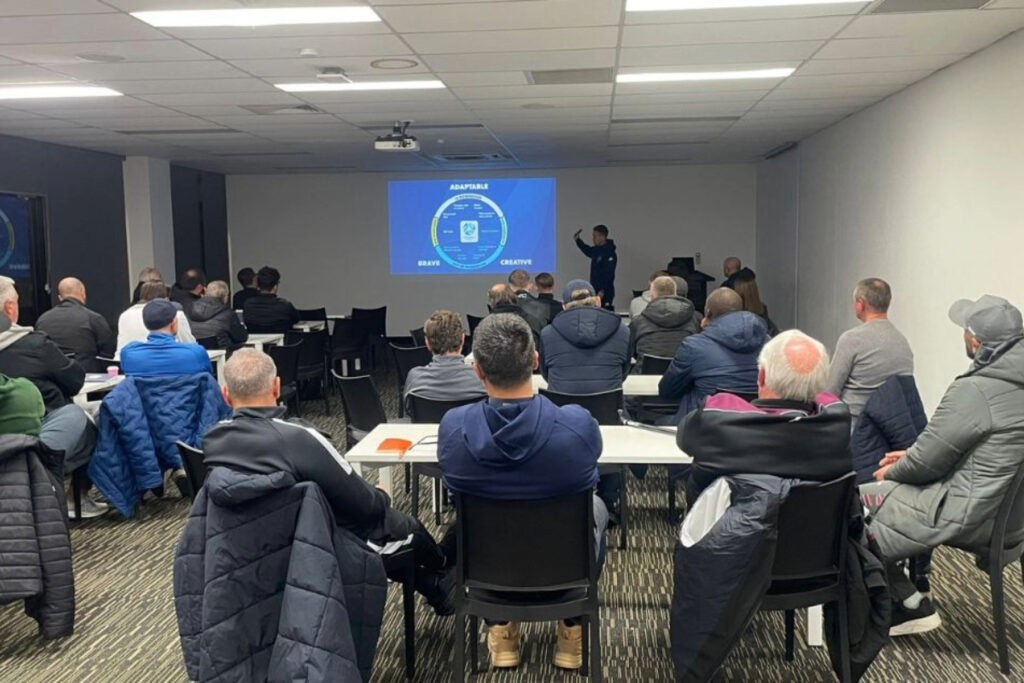
The workshop, led by Player Development Managers Phil Myall and Nadine Sheils, who oversee the technical direction of the Boys and Girls Talent Support Programs, combined classroom presentation with pitch-side observation of live TSP fixtures. Coaches from clubs including Rydalmere FC attended sessions covering talent identification processes, player development models, coaching methodology, Individual Development Plans and player profiling based on technical traits and competencies.

The structure of the day, moving coaches from theory into a live competitive environment, reflects an attempt to close a gap that has long shaped the relationship between community clubs and elite talent pathways in Australian football. Club coaches typically operate with limited visibility into how state-level development programs actually function in practice, relying on secondhand information, accreditation course material or assumptions about what elite environments look like. The workshop replaced that distance with direct access.

Why the gap matters

Talent Support Programs exist to identify and accelerate the state’s most promising young players, but the players who enter those programs come from community clubs first. If the coaching methodology and development philosophy applied within elite pathways is poorly understood at the community level, the two systems risk operating with misaligned expectations of what good development actually looks like.

This means a player developed in a club environment that does not share the technical language or coaching priorities of the elite pathway may find the transition into a Talent Support Program more difficult than it needs to be, not because of any deficiency in the player but because the systems around them were not speaking to each other.

Football NSW’s decision to bring club coaches into direct contact with TSP methodology, including observation of live matches rather than theoretical instruction alone, represents an attempt to narrow that gap at the level where it matters most. Rydalmere FC’s Head of MJDL, Michael Canale, said the experience offered a clear reference point for his own club’s program.

“It was great to see how the FNSW Talent Support Program operates and the level of alignment from the methodology and match environment,” Canale said. “For us at Rydalmere FC, I took away ideas that we can look to build into our own programme. It provided a really clear reference point and an opportunity to reflect on how we can continue to strengthen our environment moving forward.”

A model for industry-wide capability

The workshop also points to a broader question facing football governing bodies as participation continues to climb nationally. As more players enter community football and the demand for genuine development pathways grows, the capability of community coaches becomes a determining factor in whether that growth translates into improved player outcomes or simply more players moving through under-resourced environments.

Football NSW’s approach, embedding observation and direct engagement with technical staff alongside structured presentation, offers a model that other state federations grappling with similar capability gaps may look to replicate. The collaborative element of the day, where coaches from different clubs compared notes and aligned their understanding of TSP application, also suggests an organisation attempting to build a shared development language across its club network rather than treating elite pathway knowledge as something that remains internal to Football NSW staff.

Whether that shared language translates into measurable improvement in player outcomes at community level will depend on how consistently workshops like this one are delivered, and whether the ideas coaches take away are genuinely implemented rather than simply observed. For now, the initiative represents a concrete step toward addressing a gap that has shaped Australian football development for years, the distance between what elite pathways do and what community clubs understand about how and why they do it.

Previous ArticleNext Article

Tottenham Hotspur deliver player development workshop for Football NSW

The workshop focused on sharing knowledge and insights regarding player development, bringing together more than 120 coaches from across NSW with those from Tottenham Hotspur.


Experience, insight and education

Valentine Sports Park hosted the Continuing Professional Development (CPD) workshop, uniting Football NSW coaches and members of Tottenham Hotspur’s coaching staff to encourage discussion and learning opportunities about player development.

Tottenham’s player development pathway – from the academy to the first team – has produced some of the most respected names in Premier League history, including Harry Kane and Ledley King.

Under the leadership and guidance of Tottenham Hotspur Player & Coach Pathway Co-ordinator (and UEFA A Licence Coach), Jimmy Martin, as well as members of Tottenham’s coaching staff, Shannon Maloney, Kevin Moffatt and Tyler Blackwood, the workshop was a unique opportunity to learn from some of the most experienced coaches in the game.

“Coach education is a vital part of developing football across NSW, and having more than 120 coaches attend this workshop highlights the appetite within our football community to continue learning and improving,” explained Football NSW Head of Football, Edward Ferguson.

Ferguson continued to outline the value of learning from an organisation like Tottenham Hotspur, a team who have helped grow some of the game’s most exceptional talents. The lessons taken will consequently help to inform future approaches to coaching in NSW.

“The focus remains on creating better learning environments for players, encouraging decision-making, creativity and long-term development.”

What the workshop involved

The workshop encouraged coaches to dive into all aspects of player development: the technical, tactical, physical and mental aspects which contribute to the English academy setup.

Furthermore, Maloney, Moffatt and Blackwood – all of whom helped deliver a practical session for attendees – showed how a club’s playing identity can work alongside challenging training environments for players.

Game understanding, creative problem-solving and technical proficiency underpinned the main themes driving the workshop. In an age where individual expression on the pitch appears a dying art, Tottenham Hotspur coaches remain committed to encouraging players to feel confident adapating to a range of in-game scenarios.

Football NSW coaches were also able to attend a Q&A session with King, who spoke about his playing experiences for both club and country.


Final thoughts

As Australia continues to nurture the current and upcming generations of talented footballers, workshops such as this are a vital, fundamental part of the journey.

The fastest way to be among the best is to learn from them. The aim now is for Football NSW coaches to take the lessons learned, and apply them to football development in their own academies and teams across the state.

Ninja unveiled as major partner for A-League Women All Stars

The Australian Professional Leagues (APL) has unveiled the official 2026 Ninja A-League All Stars playing kit, while confirming global lifestyle brand Ninja as the team’s new major partner ahead of this month’s clash with Chelsea FC Women.

Manufactured by Kappa Australia, the new kit will be worn by the Ninja A-League All Stars when they face Women’s Super League champions Chelsea at Allianz Stadium on Wednesday, August 12, as part of the Sydney Super Cup.

The announcement further strengthens Ninja’s growing presence in Australian football after becoming the naming rights partner of the Ninja A-League earlier this year. The partnership extends the global brand’s investment in the women’s game and places it front and center for one of the league’s biggest showcase fixtures.

Kappa Australia will once again supply the match apparel, continuing its association with the A-League All Stars concept. The new design is intended to celebrate the occasion while reflecting the continued growth and professionalism of women’s football in Australia.

The fixture against Chelsea provides the Ninja A-League All Stars with another opportunity to test themselves against elite international opposition, following the competition’s continued expansion as a marquee event on the Australian football calendar.

Supporters will be able to purchase the official playing jersey at Allianz Stadium on matchday, through Ultra Football and via Kappa Australia’s online store.

Most Popular Topics

Editor Picks

Send this to a friend