

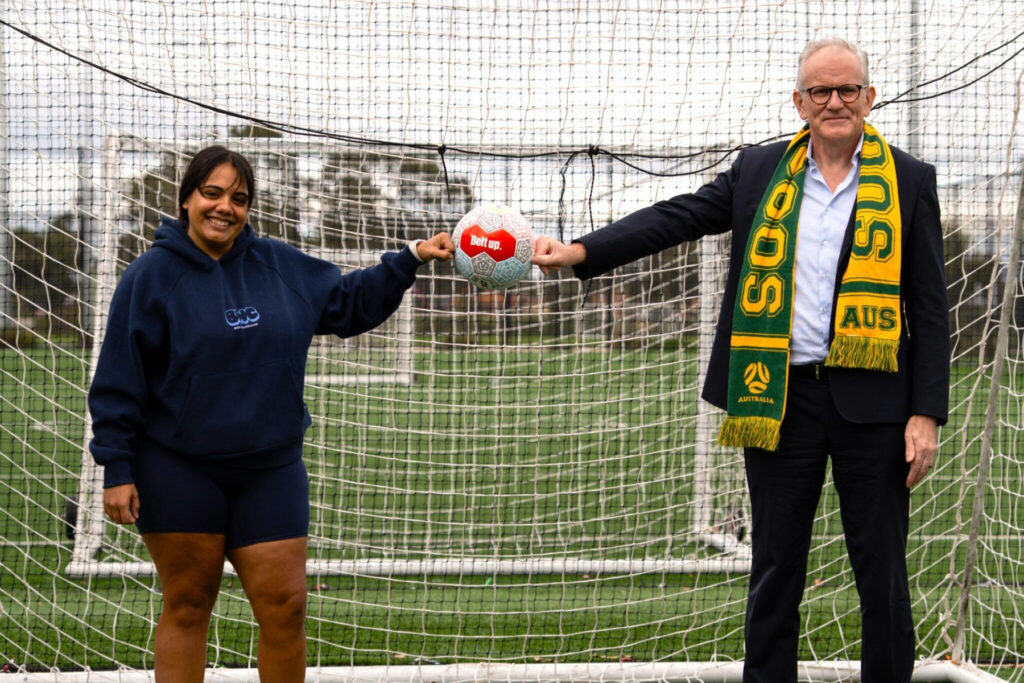
Football West’s NAIDOC ball competition turns Indigenous art into a road safety message, and a rare form of representation

Football West has opened its 2027 NAIDOC Ball Design competition, inviting members of Western Australia’s Aboriginal and Torres Strait Islander communities to submit artwork that will end up printed on 500 footballs and distributed to schools, clubs and communities across the state. It is a small competition with a modest prize, a $1,000 voucher and a set of ten footballs for the winner. But what it is actually doing sits somewhere more significant than a design contest.

The 2027 edition is a joint initiative between Football West, the Insurance Commission of Western Australia and, for the first time, Football Futures Foundation. The winning design will carry the Insurance Commission’s Belt Up road safety message alongside the artwork, with the footballs distributed during NAIDOC Week, which runs from 4 to 11 July next year.

Football Futures Foundation CEO Michael Kerr framed the partnership as an extension of work the Foundation already runs across the state.

“Through programs such as Dreamtime Spirit and Yilkari, supported by former Matildas goalkeeper Lydia Williams, we are working alongside Aboriginal and Torres Strait Islander communities to create football opportunities that are culturally safe, community-led and built around genuine belonging,” Kerr said.

A message that travels further in a football

Road trauma in Australia isn’t evenly distributed. Indigenous Australians are consistently found in national research to be two to three times more likely to be killed in a road transport crash than non-Indigenous Australians, a disparity driven in part by higher rates of pedestrian and passenger injury and compounded by the realities of remote and regional life, longer travel distances, older vehicles, and limited access to emergency care when something goes wrong. Seatbelt non-use remains one of the most consistent contributing factors in that gap.

The Insurance Commission has invested more than 2 million dollars in the Belt Up campaign over its seven years, and its Chief Investment Officer, Steve McKenna, has been explicit about who the message is aimed at.

“About 170 people die on the road each year in Western Australia,” McKenna said. “About 60 per cent of those are male. Of that total, 17 per cent aren’t wearing seatbelts when they die.”

Generic road safety advertising struggles to reach communities where trust in government messaging is not automatic and where the delivery channel matters as much as the message itself. A football, carrying artwork made by a member of the community it is meant to reach, distributed through a sport that already has deep informal roots in many Aboriginal communities, moves in a way a billboard cannot. That is not incidental to the campaign. It is the entire design logic.

Whose stories get told

Jarnda Councillor-Barns, the Ellenbrook artist who won the 2026 competition, used the colours of the Aboriginal and Torres Strait Islander flags in her design, with circular patterns representing gatherings and connecting pathways representing the journeys, knowledge and skills each player carries.

“I really wanted to amplify the stories that are in the Football West community, whether you’re based metro or rural like I was, and how everyone in a team comes with their own stories,” Councillor-Barns said.

Her own football story reflects exactly the kind of informal, community-rooted participation the competition is built to recognise. She grew up in Broome playing social games whenever she could, and has family connections to the Jambinu team, a regional Indigenous women’s side based in Geraldton, despite never being formally registered with a club herself.

“Soccer is a sport that brings people from all walks of life together, creating a larger family built on respect, teamwork and shared passion,” she said.

Football West’s David Williams, a former Socceroo who now heads the National Indigenous Boys Under-16s program, said initiatives like this had value beyond the artwork itself.

“For the creativity of artists to be involved with sport goes a long way,” Williams said. “The more initiatives we have with this kind of stuff, the better.”

That is a modest way of describing what is, functionally, a form of representation that Indigenous communities in Australian sport have not always had. Governing bodies commission Indigenous rounds, jerseys and acknowledgements regularly. Fewer hand the creative authorship, and a public platform for it, directly to community members with no requirement that they already hold a formal position within the sport.

Insurance Commission Chief Investment Officer Steve McKenna, reflecting on the 2026 winning design at its unveiling, saw something in it that spoke to the broader purpose of the exercise.

“You see the Socceroos playing, and look across the team, and a ball like this, the designs, it reflects what Australia’s all about,” McKenna said.

In the meantime, five hundred footballs carrying a community-made design and a road safety message will reach further into regional and remote Western Australia than most government campaigns manage on their own. Whether that message changes behaviour on the roads that data suggests still needs the most attention is the harder, longer question the competition cannot answer by itself.
Previous ArticleNext Article

Grassroots Investment is key to ensuring passion for Australian football remains – and grows

Australian football is continuing to grow, with record attendances and TV viewership up year-on-year due to the increasing value and demand of games across the country.

What started as a small ember stoked by a cultural heritage brought from Europe, has borne a league invested in by foreign states and major global equity firms, and a country that consistently supports its national teams at major tournaments globally; the fire is truly alive. But, can it be sustained and given even more life?

Ann-Marie Balliana, secretary of Illawarra club Fairy Meadow United, spoke with Soccerscene.

‘The biggest challenge for football in this country is how to take advantage of huge grassroots numbers and translate this into support for other levels of the game,’ said Balliana, formerly a long-term CEO of Football South Coast.

‘Instead of capitalising on this huge asset of participation numbers, it appears football is unfortunately bound by limited investment and various layers of internal boundaries.

‘There are lots of opportunities for football to rise to the next level, and significant work required to get there.’

The World Cup proves football belongs in Australia:

The success of the Socceroos in reaching the last six consecutive men’s World Cups has greatly boosted the domestic interest in football, with the 2026 World Cup highlighting how far the team has come, and how many people are behind them to succeed.

The SBS and SBS On Demand coverage of the tournament reached over 18 million Australians (64% of the population) and over 209 million hours were consumed via these sites.

Meanwhile, over 10,000 dedicated fans paid up to AUD $25,000 to watch their country participate live in North America. 

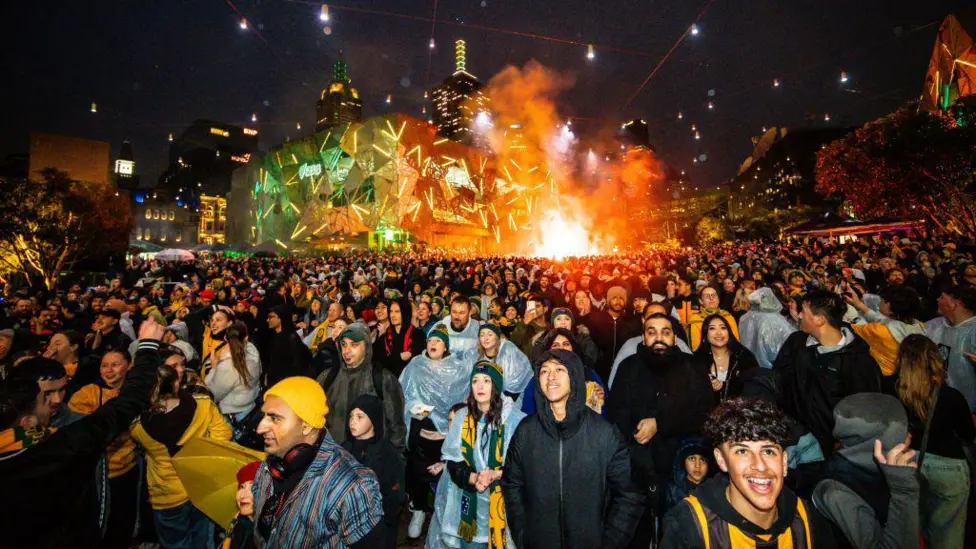
I took in the tournament from Melbourne, and the energy among the city was undeniable. Bubbling with excitement were people conversing who usually wouldn’t, and there lay an air of calm between the 90 minutes of euphoric nation-wide highs. 

Federation Square was at full capacity (7,500) for many of the group games and the knockout match against Egypt- despite the 4.00am kick-off time.

Alongside that, AAMI Park held 6,000 more spectators in the early hours of the day for the knockout game. Despite the time zone killing any convenience, the fans diligently showed up.

The post-World Cup glow also took effect: Queensland selling out both recent friendlies against Brazil.

World Cup 2026 TV ratings

Match Overall reach Average audience viewership Key detail
Final: Spain vs France 5.26m (peak) 2.69m Most watched World Cup match in SBS history
Australia vs Paraguay 4.84m 3.09m Highest viewed fixture for Socceroos
Australia vs Turkey 4.78m 3.04m Top performing early fixture

The rise of the domestic game persists:

Domestically too, figures show Australian football is continuing to grow.

October’s 2026 Australia Cup final between South Melbourne and Melbourne Victory was not only a match that will be remembered by fans for its entertainment and underdog storyline, but for investors and governing bodies that can clearly see the growing market for football in this country.

AAMI Park had its record attendance broken as 29,911 spectators packed in to watch the game. Furthermore, the TV viewership of the Cup final had a 56% increase from the previous year. The demand for football is growing significantly.

A-League Stats and Records 2025/26 season:

  • 3 sold out finals games- 22% increase on attendance last season.
  • 27% increase in digital viewership on Paramount+ and 17% on 10 Streaming.
  • For the last four seasons, over 1.3 million fans have  attended games throughout the campaign
  • TV viewership exceeded 11 million views.
  • Social media reached over 7 million people (10% increase).
  • Newcastle Jets, Adelaide United and Perth Glory all broke their previous attendance records.

The Cup final saw a non A-League club win the trophy for the first time in competition history.

South Melbourne fans. Credit SMFC

‘It also showed that NPL clubs such as South Melbourne have a fantastic support base, and this shows the potential of football to really capitalise on the community support that does exist for clubs,’ said Balliana.

‘The costs of running an A-League club are clearly the biggest issue in growing our national competition, and without significant investment through broadcast, government and other revenue streams, there are limited opportunities to take advantage of huge grassroots numbers.’ 

England is widely regarded as having the best domestic competitions on the planet, largely due to its impact on communities right across the country. However, its most attractive quality is competitiveness, and this is best showcased in the FA Cup.

Teams across all divisions have the chance to play against each other, which occasionally sees semi-professional ‘non-league’ sides the opportunity to play against a giant, such as Manchester United or Liverpool. 

Often referred to as the ‘magic’ of the cup, there is a belief that any team can win on any given day – even if their odds of succeeding are the football equivalent of what David had in beating Goliath.

The magic is in the upsets, and that competitiveness is what ties the whole football pyramid together. For the game in Australia to grow, and to sustain itself,  matches must be competitive from the first minute to the last, from the A-Leagues to the grassroots pitches all across the country.

The importance of grassroots football:

To understand football- from financial investments, market growth, popularity or simply emotional attachment – you have to start at the bottom of the pyramid.

The base of football in every country is the grassroots game. It lays the foundation, and both the future of the A-League and the Soceroos & Matildas is entirely in the hands of the grassroots level. 

Globally, amateur matches are played everyday. Those clubs have a youth system, in which the talent pool is small, and so more established clubs recruit players from that pool. This process continues all the way to the world’s elite. Domestic talent comes from grassroots football, and without domestic talent, the game is nothing.

Once a fire is lit, it needs a constant fuel source to keep it alive. If the wood is wet or rotting, the fire will slowly dissipate into ash. To keep that from happening, the fuel needs to be re-supplied so it steadily grows. Neglecting grassroots football is the quickest way for the game to decline and it is why it is imperative that it is well-funded.

‘Grassroots football is where children start their journey in football.  It’s where players fall in love with the game and develop a passion for playing,’ said Balliana.

‘This not only applies to players, but also administrators, coaches and referees. Grassroots football creates opportunities for all roles across football providing pathways across all levels of the game.’

Recently, Football NSW pledged over AUD $200,000 to three amateur clubs. The funding will allow them to upgrade facilities, create more inclusive and accessible environments and improve the fans match day experience.

Additionally, since 2020 the Dickinson Foundation set up the Active Kids Grant and has provided over AUD $5.5 million worth of equipment and uniform to support over 1000 community clubs. In 2026, 40 football clubs were supported nationwide. 

Commitment to grassroots is necessary, nation-wide. With it, clubs can grow and give players the opportunity to improve and be noticed by more established teams. Investing in grassroots football is investing in the future.

Finance and infrastructure:

As the game has grown throughout the pyramid, so too has investment in it. Globally speaking, football is an industry that has boomed in the digital age, and grown beyond what was previously conceived as possible. Some investors were early; others are riding the wave hoping it never breaks, but inevitably it will.

Everything has to peak, yet that doesn’t mean all conclusions are negative Whatever the fate of the financial wave, neither a tsunami nor shallow brake will impact people’s true love of the game. The game may take many forms, but the fans will be there for generations to come.

In 2021, US private equity firm Silver Lake acquired a 33.3% minority stake in the A-League for AUD 140 million that valued the whole organisation at AUD 425 million.

The finances of the APL have been an issue in the years since, and what becomes of their relationship with Silver Lake remains to be seen. In positive news, Network 10 & Paramount+ recently renewed their broadcast deal worth AUD 100million for an additional two years, so interest is there. Domestically, football has plenty of space to grow.

‘There is always a direct relationship between World Cup success and increased participation given the exposure of football is heightened and more people want to play,’ Balliana continued.

‘However, this also comes with challenges as infrastructure is clearly not to the level it needs to be to support the size and growth of football across our region and the country.’

As audiences grow – particularly when it comes to our national teams – the fire will continue to need fuel, and that can only be sourced organically from the ground up.

Through the continued development of grassroots football, football can still grow to be the dominant sport in this country.

WA announce TV series for Sam Kerr’s children’s novels

A new TV series based on Sam Kerr’s children’s books ‘Kicking Goals’ is set to begin filming in early 2027 in Western Australia.

The show follows a young Kerr before she became captain of the Matildas and a star at Chelsea FC. Set in her home state of WA, the story sees her navigate her way through growing up and chasing her dreams, alongside her family and friends, and the adventures that entailed.

Speaking to Screenwest, Kerr said, ‘It’s pretty surreal knowing that Kicking Goals is being adapted into a TV series. These stories are all about believing in yourself and having a go, so it feels really special that a whole new generation will get to experience them on screen.’

Co-authored by Fiona Harris, the books have been a success since their initial release in 2021, a period which has coincided with Kerr and her Matildas teammates growing from beloved within Australia’s football community, into a team of genuine national appeal and recognition. They are available nation-wide, sold at major retailers such as Big W and Dymocks.

The television adaptation will beproduced by Orange Entertainment for Paramount+.

‘Kicking Goals’ is set to inject AUD 5million into the WA economy and provide over 130 local jobs.

Creative Industries Minister of WA, Simone McGurk, said via WA GOV, ‘The series will showcase all that Western Australia has to offer – including our world-class talent, crew, and diverse locations – while celebrating the story of one of our sporting greats.’

Casting is currently underway, with a search for a young Kerr and her mates ongoing.

The months after the 2023 FIFA Women’s World Cup in Australian and New Zealand saw an 11% increase in women and girl’s participation in football compared to the previous year, showing the direct impact the biggest stage can have on grassroots football.

Kerr has managed to build on that success and begin a new chapter, inspiring kids both on and off the field.

Most Popular Topics

Editor Picks

Send this to a friend