

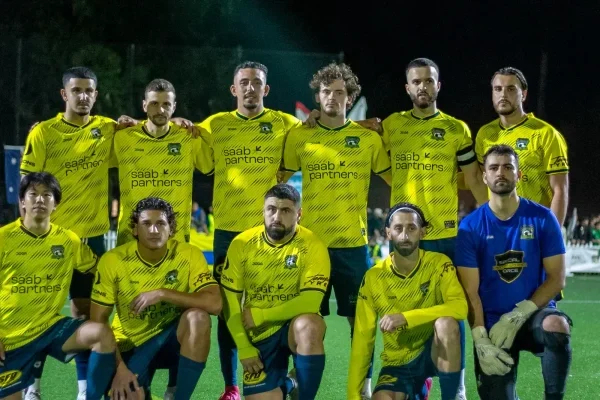



Football Path X recently hit the app store internationally, building on the connectivity of potential players from amateur to professional with clubs around the world.
Azur Omerovic has been one of key members of the Football Path X (FPX) team through its recent growth.
As head of partnerships, Azur sat down with Soccerscene to talk about the exciting journey of the company and the plans they hold for Football Path X’s future.
How did Football Path X come about?
Azur Omerovic: It all started with our CEO Rajan Zejnuni, he travelled with his wife Naava Garreth, to her home country of Uganda. For most of Africans, football is way out of poverty. Same can be seen in South America such as Brazil, though the scale and communication logistics for players with footballing ambitions is a big obstacle. Especially in the largest and most competitive footballing continent, Europe.
Rajan had talked with players and coaches who shared how difficult is to find a club locally and how much they struggle when it comes to international showcasing. Their players were left behind unless they were rich and very well connected. The players used Instagram, TikTok and YouTube to try and showcase their skills but there was little evidence of success by using these general forms of social media. FPX centralises all activities and game opportunity to individuals so it can tell complete stories about themselves and achieve, not just local, but international reach.
How did you personally get involved?
Azur Omerovic: I have played and coached at a good level before and know a lot about football. I have also had a lot of experience in business development and partnerships. I got in contact with Rajan after he published his first promo video on Facebook and announced MPV to go live. Since we both share similar values and passion, we decided to continue building FPX together.
Also in our team is my sister Amila Omerovic who is head of Player Development at FPX and has played professionally in the US and represented Croatia. Eldan Alomerovic, a brilliant designer whose creativity makes our ideas come to life, ensuring a seamless and visually stunning user experience. Assem Ragab, our Product Manager, is an IT professional and has worked in some of the biggest IT Companies such as Oracle, IBM, SAP, Meta and Tesla, at these companies he developed several products and in FPX Assem oversees product commercialisation and gamification.
So what is Football Path X and what gives it the advantage in this competitive market?
Azur Omerovic: The market is flooded with apps for individuals who can afford spending around $17 AUD a month (€10), and even then, there is little value since the major problems are not solved on a large scale. FPX is not just a mobile app – The mobile app is our first product and next year we will be publishing other digital products. This will create a set of services and products that make us a platform where all football life circles for each individual and entity (club, league) is covered.
A central part is the social part, or how people interact. FPX is huge step towards providing digital football solutions for all players and staff of clubs, equipping them with cutting-edge technology to enhance their skills, increase their visibility, and connect with the global football community and our rapidly growing platform.

What is the premium package of club management?
Azur Omerovic: For this upgrade it will be built around a club dynamic. We digitalise all football activities: Staff management, event tracking e.g. Match scheduling and tracking, training scheduling and coach-player feedback including statistical aspect of players, coaches, team and club performance. Clubs will gain complete overview of all activities and eliminate unstructured communication which consumes so much time, and this communication can be held directly, via WhatsApp and even recorded with pen and paper.
We can help digitalise clubs, which will include expert insights into training techniques and club issues from field professionals both at FPX and through over users in the App. The platform will be a football marketplace where experts and rising football stars meet, exchange knowledge and professionals can offer their services. Coaches, Scouts, Agents and other professionals like Psychologists will have their place and role on our platform.
Part of the Club Management option is a marketing package which enables clubs to interact with fans via sharing material generated in the app. Fans will get real time results and stay up to date with the club’s news like live scores or announcements. Club Management is an important brick in building this bridge, the bridge that connects demand and needs.

What is going to be the process to get clubs onto the premium package of club management?
Azur Omerovic: We have strong football network that includes around 1500 coaches around the world who have personal and professional relationships with our team and our partners. Product will be presented to them, and we believe that their leagues will get involved with our concept as well, since no one wants to stay behind. Of course, we will reach out to clubs if we notice high number of players who use the platform for personal purposes.
We are also invited to The World Football Summit which will take place in Madrid this Autumn. From this we will get direct connection with the biggest football organisations like FIFA and UEFA. This event will be the showcase for our official Club Management announcement.
Who can join Football Path X and Is there a targeted consumer?
Azur Omerovic: Though professionals are welcome to the app, 99% of footballers are amateur, semi-professional and veteran players. We believe that these players are the key. A lot of lower level clubs have the funds or ability of professional structures. So, we can offer them a system with low price and good quality. Academies are also the perfect centre for FPX to connect upcoming players in these programs to explore opportunities.
As FPX is solely football focused, parents can help manage their kids careers and represent them until they are mature enough to take over their accounts. FPX also allows their kids to get the app to communicate in a footballing environment and not get overwhelmed by the other aspects of the mainstream social media apps out there.
Only 6% of all players right now are women, we match this in our own statistics as well, with Amila Omerovic as head of Football Development it’s a central focus of FPX to increase this number.
Has Football Path X been interested in the Australian market?
Azur Omerovic: Football is developing in Australia and 10 football clubs from Australia use the current free version already. It’s a sport that is expanding professionally but has an extensive semi-pro and amateur presence. Australia is also a digitalised country, so people don’t have an issue with using apps for communication and it integrates well into the Australian way of life.
For us it’s a huge market to get into and can be a huge advantage for most of the Australian footballing community. Since the publicity of the 2023 FIFA Women’s World Cup the Women’s football market has exploded in Australia and is an exciting development for us.
How have you been engaged in the Australian Market?
Azur Omerovic: Football Path X is proud to announce a groundbreaking partnership with Australasian Soccer Academy from Sydney. At the heart of this collaboration is Tony Basha, the Chairman of Australasian Soccer Academy. His passion for football, his club and the community has deeply resonated with us. Regardless of gender or age, it is a great opportunity for all.
Tony and his academy are a respected and known academy in Europe and internationally. A true visionary, Tony recognises the power of technology in elevating football talent and has been instrumental in fostering this partnership. We are delighted to work alongside him and look forward to a long-lasting relationship that will transform football in Australia.
We encourage all players and clubs in Australia to get the app and contribute to the growing community.

How is Football Path X currently tracking?
Azur Omerovic: More than 2500 players and coaches from 120 clubs use our app even though we are just around 5 months on the market. Based on the last few weeks of the growth rate, we expect to hit the 100 000 user mark by the end of the year.
Late last year FPX team had the annual Web summit in Lisbon, where we connected to similar organisations in the digital and footballing industry. We were even approached by some famous football clubs including Atletico Madrid and Benfica.
The FPX team are keen to develop these relationships and adapt them into the app experience.
What does the future hold for Football Path X?
Azur Omerovic: The Management premium package first phase of the app is out now. We will go live early in July with a Beta version and finalise it until 1st of September. We are based primarily in Europe, with our central office in Vienna, Austria. So, Europe will continue to be a base of operations and our app’s primary focus for opportunities.
For the app to grow however, we are keen to keep pushing the app in the Australian market and expand to get more partners in South America, The US and to all countries. We already have users from 146 countries in the world.
We are driven to have FPX be the app that can connect the footballing world from the most amateur to the highest professional players, academies and clubs.