

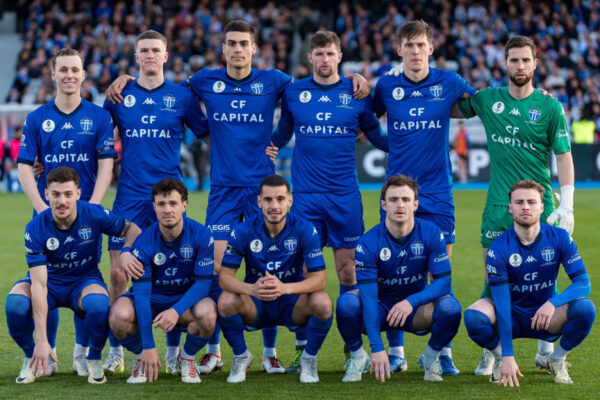

Melbourne Knights confirm innovative alliance with ProTrainUp

Melbourne Knights Football Club has confirmed a new partnership with leading football management software company, ProTrainUp.

This collaboration is set to enhance communication and streamline operations with the Club, marking a significant step forward in the commitment to excellence and growth.

Founded in 2013, ProTrainUp is a club management system fuelled by data driven technology, created by and for the football community. ProTrainUp combines quantitative and qualitative data to enhance club operations for both staff and participants, enabling the Club to:

  1. Enhance communication between club staff and players with built-in public and private messaging services.
  2. Simplify the organization and delivery of training sessions using plans and sessions provided by top international federations and clubs, available only through ProTrainUp.
  3. Maintain an up-to-date calendar of training sessions and matches.
  4. Gather data and statistics on players to create detailed reports on individual player development and overall team progress.

ProTrainUp is a system used by clubs around the world including European clubs such as Dinamo Zagreb FC and FC Porto, highlighting its importance in modern football.

The main objective of this partnership is to enhance communication among club staff, players, and parents.

ProTrainUp’s advanced software will deliver a centralised platform for efficient and effective communication, guaranteeing that all members of the Melbourne Knights community stay well-informed and engaged.

The system is accessible both online and through the app, allowing players and parents to enable push notifications so they never miss important Club updates.

The partnership will play a huge role in upskilling the juniors program in 2025, a huge focus that President Simon Pincic spoke about in length in his exclusive interview with Soccerscene.

The Knights will leverage ProTrainUp’s comprehensive tools for training management, performance tracking, and development planning to ‘provide the juniors with the best possible environment to grow and succeed’ as per their statement.

This will help more than just the junior players however with ProTrainUp, the coaches will benefit from this technology with seamless tracking of player progress, and enhanced training experiences, all contributing to the overall development of the junior players.

The club spoke about the future of their management through this advanced technology system.

“We look forward to a successful partnership and are excited about the positive impact it will have on our Club and community. Together with ProTrainUp, we are committed to building a stronger, more connected, and highly effective football club,” Knights said in a club statement.

This is an excellent and innovative partnership by the Knights that sees them advance forward in the development of technology.

The Knights have been vocal about the importance of junior development and have historically been one of Australia’s most successful clubs at creating stars from their system, with ProTrainUp only advancing that cause.


Previous ArticleNext Article

WSL Football set for major technology advancement with Sportable

The Barclays Women’s Super League (WSL) will collaborate with Nike and Sportable, a data and analytics company in the sports landscape, making it the first football league in the world to use advanced tracking technology.


Where innovation meets football

Sportable’s Connected ball technology will feature in Nike’s Official WSL Matchballs, promising a new level of insight and analysis into the game.

The product is currently undergoing a trial and test process, but may launch at an even larger scale from the start of the 2026/27 season. Potentially operating at every Barclays WSL match in the very near future, Sportable’s cutting-edge technology stands as a springboard for the future intersection between data technology and the beautiful game.

Moreover, Sportable CEO, Dugald Macdonald, expressed his excitement at what the product can bring for the women’s game.

“The opportunity to create a consistent, data-rich view of performance, from training pitches to stadiums, is truly groundbreaking and we are excited to help unlock the next level of insight for teams across the league and their fans via an enhanced, data-rich, broadcast experience,” Macdonald said via official media release.

Furthermore, with analytics and data taking a leading role within clubs to maximise performance, Sportable are providing clubs in the WSL with a vital tool in an elite, highly competitive landscape.


What does the technology provide?

Certified by the FIFA Quality Programme for Electronic Performance Tracking Systems (EPTS), Sportable’s Connected ball and player tracking system presents many benefits to clubs and athletes alike.

For example, across both training and competition, aspects such as ball speed, spin, flight, high intensity plays, team shape, tactical patterns and off-the-ball actions are all measured. Therefore, Sportable’s technology will play an essential role in backing current and future athletes with the information they need to maximise their potential.

“Nike’s new partnership with us is built on innovation and putting players first,” outlined Chief Revenue Officer for WSL Football, Zarah Al-Kudcy.

“Their desire to elevate the role of the ball through Sportable’s technology will enable us to provide enhanced performance data to our clubs as well as tell richer stories to our fans. We are excited to be the first football league in the world to use this technology.”


Read here for more information about Sportable.

Northern NSW Football Calls in SAPA as Participation Surge Sparks Big Plans

Northern NSW Football has commissioned Sports Advisory Partners Australia to lead the development of its 2027 to 2029 Strategic Plan, a process that will shape the direction of one of Australia’s most significant regional football markets at a moment when the game nationally is navigating unprecedented growth and structural complexity.

The engagement, announced this week, will see SAPA conduct extensive consultation across NNSWF’s registered participants, member zones, standing committees, board of directors and executive leadership before delivering a final plan scheduled for release in September. The firm brings to the project a track record that spans Football Australia, the A-Leagues, AFL, Rugby Australia, Golf Australia and the Oceania Football Confederation.

NNSWF CEO Peter Haynes said the organisation intended to be deliberate and ambitious about what the next plan would ask of the sport in the region.

“This plan will do more than that,” Haynes said. “It will play a critical role in shaping the future of football in our region. We are going to be bold, ambitious and take this opportunity to really push our sport forward to reach its potential.”


Building on a period of significant growth

NNSWF’s current 2024 to 2026 Strategic Plan has already delivered measurable outcomes across participation, competition strength and community engagement, and has done so against a national backdrop that has made the job of growing football both easier and more demanding simultaneously.

The 2023 FIFA Women’s World Cup and the recent AFC Women’s Asian Cup in Australia have driven participation surges that are being felt at the regional level as acutely as anywhere. Northern NSW, which covers a vast and diverse geographic footprint from the Hunter Valley to the Queensland border, has seen women’s and girls’ football registrations climb sharply, reflecting a trend Haynes flagged publicly during Football Australia’s recent push for a $343 million NSW grassroots infrastructure fund, in which he noted that participation across the region was at record levels and still rising.

That growth creates a specific strategic challenge. Momentum is relatively easy to generate in the wake of a major tournament. Sustaining it across a three-year planning horizon, through the inevitable post-event cooling of public attention, against ongoing pressure on club volunteers and community facilities, and in competition with other codes for government funding and ground access, requires a more deliberately constructed framework than goodwill alone can provide.

The 2027 to 2029 plan will need to answer questions that the current plan did not have to confront at the same scale: how to absorb participation growth without degrading the quality of the experience for existing players, how to build the referee and coaching pipelines that expanding competitions demand, and how to make the case for infrastructure investment in regional communities where football’s political leverage is real but not unlimited.


The Regional Dimension

Regional football in Australia occupies a structurally distinct position within the national game. It sits outside the metropolitan NPL systems that tend to attract most of the administrative attention and commercial investment, and serves communities where football is often the largest club-based sport and where the absence of adequate pathways has historically meant talented players relocating or disengaging entirely.

NNSWF’s decision to invest in a professionally developed strategic plan, rather than producing one internally, signals an awareness that the next phase of growth requires external rigour and benchmarking against what is working elsewhere. SAPA’s familiarity with the organisation, cited by Haynes as a factor in the appointment, also suggests a desire for continuity of thinking rather than a wholesale strategic reset.

SAPA Executive Director Sam Chadwick said the firm was focused on producing something actionable rather than aspirational.

“Our goal is to deliver a clear and actionable strategy that will guide continued growth and long-term success for the game,” Chadwick said. “Northern NSW Football has built a strong platform through its 2024 to 2026 Strategic Plan and we are delighted to support the next phase of its journey.”

Community at its Centre

NNSWF Chairman Mike Parsons emphasised that the process would be driven by community voice rather than imposed from above, a commitment that carries practical as well as symbolic weight in a region where the diversity of football communities, from coastal clubs to inland associations, means that a single strategic framework must accommodate significantly different local realities.

“This will be a strategy for the entire football community and it is vital that we hear from as many voices as possible,” Parsons said. “Through genuine consultation and collaboration we will ensure the next strategic plan reflects the needs and aspirations of our community while positioning our game for continued success.”

Consultation opportunities will roll out across the coming months. The 2027 to 2029 Strategic Plan is scheduled for release in September.

Most Popular Topics

Editor Picks

Send this to a friend