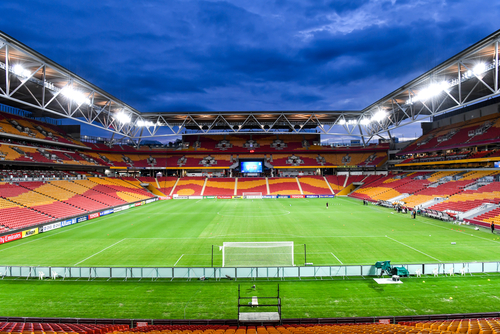




When nearly $28 million can be mobilised for one AFL venue in the City of Whitehorse, capital alignment is clearly possible. Federal, State and Council funding moved swiftly and decisively to support redevelopment at Box Hill City Oval.
Yet in that same budget cycle, Football, the state’s largest participation sport, received no transformational infrastructure commitment in the City of Whitehorse 2025 26 Budget.
At a time when Football faces a projected $385 million to $550 million statewide infrastructure requirement by 2035, there is no comparable capital signal in this municipality.
If participation growth is real, and the numbers confirm it is, why is investment not following it?
The Funding Breakdown
The redevelopment of Box Hill City Oval carries a total value of approximately $27 million to $28 million.
Funding sources include:
• $13.6 million Federal Government
• $6 million Victorian State Government
• Approximately $5.5 million City of Whitehorse
• AFL aligned contributions
This follows the earlier Michael Tuck Stand investment in the City of Boroondara.
Combined, nearly $60 million has now been committed to two AFL stands in neighbouring municipalities.
The capital was coordinated. Multi tiered. Politically aligned.
In contrast, the City of Whitehorse 2025/26 Budget allocates no funding for new synthetic pitches or Football facility upgrades.
That is not interpretation. It is fiscal record.
Source City of Whitehorse Council Budget 2025/26.
Demographics and Demand
City of Whitehorse is one of Melbourne’s most culturally diverse municipalities and home to one of the largest Chinese diaspora communities in Victoria, centered around Box Hill and surrounding suburbs.
Football is globally embedded within multicultural communities. Participation growth often mirrors demographic expansion. Demand is visible across junior registrations and female programs.
When infrastructure investment does not reflect demographic reality, misalignment follows.
Infrastructure signals priority. Priority shapes growth.
The Quantified Infrastructure Gap
According to Football Victoria Facilities Strategy 2025 to 2035, Victoria must deliver by 2035:
55 lighting upgrades
70 pitch reconstructions
80 pavilion redevelopments to meet gender equity standards
75 percent of competition pitches upgraded to 100 plus lux
85 percent of change rooms gender accessible
These are baseline requirements.
Conservative modelling places the statewide Football infrastructure requirement between $385 million and $550 million over the next decade.
Yet in City of Whitehorse’s capital works program, there is no pathway reflecting that scale of need.
Meanwhile, $60 million has been mobilised for two AFL stands.
The contrast is measurable.
The Volunteers Carry the Pressure
Infrastructure shortfalls do not first appear in Treasury briefings. They appear in club committee meetings.
Across Victoria, including Whitehorse, Football clubs are governed largely by volunteers. Mum and dads. Small business owners. Middle class Australians who give up evenings and weekends to keep community sport running.
In political language, they would be called the battlers.
They are not salaried executives. They are community stewards managing growth within facilities never designed for today’s scale.
When lighting restricts training capacity, when pitches are overused, when pavilions lack equitable access, it is not government that absorbs the pressure first.
It is these volunteers.
They are the ones who must explain:
Why do registrations close early?
Why cannot teams be formed?
Why are children being placed on waiting lists?
As a father of two, I can say plainly there is no more uncomfortable conversation than telling a child or their parent that there simply is not enough infrastructure capacity for them to play.
Not because demand is absent. But because investment is.
When capital alignment lags, volunteers carry the burden.
That is not sustainable governance. It is deferred responsibility.
“Delayed infrastructure doesn’t hurt departments, it hurts the middle class battlers who govern our clubs. Volunteer mums and dads are left explaining to children that participation has outgrown investment.”
Victoria is not the only jurisdiction facing growth pressure. The difference is how it responds.
Asia Embedded Football into Policy
In a recent Soccerscene interview, Hisao Shuto of the J.League explained:
“We don’t believe any single factor is prioritised above all others in player development. Each club equally values the development environment, including facilities, coaching staff, and the philosophy cultivated by the club itself.”
Facilities are foundational.
He further stated:
“J.League clubs contribute in multiple ways to increase youth Football participation, going beyond mere technical instruction to focus on both promotion and development within their communities.”
Japan embedded Football into municipal planning.
The K League followed similar principles.
They aligned capital with participation early.
They treated Football as civic infrastructure.
Where Is the Strategic Learning and Who Drives It
If Victoria wants to lead in Football export, where is the investment to study those mature markets?
Where is the bipartisan delegation to Japan and South Korea?
But this conversation cannot sit solely with government.
If a delegation is to be meaningful, the private sector must be brought into it. That is precisely why I have consistently called for a national and unified strategy that ends the age of silos in Australian Football. Fragmented thinking will not deliver structural reform. Coordinated leadership across government, industry and the private sector will.
Victoria is not short of business leaders capable of driving international engagement. There are passionate, prominent Football supporters within our corporate landscape, genuine shakers and movers who understand scale, logistics and long term investment.
One example is Lindsay Fox AC, who has led and participated in major international delegations, including heading the Prime Minister’s business mission to India and serving as co chair of the Australia India CEO Forum. He has represented Australian business interests at global summits and served in advisory roles such as the Committee for Melbourne.
The point is not individuals. The point is capacity.
Victoria has the private sector firepower to assemble serious, outcome driven delegations combining government, infrastructure specialists and commercial leaders to study how mature Football markets embed sport into municipal strategy and economic growth.
Delegation investment is not indulgence. It is capability building.
If we can align multiple levels of government for physical infrastructure, we can align public and private leadership for strategic learning.
The Unavoidable Conclusion:
Participation growth is documented. Infrastructure deficits are costed. Capital priorities are visible.
And it leads to a simple conclusion:
Two AFL stands total of $60 million. No strategic investment to learn from global Football markets, yet Football is told to take the back seat. If Victoria is truly the “Education State”, it is time we start acting like it.
This is not anti AFL. It is pro alignment.
If participation does not influence capital allocation, growth becomes strain. And strain eventually becomes stagnation.
The numbers are clear. The question now is whether leadership responds.