
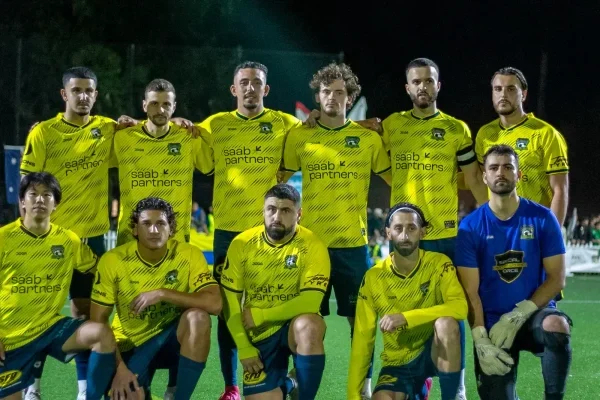


North Sunshine Eagles FC to move into $8.4 million facility

North Sunshine Eagles FC’s entire junior setup will be based out of More Park in 2022, a newly redeveloped $8.4 million facility in Ardeer.

The facility itself, amongst other things, has two full size rectangular pitches, a 21x12m fully enclosed futsal court, a mini pitch (suitable for miniroos), competition standard (200 lux) lighting, four female-friendly changerooms as well as a fully accessible sports pavilion, community social room and expanded carpark.

The club, which has continued to grow its number of registered players over multiple years, has been working with the local Brimbank City Council for a while to move on its juniors from previous homes of Bon Thomas Reserve and Lloyd Reserve.

“Over the years, we’ve been developing and expanding the club to a stage where we couldn’t continue with the levels of kids we were having at these facilities,” President of North Sunshine Eagles FC, Memet Selimi, told Soccerscene.

Selimi explained that the competition for use of the facility was hotly contested, but the club’s strong work in the area, particularly in engaging migrant communities was heavily favoured by the local council.

“We put forward a very solid application for the facility,” he said.

“Ultimately, there were several other big clubs that had applied for the position as well.

“The facility itself was traditionally a softball facility, but it never had a winter tenant – so it was pretty much always just used in the summer time and there was a big space to fill.

“Clearly, council established that there was capacity here, they wanted a winter tenant and they found us to be the most suitable candidate.

“It’s been a bit of a process, but we’re really excited about the idea of being there now for the start of next season.”

The club’s senior setup is set to remain at their home base of 30 years at Larissa Reserve in St Albans, however, Selimi revealed competitive senior matches may be played due to the improved lighting setup at More Park.

“We are looking at engaging in the possibility of playing night matches, once we run it past Football Victoria for approval,” he said.

“We will look at matches at night that will generate numbers and logistically be easy to deal with.

“Ultimately, Larissa will continue to be our home base for the seniors, but More Park will hopefully host a number of senior matches in the future.”

The club, which has a strong history going back over 50 years, are set to benefit in a multitude of ways from moving to the new facility, as is the local community – according to Selimi.

“It’s a great facility, it’s got everything we need,” he said.

“Its’s unique as well, for example, it’s got a really cool caged football setup – which is exactly something you would see in Europe or South America. It will develop a player’s skills at a much more intricate level.

“We want to grow football within the female community and engage as much as possible. We feel it’s an incredible opportunity for the club and we have grown those junior female numbers over the past few years at an exponential rate. With the new facilities we can continue to do that, with the grounds, the increased capacities and the changerooms which cater for females.

“Overall, from a footballing and club perspective, it’s going to allow us to expand our juniors, our women’s football and just create a better environment for everyone.

“From a community standpoint, it will also allow us to connect with the local migrant demographics we are trying to engage and really just try to provide an affordable option for people in the area. It’s unfair for a talent to miss out on possibilities because clubs are charging $2000 a season; we charge much less and work with individuals on things like payment plans, or trying to sponsor them, as well as other combinations as a club to make sure they don’t miss out on these chances.”

The club is extremely grateful for the improved setup at More Park for its juniors and hopes a few facility tweaks at Larissa Reserve will round out the good news.

“It will be incredible if we could seek out some funding for Larissa in regards to an upgraded carpark and lighting, but beyond that we can’t really complain,” Selimi said.

“What we’ve received up to this point is fantastic and it’s really up to us now to take it, run with it and grow our club even further – which would be great.”

Previous ArticleNext Article

South Canberra FC Breaks the Mold: Equity-Driven Model Earns ‘Club Changer’ Honour

South Canberra Football Club has been named Club Changer of the Month for April, in a recognition that reflects a broader shift across Australian football toward rewarding clubs that are actively dismantling the structural barriers limiting women’s access to the game.

The AFC Women’s Asian Cup has just delivered record crowds and unprecedented visibility for women’s football in Australia, and the Club Changer program is now asking what comes next. Its decision to name South Canberra Football Club as Club Changer of the Month for April signals a clear shift in how the program defines contribution: away from participation numbers alone, and toward the equity frameworks that determine whether women stay in the game once they arrive.

South Canberra FC built that framework from the ground up. Established in 2021, the club set out to give women and female-identifying players a safe, inclusive environment to play football at any level. It runs entirely on volunteers, operates as a not-for-profit, and is governed by an all-female committee with 13 of its 14 coaches identifying as female.


Building the infrastructure of inclusion

In 2026, the club secured grant funding and put it to work immediately. Two coaches are completing their C Licence qualification, and ten coaches, players and community members have undertaken the Foundations of Football course, which directly tackles the cost and accessibility barriers that exclude women out of coaching pathways.

The club also commissioned a female-specific strength and conditioning program with sports physiotherapists ahead of the 2026 season, targeting injury prevention and explicitly supporting players returning after childbirth.

SCFC’s leadership team draws from LGBTIQ+ individuals, First Nations people and veterans, strengthening the club’s connection to the communities it was built to represent.

The Club Changer program is backing clubs that do this work- clubs that treat equity as infrastructure rather than aspiration. At a moment when Australian football is under pressure to turn its biggest-ever surge of women’s interest into something lasting, SCFC’s model offers a clear answer to the question of how.

Football NSW announces 2026 First Nations Scholarships as pathway access program enters new phase

Football NSW has announced the recipients of its 2026 First Nations Scholarships, with ten emerging Aboriginal and Torres Strait Islander players from metropolitan and regional NSW receiving support designed to reduce the financial and structural barriers that have historically limited First Nations participation across the football pathway.

The scholarship program, developed and assessed in collaboration with the Football NSW Indigenous Advisory Group, targets players across both elite and development environments – recognising that talent identification alone is insufficient without the resources to support progression once players are identified.

Co-Chair of the Indigenous Advisory Group Bianca Dufty said the calibre of this year’s recipients reflected the depth of First Nations football talent across the state, and the importance of structured support in converting that talent into long-term participation.

“Their dedication to football and the desire to be role models for younger Aboriginal footballers in their communities is to be celebrated,” Dufty said. “I’m confident we will see some of these talented footballers in the A-League and national teams in the future.”


Beyond the pitch and into the pipeline

The 2026 cohort spans both metropolitan clubs and regional associations, an intentional distribution that acknowledges the particular barriers facing First Nations players outside major population centres, where access to development programs, qualified coaching and pathway competitions is more limited and the cost of participation more prohibitive.

The next phase of the program will introduce First Nations coaching scholarships, extending the initiative’s reach beyond playing pathways and into the coaching and administration pipeline – areas where Indigenous representation remains among the lowest in the game.

The structural logic is clear. Scholarships that reduce financial barriers at the entry point of elite pathways matter most when they are part of a sustained ecosystem of support rather than isolated gestures. Football NSW’s collaboration with the Indigenous Advisory Group provides that continuity, ensuring the program is shaped by the communities it is designed to serve.

Most Popular Topics

Editor Picks

Send this to a friend