




No overnight success: The slow transformation of women’s football in Australia

While the jury is still out on Matildas coach Tony Gustavsson following the performances in the two-game friendly series against reigning World Cup champions, the United States, there’s one thing for certain – women’s football has never been more popular.

A total of 56,604 people turned out to the two games against the US in Sydney and Newcastle, including a record-breaking 36,109 at Stadium Australia on November 27.

A further 457,000 people tuned into the game on Channel 10’s free-to-air coverage, highlighting the incredible rise in accessibility for Australia’s flagship national football teams to the mainstream audience.

With a Women’s World Cup on the ever-approaching horizon, the outlook for women’s football has rarely looked better.

However, the so-called overnight success of women’s football has been 50 years in the making.

And for some of the pioneers who helped champion the game’s cause in the face of countless doubters, the delight of seeing the women’s game reach the incredible heights of recent years leaves many thinking, where would we be if women’s football had been backed since day dot?

It’s a question that long-time football administrator Maggie Koumi has, who currently sits on Football Victoria’s Historical Committee and Women’s Committee. She was also recently featured in the Fair Play Publishing title, Dedicated Lives – Stories of Pioneers of Women’s Football in Australia by Greg Downes.

“If people had believed in us at the start, it could have been 50,000 people per game this time,” Koumi told Soccerscene, reflecting on her earlier days in the sport.

“But it is what it is. We can’t worry too much about the past now, although I do feel for the friends of mine, the former Matildas, who had to go through a hard slog and used to have to ry and pay their way to play.

“The good thing is that we’ve come a long way since then, and the difference between what my friends had and what the Matildas get now is amazing.”

In a mark of just how quickly the women’s game has propelled forward, it was not even 25 years ago that women’s football in Victoria was administered completely, and separately from the rest of the game.

Koumi, who played a key role in the amalgamation of the Victorian Women’s Soccer Association and the Victorian Soccer Federation in the late 1990s, explained that when change did eventually come for the women’s game, it came quickly.

However, it was a long, hard slog before those changes took place.

“For a long time, I think we were just a pain in the ass to most people in the game,” she said.

“We were just sort of tacked on without any real support. There was no money for the women’s game and no one seemed to care about it. There was just an assumption that no one was interested in it and that attitude pretty much floated around football in Victoria.

“For the most part, they just made women’s football mirror the men’s game and was really hard to get people to understand that that approach didn’t work. Trying to get people to understand that you can’t just mirror whatever the men do, because the women don’t have the resources that the men do was always very challenging.”

Koumi believes changes at the top of the game – in particular at Football Australia and Football Victoria – as well as the findings of the Crawford Report, were massive institutional changes that helped set the scene for the gigantic strides forward taken in such a short space of time.

“Football Australia started to take note of the women’s game and they had people come and talk to the different federations to try and start the conversation around changing things in football,” Koumi said.

“The changes to the Football Victoria constitution [in 2006, when FV was known as the Victorian Soccer Federation], was another big catalyst.

“It changed the voting system allowing clubs to vote for zone reps and the zone reps would vote for the board and from there the face of Football Victoria changed a lot.”

The groundswell of young girls looking to play the game opened the eyes of many grassroots clubs to better.

“Brighton Junior soccer club was one of the really, really big clubs that managed to get lots and lots of people playing good a great promotion on women’s football and it all started to change,” Koumi added.

“The numbers crept up and the club’s suddenly realised that they can have a whole stack of girls playing and increase their membership and revenue, which helped.

“It didn’t necessarily change the attitude towards women’s football, but at least we started to get some serious numbers of girls playing football.”

Further efforts to provide access to education at clubs about how to run a successful women’s program – as well as greater funding for high-performances teams in women’s football – further propelled the trajectory of women’s football in Australia as a new generation of brilliant women’s footballers emerged and helped the Matildas to become a genuine force in the game.

Of course, there is still work to be done.

Koumi argues greater media recognition of women’s football, a more professional A-League Women competition and a further improvement of attitude and embracement of women’s football at grassroots clubs are crucial to the ongoing success and improvement of the game in Australia.

“A lot of clubs still do things like putting their women’s team on the back paddock while junior boys are playing on the main pitch, so there’s still work to do,” she said.

“That attitude is changing, but in some places, it still exists.

“The World Cup coming to Australia is great and I think it’s a fantastic opportunity to promote women’s football and improve the facilities we have.

“We produce good players but they have to go overseas to prove themselves or to play with the best and improve and I’d like to see that be able to happen here one day.”

You can read more about Koumi’s journey and experiences in Australian football – and those of 17 other people who pioneered the women’s game in this country – in the new book titled Dedicated Lives – Stories of Pioneers of Women’s Football in Australia.

Previous ArticleNext Article

Victorian Labor commits $500,000 to Thornbury Football Facility as State Election Advocacy Intensifies

The Victorian Labor Party has confirmed $500,000 in 2026-27 State Budget funding to upgrade facilities at Mayer Park in Thornbury, with Northcote MP Kat Theophanous joining Darebin United juniors for a training session earlier this month to mark the commitment. The funding follows a public campaign by Football Victoria highlighting the ground’s deteriorating conditions, and lands within an escalating advocacy effort by the sport ahead of the next Victorian election.

The money will go toward upgrading the playing surface and planning a new pavilion at a ground that has received no infrastructure investment in over a decade, according to Football Victoria, despite participation at Darebin United more than quadrupling in that time. The club fielded five teams in 2021. It now fields more than 20, with over 300 players including more than 130 children under 12 and over 70 female players.

That growth has collided directly with the limits of the ground itself. Mayer Park has no drainage and no synthetic surface, and Football Victoria reported that Darebin United lost 23 training sessions in 2024 alone due to unsafe, waterlogged conditions. Club President Michael Slaughter described a pitch that was uneven and at times dangerous, particularly for junior and female players.

“I have been there for six years, and the club is at a stage now that we need something new,” Slaughter said in comments to Football Victoria earlier this year. “There’s only so many training sessions you can cancel, and then there’s the cost of finding alternative grounds indoors or outdoors, which isn’t ideal.”

A campaign that found its target

Football Victoria published a dedicated article in March calling on Darebin City Council to urgently prioritise redevelopment of Mayer Park, explicitly linking the club’s case to its broader Level the Playing Field campaign. Three months later, the funding arrived, not from council, but from the state government, attached to the local member’s name and delivered with a photo opportunity on the training pitch.

A club’s need becomes visible through governing body advocacy, a local member adopts the cause, and the funding is announced as a direct response to community need rather than as a line item in a broader budget process. Theophanous’s own account of the announcement makes the local framing explicit, describing the investment alongside free public transport, school upgrades and registration discounts as part of what she has billed as “easier, safer and more affordable” support for Northcote.

“Community sporting clubs bring Northcote locals together,” Theophanous said in her budget statement. “Through our Get Active Kids voucher program, we’re making sure the cost of fees and equipment doesn’t keep kids from playing the sport they love. And we’re also investing to make local clubs even stronger.”

Earlier this year, Avondale FC secured $500,000 for lighting at Avenger Park and Hume City FC received $250,000 for upgrades at Nasiol Stadium, both delivered through the same budget cycle and both paired with local member announcements. Mayer Park follows the same pipeline, a state government commitment, a local seat, a community club whose growth has outpaced its facilities, and a governing body using the win as evidence in a larger campaign.

The equity dimension

What distinguishes the Mayer Park case is the explicit role gender and accessibility played in Football Victoria’s advocacy. The governing body noted that unsafe pitch conditions were particularly dangerous for junior and female players, and highlighted that Darebin United maintains 40% female representation on its committee with seven female coaches, alongside its status as one of Darebin’s first 2-Star Club Changer accredited clubs, a Football Victoria program recognising clubs that actively remove barriers to female participation.

A club building one of the more credible female participation pathways in the municipality was, until this announcement, doing so on a ground its own administrators described as unsafe. Infrastructure investment of this kind does not simply improve playing conditions. It determines whether programs explicitly designed to grow women’s and girls’ football can function as intended, or whether they remain constrained by the same ageing facilities that have shaped community football for a decade.

What it means for the campaign ahead

Football Victoria has framed the Mayer Park outcome as one data point within its Level the Playing Field campaign, which continues to call for more equitable government investment in football relative to other codes. The organisation has indicated further football-related announcements are expected from the 2026-27 Victorian State Budget, with the upcoming state election positioned as the decisive moment for the sport’s broader infrastructure future.

For Slaughter, the immediate outcome is more concrete. “The funding is extremely important,” he said. “It allows us to deliver our football program and to grow. This will give them a place to come, to have fun and to enjoy their soccer”.

Whether that template, governing body advocacy, local political adoption, budget announcement, repeats consistently enough to address the scale of Victoria’s grassroots facilities gap remains the open question Football Victoria’s campaign is designed to keep in front of both major parties as the election approaches.

Football Victoria joins campaign to fight racism in sport

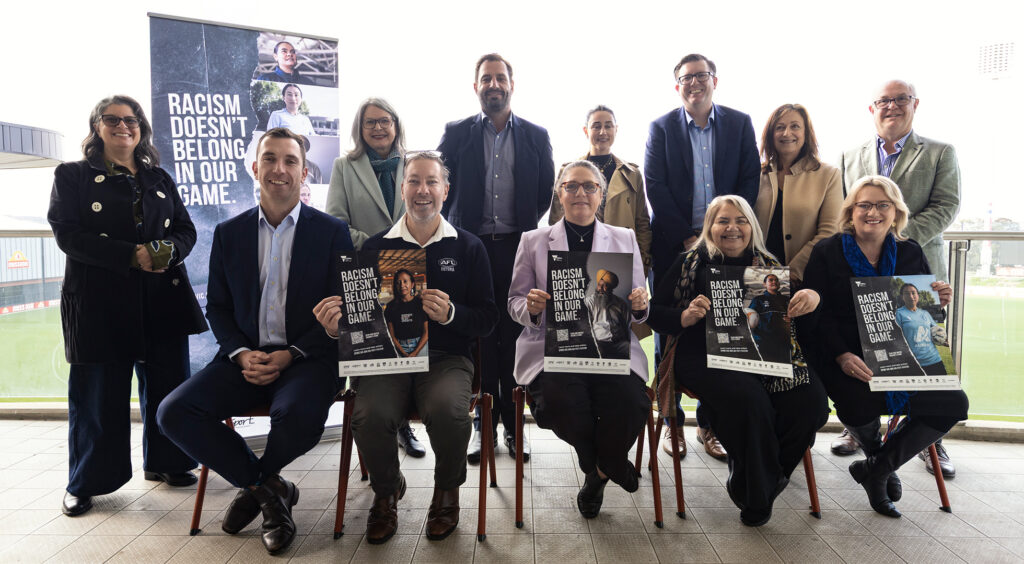
With the launch of the Victorian Government’s Racism Doesn’t Belong in Our Game campaign, Football Victoria joins several sporting organisations in the state to ensure sport remains inclusive and welcoming for all.


About the campaign

Racism Doesn’t Belong in Our Game aims to raise awareness of racism in community sport, uniting organisations and associations like VACSAL, Vicsport, VicHealth and more.

Football Victoria, as the state’s governing body for the beautiful game, will affirm its commitment to ensuring football is a safe and inclusive place for all who play, coach or support by joining the campaign.

It reflects the leadership and guidance of the Centre for Multicultural Youth (CMY) and its CMSport initiative, a service provider with over 30 years of experience in supporting diversity in sports through training, coaching and mentoring, and consulting support.

“It has been fantastic to work with CMSport, CMY and the other sporting codes to bring this campaign to life,” said FV Executive Manager of Equity Growth and Government Relations Karen Pearce via media release.

“The Racism Doesn’t Belong in Our Game campaign started with a pledge from all seven codes to tackle racism, and I really do believe that we can achieve that as a cohesive group pulling toward the same goals.”


Strength in diversity

Australia is an immensely diverse and multicultural nation. According to numbers from the Australian Bureau of Statistics, the population includes 8.8 million people born overseas, representing 32% of the population. 48% have a parent born overseas, while 4% is Indigenous.

It should therefore be expected – and indeed, welcomed – that Australia’s most-participated sport reflects this multiculturalism.

But for many who want to enjoy playing or watching football in their local community, incidents of racism continue to plague their experiences in the game.

“Research tells us over 56% of Victorian community sport have reported experiencing or witnessing racism, a truly alarming number,” Pearce continued.

“We look forward to working together to lower that stat as we try to stamp out racism in sport once and for all.”

Racism Doesn’t Belong in Our Game ultimately embodies not only the goal for all sport going forward, but the best way through which to achieve it.

That is, through unity and championing the diversity which makes Australia a nation to admire.

Most Popular Topics

Editor Picks

Send this to a friend