
AusPlay survey reveals most popular sport

The AusPlay survey for 2019 by Sport Australia has confirmed that soccer is the most popular organised sport in Australia.

With more than 1.76 million participants, it tops the list of sporting activities in the country. To put things into perspective, soccer has almost twice the number of participants as any other football code.

AusPlay features many other physical activities people engage in, including walking, fitness & gym, swimming, running and cycling.

The AusPlay survey is in its third year and has shown that popularity of the game is in a good state:

  • 5.4 per cent of the adult (15+ of age) male population regularly participates.
  • More than 396,000 girls and women participate, one of the highest figures of any sport.
  • More than 681,000 children aged up to 14 years took part in organised out-of-school football.

Football Federation Australia (FFA) Chief Executive David Gallop AM spoke about the positive outcome the survey.

“This confirms our own data that football is by far the most popular club-based participation sport in the country,” Gallop said.

“As a sport that you can play whether you’re under five or over 75, the opportunities to participate are limitless.

“Football plays such an important role in our communities, providing significant physical and mental health benefits, helping the fight against obesity, promoting social cohesion and multicultural inclusion.

“I applaud the Federal Government for working with FFA on programs to increase participation to improve the health and wellbeing of our nation. In conjunction with Sport Australia, we recently announced a brand new national Walking Football program targeting older Australians, and have received funding for three new safe, inclusive and social football programs for females, ‘Soccer Mums’, ‘Kick On’ and ‘Culturally and Linguistically Diverse (CALD) Women and Girls’.”

Previous ArticleNext Article

NSW Football Associations Unite Behind AED Mapping Project for Statewide Safety Network

Twelve football associations across New South Wales have joined a statewide effort to map and register Automated External Defibrillators across sporting facilities, in a project that its organisers say will significantly improve emergency response times and save lives at community sport venues.

The Heartbeat of Sport AED Mapping Project, backed by funding from the Minns Labor Government to the Heartbeat of Football Foundation, represents the first comprehensive research into AED placement across NSW sports grounds. The data collected will be provided to NSW Ambulance and its GoodSAM team to enrich the existing AED registry available to ambulance and public first responders, and will feed into NSW Health’s newly released public AED map.

The project has drawn active participation from associations spanning the breadth of the state’s football community, including Eastern Suburbs, Manly Warringah, Granville, Southern Districts, Nepean, Northern Suburbs, Football Canterbury, Bankstown, Hills, Sutherland Shire, North West Sydney Football and Football South Coast.

When seconds matter

The urgency behind the project is not theoretical. At Doyalson Wyee Football Club, a 70-year-old player survived a sudden on-field cardiac arrest because an AED was available on site. The outcome of that incident – and the many others like it that occur across community sport each year – depends entirely on whether a defibrillator is accessible, charged and registered in the systems that emergency responders rely upon.

Sudden cardiac arrest kills without warning. The survival rate drops by approximately ten percent for every minute without defibrillation. In a community sport setting, where professional medical staff are rarely present, a registered and accessible AED is the difference between a player walking off a pitch and one who does not.

The mapping project addresses a gap that has existed largely unexamined. More than 2,400 defibrillators have been deployed across NSW sports and recreation facilities through the Local Sport Defibrillator Grant Program, with grants of up to $3,000 available to eligible organisations. But a device that exists without being registered in emergency response systems provides significantly less value than one that is accurately mapped and immediately locatable by ambulance crews responding to a call.

By encouraging clubs to complete AED registration surveys, the twelve participating associations are ensuring that the equipment already on their grounds is activated within the broader emergency infrastructure – translating a physical asset into a functional one.

Regional communities and the equity of safety

The project’s expansion of the #HeartHealthMatters Program, which brings CPR and AED familiarisation training to sporting organisations with a particular focus on regional areas, addresses a dimension of safety preparedness that often receives less attention than equipment access alone.

Knowing a defibrillator exists on site is insufficient if the people present during an emergency do not know how to use it. Regional clubs, which frequently operate with smaller volunteer bases and less access to formal training programs, face a compounded risk – less equipment, less training, and longer ambulance response times due to geography. The program’s regional focus acknowledges that safety infrastructure, like sporting infrastructure more broadly, is not evenly distributed.

The data gathered through the mapping project will also guide future investment decisions, identifying facilities that still lack AEDs and providing the evidence base for targeted grant funding to address those gaps.

Football associations that have already contributed AED data have demonstrated, in the words of the project’s organisers, strong sector leadership and a shared commitment to safeguarding participants at every level of the game.

For a sport that involves hundreds of thousands of players, officials and volunteers across the state each week, the ambition of the Heartbeat of Sport project is straightforward – that no preventable death occurs on a football ground because the right equipment was not there, or could not be found.

World Cup 2026 build-up: FA urges Victorian Government to overturn live site decision

Football Australia responded yesterday to the decision by Melbourne Arts Precinct not to host live watch parties during this year’s FIFA World Cup tournament.

FA urges reconsideration

Citing safety concerns, Melbourne Arts Precinct announced that live watch parties would not take place this summer.

As a result, many fans and officials are eager to see the decision overturned as they look forward to rallying behind the Socceroos at their seventh FIFA World Cup tournament.

Football Australia revealed yesterday that they are speaking to both the Victorian Government and the Melbourne Arts Precinct to ensure fans across the city can view live matches together.

“The FIFA World Cup is the biggest sporting event in the world and unites Australia’s multicultural communities, while reinforcing our national identity,” explained Football Australia CEO, Martin Kugeler, via official press release.

“Live sites create iconic moments for Australian sports fans. They bring all Australians together to celebrate and cheer our National Teams competing on the biggest stage.”

“Melbourne is one of Australia’s sporting and multicultural capitals, and this decision goes against this tradition.”


Celebration vs safety

While many will be backing the FA in their call to overturn the decision, the motivations behind it nevertheless stand to reason.

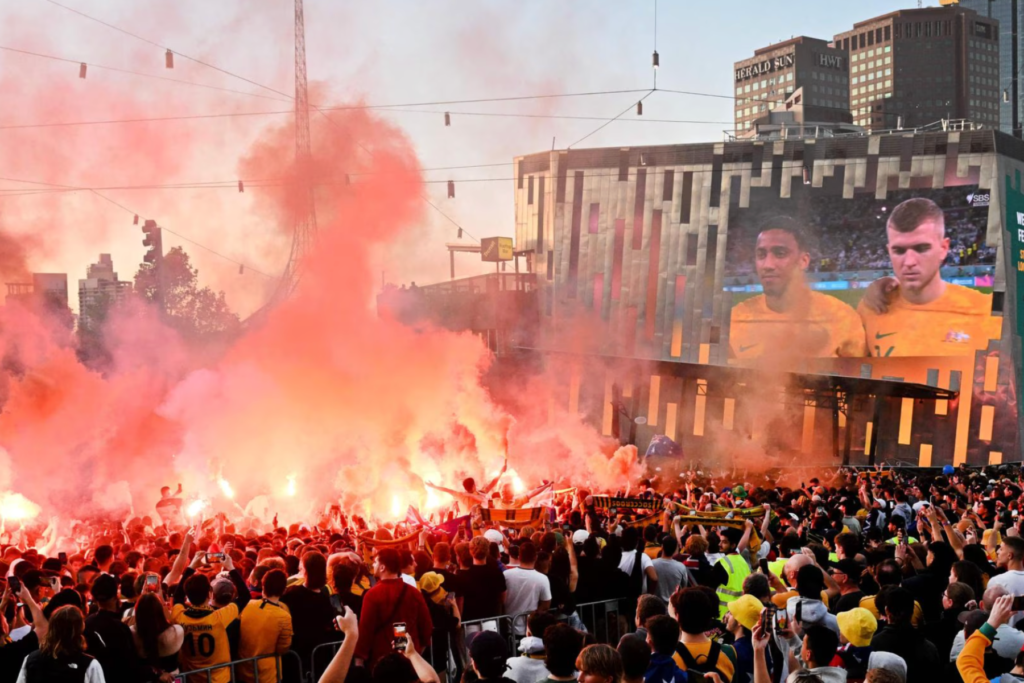
With thousands of fans packed into an outdoor, public space like Federation Square, guaranteeing order and safety becomes increasingly difficult to deliver.

During the 2023 FIFA Women’s World Cup, up to 12,000 fans attended the semi-final screening against England. And although the majority were there to enjoy and support, a small minority took the opportunity to light and throw flares.

Therefore, the response from the FA begs an important question in staging live sporting events:

At what point do celebrations compromise safety?


Final thoughts

Football brings people together, and international tournaments allow fans to display pride for their respective nations.

But safety remains an absolute priority in sports – from the athletes on the pitch to the fans in the stadium or, during major tournaments, at popular live sites.

Hopefully, an agreement can be reached which balances both aspects of the game.

Most Popular Topics

Editor Picks

Send this to a friend