Matildas extend key partnership

Football Federation Australia (FFA) has agreed to extend their partnership with Westfield as the leading sponsor for the Australian women’s national soccer team.

The Matildas, who are set to embark on the FIFA Women’s World Cup in a month, have been backed further by Westfield for a further two years.

The FFA and Westfield’s new owner Scentre Group has kept a long-running deal alive that began in 2008 – where the women’s game has grown in leaps and bounds,

The women’s teams will be continue to be referred to as the Westfield Matildas, Westfield Young Matildas and Westfield Junior Matildas, while the W-League will also feature Westfield in it’s name.

“We are very excited that Westfield will continue supporting women’s football in Australia and we look forward to working closely with everyone at Scentre Group as we seek to innovate and continue to grow the game in Australia,” – David Gallop, Chief Executive of the FFA.

“The sponsorship connects our communities with the sport they love through memorable player experiences in our living centres and exclusive opportunities at Westfield Matildas matches. I would encourage other business leaders to get involved and foster the continued growth of women’s sport in this country.” – Scentre Group Chief Executive, Peter Allen.

Previous ArticleNext Article

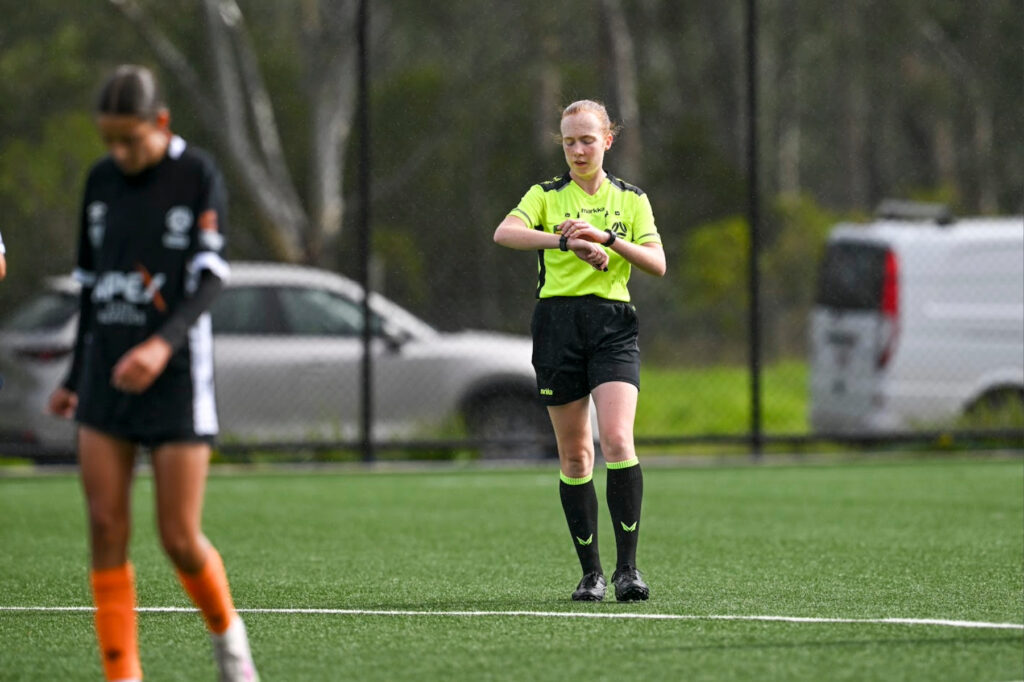
Football Australia Expands Mental Skills Program for Match Officials Amid Sustained Focus on Referee Retention

Football Australia has confirmed a second national webinar for match officials, led by sports psychologist Dr Liam Slack, extending a referee development series introduced after strong engagement with an initial session on managing match-day pressure.

The upcoming session, themed “parking with purpose,” will focus on decision-making strategies designed to help referees process on-field calls and reset attention quickly across a match that can present hundreds of individual decisions. Dr Slack, who also consults with The Football Association and the AFC Referee Academy and previously spent over a decade as a performance psychologist with the Professional Game Match Officials Limited in England, brings substantial elite-level experience to a program open to officials at every level, from grassroots to professional.

The theme builds on work Dr Slack has already delivered within Australian officiating. He recently led a session with Football Australia’s National Referee Academy on the same concept, framing the ability to consciously park a decision and refocus on the next phase of play as a trainable skill rather than an innate trait, one that separates officials who reset quickly under pressure from those who don’t. He has also addressed more than 100 Football Australia elite match officials and staff on developing a stronger match-day mentality, an indication of how embedded this psychological framework has become across the officiating pathway rather than remaining a one-off intervention.

The expansion of the webinar series reflects a broader shift in how football administrators are approaching referee attrition. Rather than treating retention purely as a recruitment or pay problem, the program signals an institutional acknowledgment that the psychological demands of officiating, particularly the compounding pressure of split-second decisions under public scrutiny, are a material factor in whether officials remain in the game.

It rests alongside other measures adopted across Australian football in recent years, including visible identification programs for junior referees and structural reviews of referee departments at state federation level, all aimed at the same underlying issue: a shrinking pool of match officials relative to demand.

Football Australia has not detailed metrics for assessing the program’s impact on referee numbers, though the recurring engagement of an internationally credentialed specialist across multiple tiers of the officiating pathway suggests sustained institutional investment in the approach.

How Australian Support for the World Cup Has Changed Since 2022

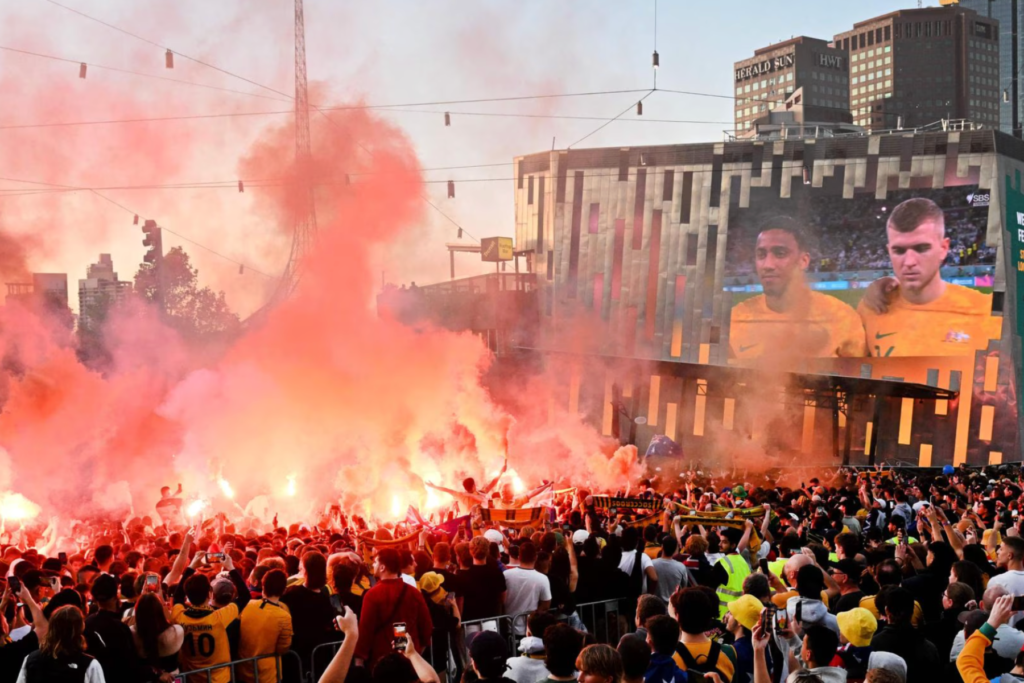
Sodden, rowdy and 7,000-strong, the crowd that gathered at Federation Square before dawn on Saturday for Australia’s clash with the United States offered a vivid illustration of how much, and how little, has changed in Australian football support since Qatar 2022.

The scenes themselves were familiar: fans queuing from 2am, flares lit during the anthem, a barrier breach as the precinct hit capacity within minutes of opening. But the fact the screening happened at all says something about the shifting institutional weight football now carries in Australia.

Just this May, the Melbourne’s Arts Precinct had decided not to screen Socceroos matches at Fed Square this tournament, citing crowd damage and arrests during a 2022 World Cup screening. Football Australia publicly pushed back, and the Victorian Government ultimately overturned the decision, with security and police presence increased to manage the risk. That a state government intervened to guarantee a public screening reflects how central these gatherings have become to football’s standing in Australia, not just as a peripheral fan event but a piece of cultural infrastructure worth a premier’s political capital.

A Tournament Inherited, Not Just Attended

The scale of public interest now sits on a different foundation than it did in 2022. Football Australia’s most recent National Participation Report recorded an 11% increase in total participation to 1,911,539 people, with women and girls’ participation rising 16% to 221,436. Industry analysis attributes much of that growth to the “Matildas effect” following the home Women’s World Cup in 2023, projecting 407,000 new junior participants by 2027 on the back of that tournament and Football Australia’s broader infrastructure strategy. Whatever happens to the Socceroos in the United States, the crowd at Fed Square this year is drawn from a participation base substantially larger than the one watching from lounge rooms and pubs in Qatar.

That shift shows up in how fans say they’ll engage with this tournament regardless of results. New industry research found 79% of intended Australian viewers plan to keep watching the World Cup even if the Socceroos are eliminated, an 11-point increase on 2022, suggesting interest is becoming less tied to the national team’s results than it once was. The same research found television remains dominant, with 88% of viewers planning to watch on TV, rising above 90 per cent for evening and weekend matches, even as audiences increasingly split their attention across streaming and second screens.

Crowd Behaviour as the Unresolved Question

What hasn’t shifted is the tension over crowd conduct at public screenings, and what it costs football’s civic standing when things go wrong. The Melbourne Arts Precinct’s chief executive was explicit in 2026 that damage and behaviour during 2022 screenings were the basis for initially declining to host watch parties this time, despite trouble-free crowds during the 2023 Women’s World Cup.

Saturday’s flares and barrier breach will likely feed that same debate going into the knockout stages, even as the broader numbers tell a story of a sport with a far deeper public footing than it had four years ago. The Fed Square images from 2022 prompted other Australian cities to scramble together live sites once the Socceroos reached the knockout rounds, reflecting a pattern likely to repeat if Australia progresses from Group D, with Friday’s match against Paraguay now carrying outsized weight for a campaign that began with what fans, by their own description, considered horrible refereeing and a result short of expectations.

Most Popular Topics

Editor Picks

Send this to a friend