Australian football has long placed player development at the centre of discussions about the game’s future. But former Socceroo, coach and football administrator Gary Cole believes another question deserves greater attention: who is developing the coaches responsible for developing those players?
Following Soccerscene’s recent analysis of the challenges facing Australia’s coaching system, Cole spoke about his experience of coach education, the National Football Curriculum, pathways into professional coaching and the growing number of Australian players pursuing opportunities overseas.
His assessment points to a broader issue. Australia does have a formal pathway for aspiring coaches, but qualifications alone do not necessarily create better coaches or provide a pathway into professional employment.
For Cole, the missing link is what happens between completing a coaching course and becoming capable of consistently improving players on the pitch.
From coach education to coaching
Cole’s introduction to coaching stretches back to the early development of formal coach education in Australia during the 1970s.
He recalls being encouraged into coaching by Dr Ron Smith while studying to become a primary school teacher, before later working under influential figures including Eric Worthington.
One experience with Worthington as a young player fundamentally changed Cole’s understanding of what coaching could achieve.
Worthington worked with Cole and his fellow forwards on their movement and ability to create space for one another. Rather than simply organising a training exercise, the coach was deliberately changing individual and collective behaviours that could then influence what happened in a match.
“It was a light bulb moment for me,” Cole said.
“What he was doing was changing my and the team’s behaviours in training, where that could impact the way we played together on the field.”
That distinction remains central to how Cole views coach education today.
Does the current coach education system adequately prepare Australian coaches?
“I think it prepares some of your coaches some of the time, but not all of the coaches all of the time,” Cole said.
His concern is that Australian coach education has, at times, moved too far away from the practical environment in which coaching actually occurs.
“In my opinion, and from the feedback that we’ve gotten at Football Coaches Australia over the journey, coach education lost its way a little bit for a period of time,” he said.
“Some of it became academic. It was more about PowerPoint presentations, more about talking about coaching than it was about coaching.
“The magic of coaching happens between human beings on grass. That’s where the success happens.”
Cole does not dismiss the importance of theory, tactical discussion or other off-field preparation. Instead, his argument is that these elements ultimately need to translate into a coach’s ability to influence player behaviour.
As coaches progress further into performance environments, he believes that ability becomes increasingly important.
“The reality in coaching, as you go up through the performance pathways, is it becomes more and more about helping people to get the right behaviours individually and collectively on the pitch on the weekend,” he said.
“And that requires you to do that on the pitch during the week.”
Is the National Football Curriculum still fit for purpose?
Australia’s National Football Curriculum has played an important role in creating a common framework for player and coach development.
But with the current curriculum dating back more than a decade, Cole believes a review is overdue.
“There was a lot of good stuff in there,” he said.
“There was a bunch of stuff that wasn’t in there. There’s nothing about tackling or heading the ball, which is quite bizarre given these are two parts of the game.
“Does it need reviewing? Yes, absolutely.”
The need for a review is not simply about individual football skills.
The environment surrounding coaching has changed significantly, from data and performance analysis to artificial intelligence and the increasingly diverse backgrounds of players entering Australian football.
“The game does change and evolve,” Cole said.
Perhaps more importantly, Cole cautions against assuming there is only one correct way to coach.
He admits that earlier in his career he was something of a “coaching snob”, believing successful coaches needed to approach the game in a similar way to those he had learned from.
Experience changed that perspective.
“There’s never just one way of doing it,” he said.
“People can be successful doing things differently.”
For Australian coach development, that raises an important question: should a national curriculum prescribe how coaches should think, or give them the foundations from which they can develop their own approach?
Australia has a coaching pathway – but where does it lead?
Cole is clear that there is a formal route available to aspiring Australian coaches.
Coaches can progress through the licence system from the C and B Licences towards the A and ultimately Pro Licence.
But accessing qualifications and building a professional coaching career are two different challenges.
“Having the licence is one thing that gives you access to the road,” Cole said.
“But to become the driver, you need to get on the road, make some mistakes – preferably don’t kill you – and do all those things.
“Go and get yourself a job at whatever level that you can and you’re comfortable at and develop as a coach.”
Experience, he argues, cannot be replaced by certification.
“The best coaches are the ones that have had hundreds and thousands of hours working with football and on the park, because that’s where they develop.”
Cole points to Joe Montemurro as an example of that evolution.
Early in his coaching career, Montemurro told Cole he would observe other coaches and borrow training exercises that looked effective. Over time, however, he developed a clearer understanding of who he was as a coach, how he wanted his teams to play and which exercises actually served that philosophy.
“The best coaches have the capacity to make the complex simple,” Cole said.
The missing bridge into professional coaching
The greater structural problem emerges when coaches attempt to turn that development into a career.
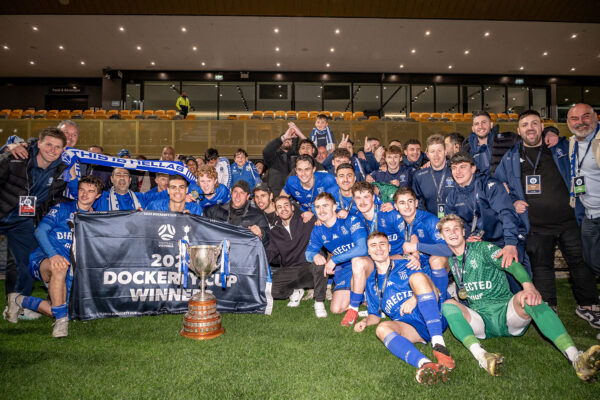
Cole points to Heidelberg United coach John Anastasiadis as an example of the type of progression that should theoretically exist: achieve success in the NPL, earn an opportunity within an A-League environment and potentially progress towards becoming a professional head coach.
In practice, Cole believes that transition remains rare.
“The number of NPL coaches that get spotted and targeted by A-League coaches is almost non-existent,” he said.
“If they’re lucky, they can get a job, and that’s great because it’s the door towards being a professional coach.”
Cole believes Australian coaches with established professional records are highly regarded. However, when clubs look beyond that group, overseas experience can often be prioritised ahead of coaches working within Australia’s NPL competitions.
“We rarely then look down into the NPL competitions in all of the states to find the next batch of elite coaches,” he said.
It creates a difficult contradiction within the Australian pathway.
Coaches are encouraged to obtain qualifications, accumulate experience and prove themselves within the domestic system, yet success at NPL level does not necessarily provide a clear bridge into the professional game.
Are overseas pathways a failure of Australian development?
The same pathway debate applies to players.
The United States college system has become an increasingly visible option for Australian footballers, offering an established sporting and educational environment alongside opportunities to progress into professional competition.
Cole, however, cautions against treating every player who leaves Australia as evidence that the domestic system has failed.
“Development of players is not linear,” he said.
“You like to put things in boxes, but the reality of player development is it can go ahead in leaps and bounds, and then it doesn’t move for a while.”
His advice to parents of talented young players is therefore relatively simple.
“Take them to somewhere where they want your child to be a part of it, you’ve got a good coach and they’re going to play.”
That final point is particularly important.
Australian players have increasingly secured opportunities in Europe and other overseas markets, but Cole argues the prestige of signing abroad matters less if the player is not receiving meaningful playing time.
“We’ve seen a whole bunch of young Australian players in the last 10 years go off into Europe, get a contract in Europe, not play in Europe, get some time in the reserves, and then come back and play more regularly in the A-League,” he said.
“And that’s okay as well.”
For Cole, development should ultimately be judged by whether an environment gives a player the coaching and competitive minutes required to improve.
“Who coaches the coaches?”
It was Cole’s final observation that perhaps best encapsulates the challenge facing Australian football.
When formal coach education was first established, he recalls technical directors carrying responsibility for both player development and coach development.
He believes that role has changed significantly.
At NPL level in particular, technical directors can now spend substantial amounts of time dealing with parents and concerns surrounding selection, playing time and the significant fees families pay for junior football.
“The technical director role is more like a customer service officer because they’re dealing with parents who are paying an awful lot of money for their kids to play,” Cole said.
“If the kids don’t play, they don’t get enough game time or they don’t start enough, they want to know why, and that role falls back on the TD.”
The consequence is potentially significant.
If technical directors become consumed by administration and parent management, responsibility for actively developing coaches can become secondary.
“Within the club system, someone needs to be responsible for player and coach development,” Cole said.
“Because if we’re going to help our players and coaches develop, we need to be thinking about what goes on.
“And who coaches the coaches?
“Coaches can learn without being coached, but coaches benefit from being coached as well.”
That may ultimately be the distinction Australian football needs to address.
Creating more qualified coaches is measurable. Creating environments in which those coaches receive mentorship, accumulate meaningful experience, develop their own football philosophies and can progress towards professional employment is considerably more difficult.
If Australia wants to improve the players emerging from its development system, strengthening the people responsible for developing them may be one of the most important places to start.