



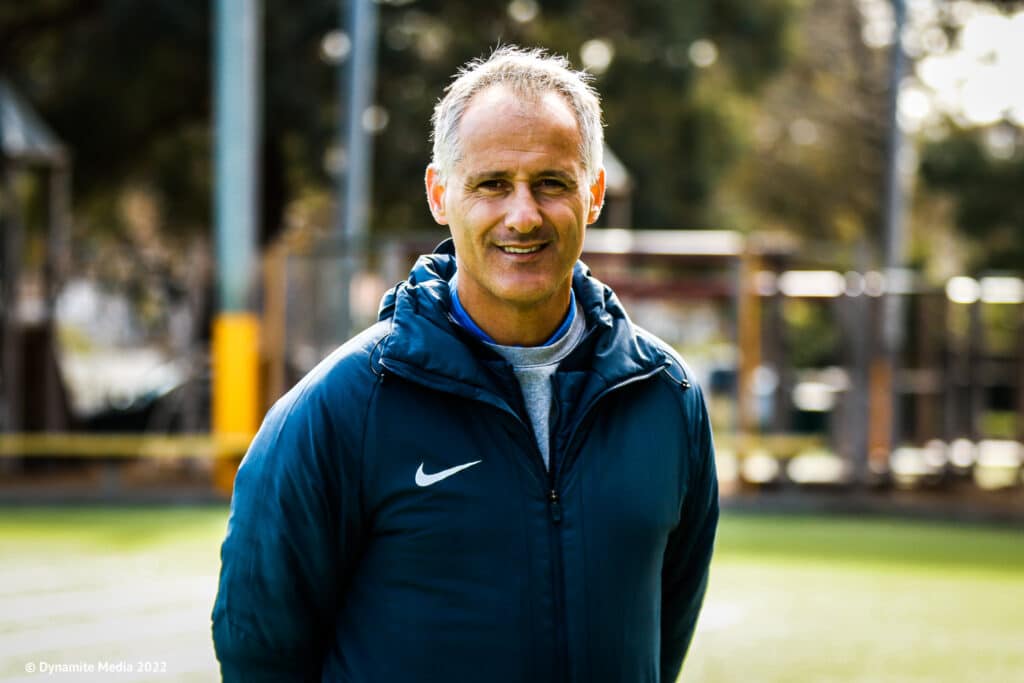
South Melbourne icon Con Boutsianis is steadfast in his view that issues in Australian football’s much-debated talent pathways are rooted in a lack of specialised, skill-specific training, and that higher game loads will not act as the panacea some believe it could be.
As the gears slowly grind towards the development of a National Second Division, and the rebranded A-League Youth (formerly Y-League) competition prepares for its return post-Covid-19, there is a general sentiment that the improvement of the game in Australia depends on the procurement of more football and added opportunities.
This has been a focus of the Australian Professional Leagues ahead of the new A-League Women’s campaign, who in June announced that within two years the competition will run as a 22-round home and away season that offers the global standard of 1,980 match minutes (before finals) per season.
The increase has been welcomed by all and sundry given the relatively low base of the fourteen match season from which it’s risen. But in the men’s game, Boutsianis is wary that more time on the pitch would cause further neglect to skill-specific training. Put simply, he feels the game wants to run before it can walk; or as he puts it, writing literature without the ability to spell.
“I use the alphabet as an example: when you know the alphabet, spelling words becomes easier. We don’t have a curriculum or syllabus that would suggest there is an alphabet in football, because if there was, every single club and academy in the world would teach players how to kick properly with both feet,” Boutsianis told Soccerscene.
“That doesn’t happen, so we know the system is discordant in some way. It’s important we understand what the basics are and how we improve them. The philosophy is very simple: learn the basics well, be able to kick with both feet, run with the ball well, be a good athlete, eat well, and nail all the things that are required to be a top line athlete.”
Without these fundamental structures in place, or without a unified idea across the board of what these fundamentals are, Boutsianis is of the belief that those holes will become exposed on the pitch, and that the pitch is not the environment to improve.
“Everyone’s talking about game load. I use Graham Arnold as an example, his solution to development is playing more games. Yes, you get some experience, but there are other fundamental things that need to be improved on,” he said.
“Whether it’s fitness, mechanics, goalscoring, the technical aspect of kicking the ball on both feet; if those things aren’t being addressed, and then you say ‘we need to play more games’, all it’s showing me is what you can’t currently do. The nation is not going to become better by playing more games.”
Boutsianis speaks about Australian football at breakneck pace, with his undeniable passion tinged with evident frustration at the direction it’s taken. He frequently diverts the conversation between sports – be it basketball, table tennis or golf – arguing their secrets to success are transferable, but are being wasted.
“Ray Allen was the three-point shooting specialist in the NBA; he’d taken a year off his contract to improve his shooting, especially from the three-point line. He said ‘I don’t have time to improve while playing, I need the time to improve and I’ll come back next year.’”
“From there, he went on to be the all-time shooting champion in the NBA. Someone who’s superseded him now is Steph Curry, he’s taken it to another level. He can shoot at the three-point line, and go one, two, three metres back from there.
“In my experience, the data on football shows most goals are scored close to goal. That’s true, but they’re only analysing what happens, not how they can make it better. Of course if you’re closer to goal it’s easier to score, and if you’re 20-30 metres away it’s harder, but you should be able to do both.
“A fine example of that is Ronald Koeman, who scored 256 goals from his sweeper centre-back position. Because he was able to strike the ball the way he should, he scored. Everyone should be able to hit the ball fluently on both feet, but we get coached in a way that says ‘you’re not allowed to shoot as a defender, you’re only allowed to do this or that.’”
Boutsianis argues that with time away from match play comes the freedom to pull apart and remodel individual skills, with a focus on biomechanical movements in the body central to his Football First coaching business.
His methods helped US Women’s legend Carli Lloyd reconstruct her shooting technique mid-way through a career that finished as a two-time World Cup winner (nine goals) and two-time Olympic gold medallist (eight).
“I haven’t spoken to her for a while, but I know she’s finished up and is running her own academy. She’s a fine example, she’s the all-time leading goalscorer at the Olympics, I just taught her to refine her technique to score goals and make sure she used both sides of her body.
“It’s down to the biomechanics, the mechanical action we use to perform these skills. Table tennis has certain movements, swimming has certain movements. When you go to kick a ball, our players are making enormous errors mechanically, so we have to identify how the muscles work in a certain way and start teaching kids how to perform those exercises.
“The probability of one team winning against another is based around skill sets. If your skills are higher than the others, and you have wider skillsets that you can use faster and for longer, your probability of winning is higher.”
Discussion around Australian youth development rarely lasts long before the inevitable yearning for the halcyon days of the AIS system begins. Having trained in the system as part of the 1992 Barcelona Olympics squad, Boutsianis credits its quality, but argues its success was not solely dependent on the concentration of talent under one roof.
“I trained there, great establishment, but you’ve got to realise most of the players that got picked to go were already pretty good. If you go round to every individual that went there, Paul Trimboli, Mark Viduka, Josip Šimunić… they all have one thing in common. They practised on their own, for many hours a day,” he said.
“When you put them all in an environment like the AIS – and Ron Smith knows his stuff – of course things start to happen, but that for me is not the solitary reason they became that good. They were already busting their arses on their own. When Viduka was there he was hitting the ball against the wall, everyone told him to shut up. And he would not stop.”
The Socceroos head to their fifth consecutive World Cup this November with a playing group widely considered of lesser ability than four years ago, and certainly below that of 2006-2010. If Graham Arnold’s side perform admirably against France, Tunisia and Denmark but fail to win a game, as was the case in Russia under Bert van Marwijk, Boutsianis will be the last to pat them on the back for effort.
“The great Ferenc Puskás was my coach at South Melbourne. He told me something very important when I was eighteen: ‘if you don’t shoot, you can’t score.’ Now, if you can’t putt, you can’t win golf tournaments. Tiger Woods is a classic for it. He’ll say ‘I didn’t hold my putts.’”
“He doesn’t say ‘I deserved to win, I had plenty of chances’, like we hear coaches say. Why didn’t you take your chances? It’s all about execution at the highest level, and if you can’t execute, you can’t win.
“So why is it that we spend such little time on finishing? I know golfers who spend hours a day practising their putting. I know table tennis players that are ten years old who do four hours. We do ninety minutes of training a day at A-League level and expect to play at the highest level, and produce players to win the World Cup? Forget about it.”