Jake Stringer isn’t a football analyst, a broadcaster or a football administrator.
Yet this week, he articulated a frustration many Australian football fans have felt for decades.
Following Australia’s opening match at the FIFA World Cup, the former AFL star labelled it a “disgrace” that AFL fixtures were scheduled head-to-head with the Socceroos, questioning why Australian sport would compete with one of the country’s most important sporting events rather than embrace it.
Whether you agree with Stringer or not, his comments touch on a much larger issue.
For all the discussion about football’s growth in Australia, the game still struggles to receive the national recognition afforded to comparable moments in other sports.
The Socceroos are not simply another national team.
They are Australia’s most globally relevant sporting side.
The argument that football remains a niche sport in Australia becomes increasingly difficult to sustain when the Socceroos take the field.
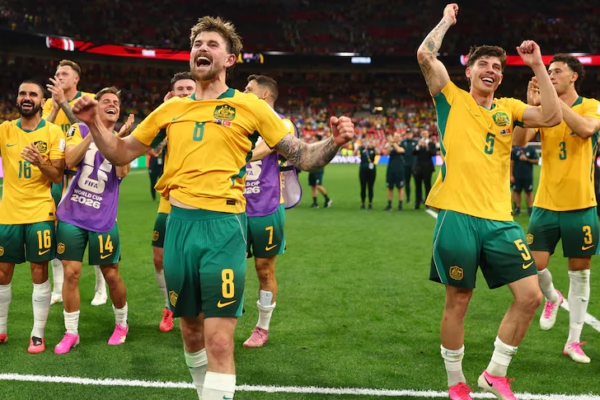
Their opening World Cup victory over Türkiye attracted a total television audience of 4.78 million Australians, with an average audience exceeding three million across SBS and SBS On Demand. SBS confirmed it was the third most-watched free-to-air event of 2026, while World Cup coverage had already reached more than eight million Australians during the tournament.
These are not football numbers.
They are national event numbers.
The Socceroos’ 2-0 victory, powered by goals from Nestory Irankunda and Connor Metcalfe, generated nationwide interest that extended far beyond football’s traditional supporter base. It was one of those increasingly rare sporting occasions capable of capturing the attention of millions of Australians simultaneously.
When an event is attracting audiences measured in the millions and commanding national attention, it ceases to be simply a football fixture. It becomes a moment of national significance.
Now the question is why Australian sport still struggles to treat one of its most globally relevant teams as a national asset rather than a competitor.
The argument from competing codes is usually straightforward: schedules are set years in advance, broadcasters have obligations, and domestic competitions cannot simply stop every time the Socceroos play.
That is true.
But there is a significant difference between maintaining a schedule and actively competing against a national moment.
Other sporting nations understand this distinction.
When major national teams compete on the world’s biggest stage, rival sports often find ways to accommodate, promote or at the very least avoid directly undermining the occasion. Not because they are required to, but because there is an understanding that national representation transcends code wars.
In the United States, the NBA adjusted its 2026 Finals schedule to avoid a direct clash with the USMNT’s opening FIFA World Cup match against Paraguay. It was not a charitable act towards football, but a recognition that a home World Cup creates a national sporting moment too significant to ignore.
That is the point Australia still struggles to grasp.
When the Socceroos play on the world stage, it should not be treated as just another football broadcast competing for space. It should be viewed as a national event.
One that rival codes can acknowledge without diminishing themselves.
Missed opportunities
The irony of the current approach is that everyone loses.
Football loses potential viewers and momentum.
Competing codes lose the opportunity to align themselves with a rare moment of national unity.
Most importantly, Australian sport misses the chance to present itself as a collective ecosystem rather than a collection of competing tribes.
This is particularly significant as Australia prepares for one of the most important decades in its sporting history.
Australia’s football rise
The Socceroos have now qualified for six consecutive FIFA World Cups and continue to build on the momentum generated by their remarkable run in Qatar. Under Tony Popovic, expectations are growing that Australia can once again challenge on the world stage.
At the same time, football participation continues to rise nationally, women’s football is experiencing unprecedented growth, and Australia is positioning itself as a major player in the global game.
Yet moments that should be celebrated nationally still feel like they require justification.
Perhaps that is why Stringer’s comments resonated.
They did not come from a football insider defending his own code.
They came from someone outside the game looking in and questioning why Australia would choose competition over collaboration when the Socceroos are representing the nation.
The real conversation is not whether one AFL round should move or whether broadcasters should alter their programming.
The question is much bigger.
If we genuinely believe football has a place at the centre of Australia’s sporting landscape, then our biggest football moments should be treated as national sporting occasions—not just football occasions.
Until that happens, Australian football will continue fighting a battle that most football nations settled long ago.