

Record-breaking AFCON tournament indicates a bright future

Africa Cup of Nations (AFCON) has been a roaring success that has symbolised the bright future of the world game in Africa. Record number of goals, booming social media channels and incredible upsets set up a future-defining campaign for all African football enthusiasts.

In a press conference before the final of the competition, Patrick Motsepe, president of the Confederation of African Football, claimed nearly 2 billion people watched the Africa Cup of Nations 2023 over the past month. This indicates an over 300% growth from AFCON 2021 in Cameroon which reached around 600 million viewers across 160 different nations.

This incredible reach was made possible due to many significant factors, most being extremely positive and setting a tremendous foundation due to the continent’s steep rise in football popularity across the last few years.

Record prize money and revenue earned

Before the tournament started, the Confederation of African Football (CAF) announced a 40% increase in the prize money for winning Afcon. The winning national team, hosts Ivory Coast, took home AUD$10.7 million while runners-up Nigeria took AUD$6.1 million, third place South Africa took AUD$3.8 million and the fourth placed D.R Congo team took home AUD$1.9 million.

AFCON this campaign had a record 17 commercial partners, and the competition is estimated to also smash the previous revenue record of AUD$93.4 million. CAF is estimated to be earning around AUD$114.6 million in sponsorship revenue from this year’s AFCON according to London-based market research firm GlobalData.

Global viewership and increased media coverage

Matches were shown in about 180 countries through deals with partner broadcasters like Sky, Canal+, beIN Sport, BBC, and MultiChoice, as well as 45 Free To Air broadcasters.

Australians were afforded the opportunity to watch every AFCON 2024 game live and in HD thanks to beIN Sports.

Media accreditation at the event was more than doubled from the last AFCON, with over 6,000 journalists applying for accreditation from all over the world. The increased coverage on social media platforms played a huge role in its international popularity.

Star attractions

There is no denying the enormous role played by star players who featured in this stacked AFCON tournament which is also proving that Africa as a continent is turning over elite talent like never before.

Huge international names like Victor Osimhen, Achraf Hakimi, Mohamed Salah and Mohammed Kudus are just four names out of many that most football fans would consider quite entertaining to watch. This erray of talent makes any football fan excited to tune into matches, even as a complete neutral.

World class facilities

Côte d’Ivoire really stepped up their game in preparation for this tournament, with planning years in advance to host a world class event.

AUD$1.53 billion was estimated to have been spent on renovating roads, stadiums, hospitals and other infrastructure in preparation for the tournament. Beyond renovating existing stadiums, the country built three new venues, two with a 20,000 capacity and the new Alassane Ouattara stadium, named after the president of the country, which seats over 60,000 spectators and was used for the Final of the tournament.

A fairytale ending for the hosts Côte d’Ivoire capped off a groundbreaking tournament that is proven to the world just how serious Africa is about its footballing development. With a host of exciting youngsters and more funding going directly into grassroots and professional football, there is only one trajectory that we can expect for the continent, and that is straight up.

Previous ArticleNext Article

Google expands football footprint with AI partnerships at five European giants

Google has announced long-term partnerships with five of Europe’s biggest football clubs.

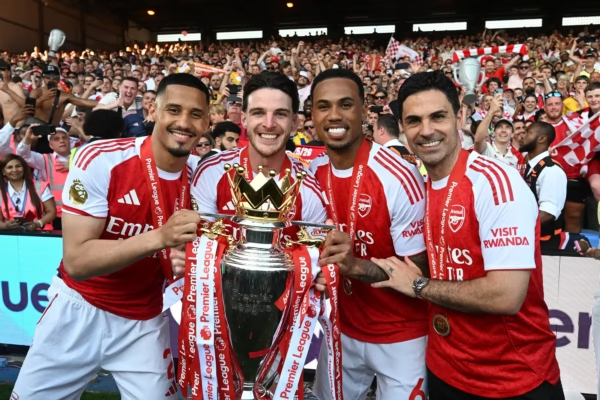
Expanding the role of artificial intelligence in fan engagement through collaborations with Arsenal, Barcelona, Bayern Munich, Liverpool and PSG.

Google Gemini will become each club’s official consumer AI Partner, while Google Pixel will serve as the official smartphone partner.

The partnerships are designed to deliver AI-powered match insights, personalised fan experiences and exclusive behind-the-scenes content across the clubs’ digital platforms.

Supporters will be able to use Gemini to access tactical insights, historical statistics and match analysis while Pixel devices will be used by club media teams to capture content through the company’s “Shot on Pixel” initiative.

A key component of the partnership is the commitment to increasing the visibility of women’s football.

Google confirmed the agreements cover both men’s and women’s teams, with AI tools and Pixel technology set to help produce content and expand the reach of the women’s game through club media channels.

The announcement continues Google’s growing investment in football technology.

Google initially had individual agreements with several of the clubs, including PSG and Liverpool.

By bringing the partnerships together under the Gemini and Pixel brands, Google is positioning artificial intelligence as a core part of the modern football fan experience rather than simply a commercial sponsorship.

For football clubs, the collaboration highlights a broader industry trend towards technology partnerships that extend beyond branding.

AI is increasingly being used to produce personalised content, deliver deeper match analysis and strengthen engagement with large global audiences.

Clubs continue to invest in these growing digital platforms alongside their traditional commercial portfolios.

The partnerships also reinforce the growing intersection between football and technology, with leading clubs increasingly working alongside global technology companies to enhance supporter experiences and explore new ways of connecting with fans on matchday and beyond.


Football Has the Audience. Does It Have the Commercial Strategy?

Soccerscene has launched Survey 4: Commercial Confidence in Football, calling on clubs, sponsors, governing bodies, commercial leaders and football industry professionals to assess whether the game is making the most of its enormous commercial potential.

Football has the audience, participation base and community reach to be one of Australia’s most powerful commercial platforms. But does the industry have the commercial strategy, professionalism and infrastructure required to turn that potential into sustainable growth?

That is the question at the centre of Soccerscene’s latest industry research.

The survey examines how attractive grassroots football is to potential commercial partners, what industry professionals believe is limiting football’s commercial potential, and whether clubs are presenting themselves professionally enough to sponsors.

It also explores what sponsors value most when engaging with football – from community reach and participation scale to brand alignment, values and purpose – as well as whether improved facilities could directly contribute to stronger sponsorship outcomes.

Is football fully capitalising on its commercial opportunity?

Football continues to provide brands with access to highly engaged communities across grassroots, community and elite environments. Yet the commercial landscape remains fragmented, with clubs operating with vastly different levels of resources, capability, governance, media infrastructure and commercial expertise.

Soccerscene’s survey is designed to capture the industry’s perspective on where the opportunities exist – and where football may be leaving commercial value on the table.

The research will look specifically at four key areas:

  • Commercial attractiveness – How attractive is grassroots football as a commercial partnership?
  • Commercial barriers – What is holding football back from reaching its full commercial potential?
  • Club professionalism – Are clubs presenting themselves effectively and professionally to sponsors?
  • Sponsor value – What are sponsors really looking for when they invest in football?

The survey also asks whether better facilities would have a direct impact on sponsorship outcomes, highlighting the potential relationship between infrastructure, commercial presentation and investment.

Have your say

Soccerscene is encouraging football clubs, sponsors, commercial professionals, governing bodies, administrators, media professionals and industry stakeholders to participate.

The findings will contribute to Soccerscene’s ongoing program of industry research, designed to provide a clearer picture of the challenges and opportunities facing football and the organisations operating within it.

Take the Survey: Commercial Confidence in Football

Complete the Commercial Confidence in Football Survey here

The survey will close on 30 August 2026 at midnight, with responses received before the deadline included in the final analysis.

Football has the audience. The question is whether it has the commercial strategy to match.

Most Popular Topics

Editor Picks

Send this to a friend