
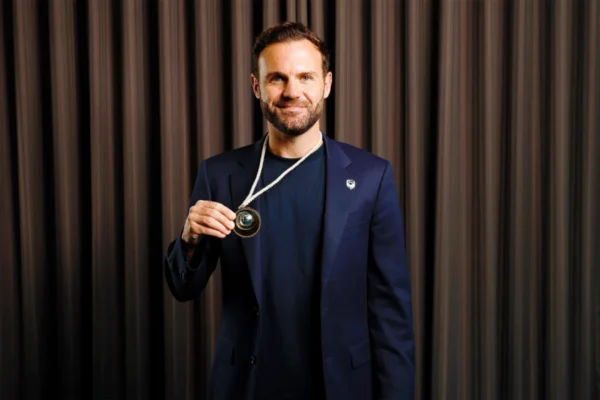



John Paraskevas is the founder of Faraday West – a leading specialised lender for the self-employed.
As Australia faces uncertainly around interest rates, coupled with the cost-of-living crisis presenting its own challenges, approaching a bank for financial help can be a daunting experience.
Those with irregular income have often found themselves knocked back by a bank in times of need, where it appears the self-employed cannot be trusted.
However, Paraskevas’ business Faraday West has changed the game – supporting the self-employed and backing them in for 25 years.
Speaking with Soccerscene in a wide-ranging chat, Paraskevas discusses how his business began, why it’s a success, his approach to changing the lives of people on a daily basis and his affinity with the round ball game.
First of all, John, could you tell us a little bit more about the origins of Faraday West?
John Paraskevas: I finished up with university in the late 80’s, I did a business course in accountancy, so I was always going to be business focused.
I chose lending, it just resonated well with me. Meeting people, solving their problems and then watching their reactions as they start off nervous trying to borrow money, but once you approve the loan, the elation on their faces, knowing now they can focus on achieving their goals; it’s fantastic.
Lending was always a big part of me and I just found it really natural – with this business it is always about relationships.
That’s what I found over the last 25 years since starting Faraday West in 1999, it’s about relationships and listening to people. A lot of people try and sell something, but for me it was always about the relationship and building rapport with a person.
I’ve got clients that I dealt with 25 years ago that I’m still dealing with now, it’s extraordinary.
As an organisation we address the question of who looks after the self-employed people. They’ve struggled when they went to the bank and I remember personally my father facing these challenges.
He is still self-employed and it was always hard borrowing money from the bank.
For me, that was where my passion kicked in. My thinking was it’d be great to create lending products to support those who are self-employed, who the bank doesn’t really care about or they’re just too hard, whatever the case is.
That was the emergence of the self-employed space and from there came what we call low-doc programs and loans for the self-employed. 25 years later, these low-doc programs now are stronger than ever.
I realised very early that a lot of friends who were self-employed all struggled when it came to borrowing as well. With my dad being a builder, buying a block of land and building a couple of units should be simple, but unfortunately it was always more complicated with the bank.

What is it like working alongside clients day-to-day?
John Paraskevas: We still have clients from decades ago, their kids now call us who are self-employed – so it’s incredible again to see the longevity.
It’s been a fantastic journey with a diverse range of clients.
From lawyers, to tradies, to engineers, to anyone in that self-employed space, we can support any industry. When people hear the term self-employed, they automatically assume one person; but self-employed could be the individual, a small team of 1-3 people or even 10-30 people. They’re all still self-employed, so it’s very much a medium enterprise.
There’s just been so many memorable moments, everyone’s story is a success.
It’s not about the size of the loan, it’s about the journey and helping that individual or group of people. There’s been many situations where you’ve got someone starting out in business, they’ve been working for a year, wanting to buy their first home and multiple banks have been saying no to them for a year.
Eventually, they come see us, you meet them and then if we tell them within an hour that it’s a done deal, they just can’t believe it. I love seeing that smile on their face, being surprised by the outcome.
That is the buzz for me where we approve loans, assist people and work through their financial duties.
Talk to me a little bit about your other love John, Soccer, what’s your background in the game?
John Paraskevas: I played soccer in my younger years for Thornbury United and then moved to Northcote City at a reserve state league level. We’re talking in the mid-1980’s, I loved playing soccer. I had a break for a few years and then in my late 30’s started playing again till about 50, so the sport has always been in the family’s blood and we’ve loved it.
I’ve got two daughters at NPL level, one is playing seniors at Boroondara Eagles and doing quite well with her development, while the other one is 17 playing at Bulleen and absolutely loves it – been at that club for two years now.
What is your view on the local game’s main strength?
John Paraskevas: The participation levels at a junior level are fantastic.
For the girls and also the boys, participation in the game promotes a healthy lifestyle and these individuals can also make changes in the way they eat, train, socialise, it improves their mental wellbeing – there are so many benefits that are a result of engaging in the game of soccer.
What are the main reasons you’ve decided to partner with Soccerscene? What are the similarities you see across both businesses?
John Paraskevas: We are in very similar paths. Firstly, there’s a lot of risk in trying to start up a business. People always see the end product, but they don’t see the sleepless nights, the money you pour into something, the time and effort – a lot of the rewards, if they do come at all, they come later (sometimes 5-10 years down the track).
Looking at Soccerscene, it reminds me of the early days of Faraday West – you were told by others you couldn’t do something, this is not going to work, but ultimately it comes down to the passion you have in what you do.
With that passion, the product or business continues to develop and get bigger and bigger every year. You’re out there every day speaking with people and getting the message out there, but the most important thing is you have to love what you do and across both businesses you can see we share common values.

On those values John, why should someone use Faraday West?
John Paraskevas: What generally happens is most borrowers or someone seeking a loan would simply go to the bank, generally the bank where you’ve got your savings account and ask for a loan – that’s the normal natural process.
You see these banks advertising here and there so instinctively you’re going to go there, which is 80% of people because of PAYG (they work for someone). However, the self-employed unfortunately don’t get that fair go because their situation is a bit more complex – their income could vary from week, to month, to year.
All those variables make it very difficult for the bank to be able to come back and say we can help you. They’ll say you’re great, but come back in three months.
From one bank to another, it becomes the same story; ‘I’m going to struggle to borrow money from the bank to buy my dream home’. Suddenly, they hear about Faraday West, loans for the self-employed and it’s almost too good to be true.
The fact that we can assess the position purely just by talking within an hour or two and give them that positive news that we can help, is just gold.
A lot of people just don’t believe it, because they’ve never experienced it before. Their experience has always been this long journey through the bank.
The fact that we can give them an answer straight away is what’s important. Not only that, people have this perception that low-doc loans or loans for the self-employed are expensive, but they’re not. They’re very similar to home loan bank rates.
Once people understand that it’s not too difficult to qualify for a loan, they warm up to it. Once they do the transaction and it settles, you’ve got them as clients for life – because they believe you’ve delivered something for them, that they’ve been trying to do for years.
What could a self-employed person expect in a consultation with Faraday West?
John Paraskevas: I always say to people tell me your story and we will listen.
Every self-employed person can be supported. It could be that person isn’t quite ready yet to save for a deposit. Generally, as long as you’re self-employed, you’ve got an ABN number and you’ve been operating for more than 12 months, there are solutions to help you in that journey.
It’s also an education process, learning throughout the journey.
We have a motto here: keep it simple. How do you do things in the easiest, quickest way? That’s what people want.
Once they discover it, it’s like it’s a pandora’s box. It really opens up a lot of opportunities to them, such as buying another property for example – because at the end of the day they should be focusing on their business and their future.