



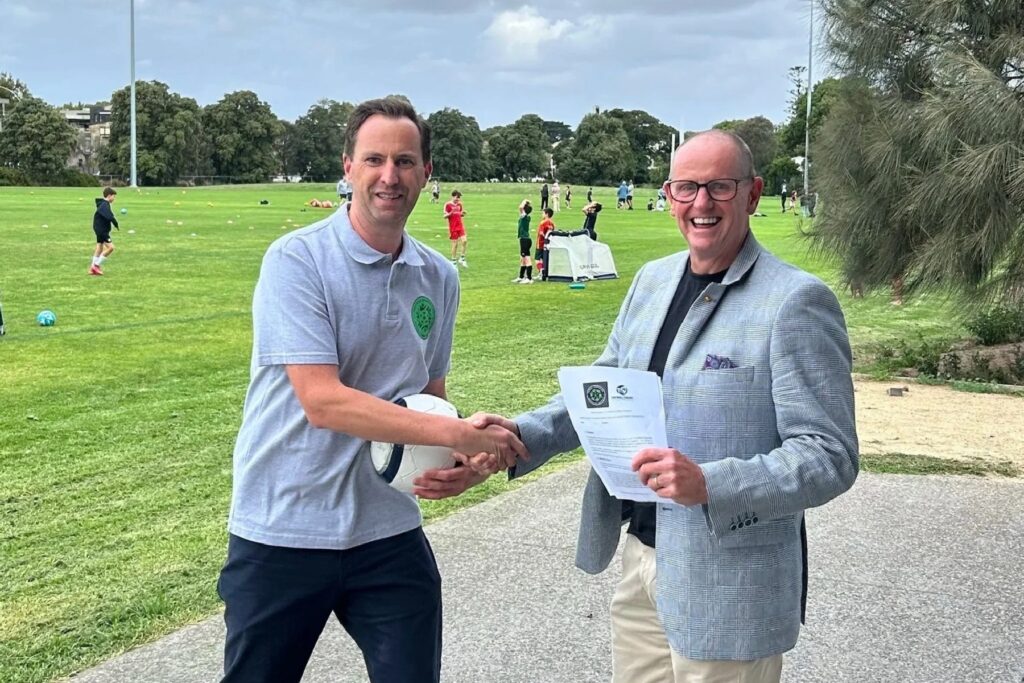
Australian coaches and supporters unite in new partnership

Football Coaches Australia (FCA) and The Football Supporters Association Australia (FSAA) announced the beginning of a new agreement which will see two essential parts of the game brought together.

Terraces and touchlines

The partnership marks an exciting progression for both organisations, and reflects the ambitions of many in Australia’s football industry to continue forming alliances which can help the game grow.

“We’re delighted to announce a formalised partnership with The Football Supporters Association Australia (FSAA) aimed at uniting two of the most vital stakeholder groups in the game: the supporters on the terraces and the coaches on the touchlines,” said FCA via official social media announcement on Wednesday.

“It is desigend to ensure open communication, mutual understanding, and active collaboration through the sharing of ideas and finding solutions to universal issues across the Australian football landscape.”

Ultimately, growth only becomes possible when all stakeholders in the industry unite in vision, commitment and understanding of what the next steps must be. Fortunately, through FCA and FSAA’s shared dedication, several key elements will be addressed, including:

  • Advocacy and voice
  • Engagement and dialogue
  • Education and cultural development
  • Research and projects


United through values and vision

Supporters are the beating heart of the world’s game – whether at grassroots level or on the international stage. Thus, FSAA’s work is a pivotal part of Australia’s football landscape.

“We want all organisations to understand the importance and needs of football supporters,” outlined FSAA Chair, Patrick Clancy, via media release.

“Football coaches around our nation clearly recognise the vital support of fans and the value they can provide to players and success of clubs. FSAA’s new partnership will be one of mutual benefit, helping to grow both organisations.”

Furthermore, the partnership highlights how two organisations – representing two distinct groups of people within the game – can still share common values and ambitions to ensure success.

“This partnership reflects our belief that meaningful progress happens when every part of the football ecosystem works together,” said FCA President, Gary Cole, via media release.

“By joining forces with FSAA, we’re strengthening the foundations of our game and ensuring that respect, connection and community remain at the heart of Australian football.”

Final thoughts

At a time when much of the Australian football landscape is divided and criticsed, partnerships such as this become more valuable than ever. Now is the time for building bridges in the industry, not burning them.

Coaches and supporters, while divided by advertising boards and match stewards, will now be more united than ever by the combined efforts of FCA and the FSAA.

Previous ArticleNext Article

Project ACL: The initiative leading the way on injury research

Launched in 2024, the research project recently welcomed two US-based organisations: the National Women’s Soccer League Players Association (NWSLPA) and National Women’s Soccer League (NWSL).


About Project ACL

Led by FIFPRO, PFA England, Nike and Leeds Beckett University, Project ACL aims to research ACL injuries and understand more about multifactorial risk factors.

After piloting in England’s Women’s Super League (WSL), Project ACL will expand to the NWSL in the US, reflecting the global importance of the project’s research and outcome.

“We are incredibly excited to bring the NWSLPA and NWSL to Project ACL,” said Director of Women’s Football at FIFPRO, Dr. Alex Culvin, via official press release.

“Overall, we believe that player-centricity and collaboration with key stakeholders are central to establishing meaningful change in the soccer ecosystem and that players, competition organisers and stakeholdersaround the world will benefit from Project ACL’s outputs and outcomes.”

Interviews with over 30 players and team surveys across all 12 WSL clubs provided the project’s research team with valuable information about current prevention strategies and available resources.

Furthermore, the project tracks player workload and busy schedule periods during the season through the FIFPRO Player Workload Monitoring tool, therefore gaining insights into the link between scheduling and injury risks.


Looking to the data

Project ACL’s partnerships with the WSL – and now the NWSL – are immensely valuable for the future of player welfare in women’s football.

Although ACL injuries affect both male and female athletes, they are twice as likely to occur in women than men. However, according to the NWSL, as little as 8% of sports science research focuses on female athletes.

In Australia, several CommBank Matildas suffered ACL injuries in recent years: Sam Kerr was sidelined from January 2024 to September 2025, Ellie Carpenter for 8 months after suffering the injury while playing for Olympique Lyonnais, and Holly McNamara came back from three ACL’s aged 15, 18 and 20.

And this is just the tip of the iceberg. The 2025/26 ALW season saw several ACL incidents, including four in just two weeks.


Research, prevent, protect

Injury prevention and research are vital to sport – whether professional or amateur.

But when the numbers are so shocking – and incidents are so common – governing bodies must remember that player welfare comes above all else. Research can inform prevention strategies. Prevention means players can enjoy the game they love.

The work of Project ACL, continuing until 2027, will hopefully protect countless players across women’s football from suffering long-term or recurring injuries.

How Husqvarna Is Helping Stadiums Cut Costs Without Cutting Quality

At a time when operational costs are rising across global sport, stadiums and football clubs are being forced to rethink one of their most overlooked expenses: turf maintenance.

From diesel consumption to labour hours, maintaining elite playing surfaces has traditionally been both resource-intensive and environmentally taxing. But new data emerging from venues like CBUS Super Stadium suggests a smarter, more sustainable model is already taking hold.

Leading that shift is Husqvarna, whose autonomous turf technology is quietly reshaping how professional venues manage their playing surfaces. Their product delivers measurable cost savings without compromising quality.

Cutting fuel consumption costs

At CBUS Super Stadium, the introduction of Husqvarna’s CEORA™ robotic mowing system has reduced diesel usage by approximately 20–30 litres per week. Over the course of a season, those savings compound into a significant reduction in both fuel spend and carbon emissions. This is particularly efficient for stadiums hosting regular fixtures and large-scale events.

CBUS Super Stadium General Manager Kristian Blundell said the robotic mower was a game-changer for the venue:

“This technology is not replacing staff but rather giving our grounds team the ability to do what they do best by helping to improve turf management processes, better manage fatigue and decrease our environmental footprint”

But the impact goes beyond fuel.


Time efficiency

By automating routine mowing, Husqvarna’s technology enables grounds teams to focus on higher-value maintenance tasks, from pitch recovery to detailed surface management. The result is not only greater operational efficiency but also improved turf consistency, which is an increasingly critical factor in elite football performance.

The benefits are being mirrored beyond stadium environments. At Oatlands Golf Club, Husqvarna’s autonomous mowing has delivered savings of up to 60 litres of fuel per week while freeing up staff for precision work. Quiet, round-the-clock operation also ensures surfaces are maintained without disrupting play—an advantage that translates directly to multi-use stadium settings.

Image Credit: Husqvarna

Importantly, Husqvarna’s lightweight robotic systems reduce the wear and tear typically caused by traditional heavy machinery. This not only protects the integrity of the playing surface but also reduces the need for costly repairs over time.

Football clubs navigating tight budgets at grassroots and semi-professional levels could benefit from such cost savings.

With rising energy prices, increasing sustainability expectations, and limited staffing resources, the ability to cut costs while improving performance is no longer optional. Solutions like Husqvarna’s CEORA™ are positioning clubs to operate more efficiently today, while preparing for a more environmentally accountable future.

As the sports industry continues to evolve, one thing is becoming clear: the next competitive edge may not just come from what happens on the pitch—but how it’s maintained.

Most Popular Topics

Editor Picks

Send this to a friend