



How Husqvarna Is Helping Stadiums Cut Costs Without Cutting Quality

At a time when operational costs are rising across global sport, stadiums and football clubs are being forced to rethink one of their most overlooked expenses: turf maintenance.

From diesel consumption to labour hours, maintaining elite playing surfaces has traditionally been both resource-intensive and environmentally taxing. But new data emerging from venues like CBUS Super Stadium suggests a smarter, more sustainable model is already taking hold.

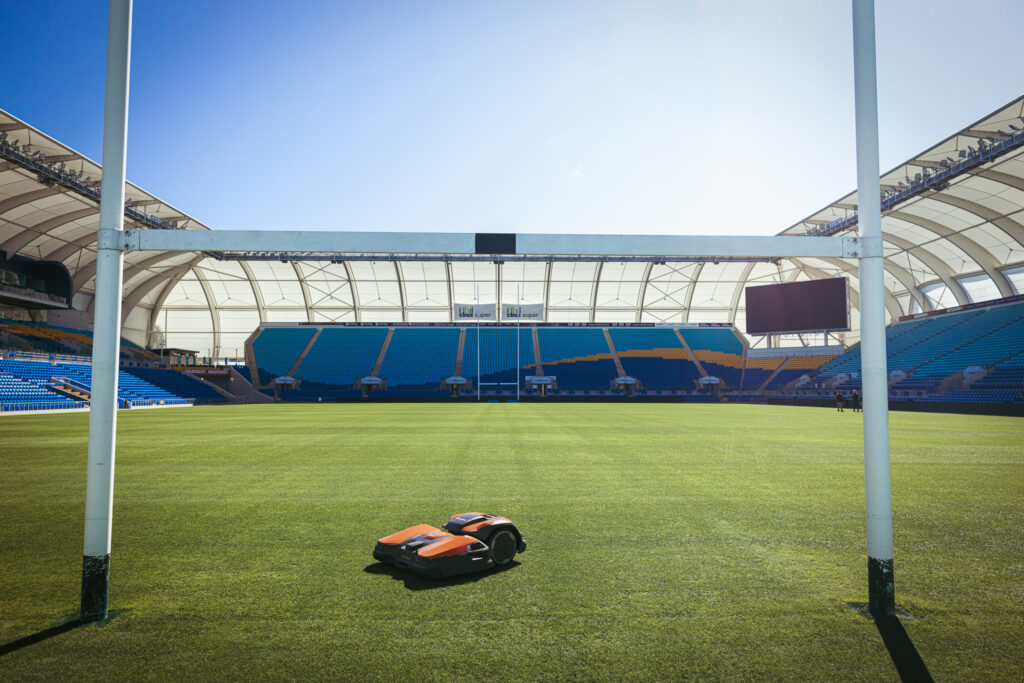
Leading that shift is Husqvarna, whose autonomous turf technology is quietly reshaping how professional venues manage their playing surfaces. Their product delivers measurable cost savings without compromising quality.

Cutting fuel consumption costs

At CBUS Super Stadium, the introduction of Husqvarna’s CEORA™ robotic mowing system has reduced diesel usage by approximately 20–30 litres per week. Over the course of a season, those savings compound into a significant reduction in both fuel spend and carbon emissions. This is particularly efficient for stadiums hosting regular fixtures and large-scale events.

CBUS Super Stadium General Manager Kristian Blundell said the robotic mower was a game-changer for the venue:

“This technology is not replacing staff but rather giving our grounds team the ability to do what they do best by helping to improve turf management processes, better manage fatigue and decrease our environmental footprint”

But the impact goes beyond fuel.


Time efficiency

By automating routine mowing, Husqvarna’s technology enables grounds teams to focus on higher-value maintenance tasks, from pitch recovery to detailed surface management. The result is not only greater operational efficiency but also improved turf consistency, which is an increasingly critical factor in elite football performance.

The benefits are being mirrored beyond stadium environments. At Oatlands Golf Club, Husqvarna’s autonomous mowing has delivered savings of up to 60 litres of fuel per week while freeing up staff for precision work. Quiet, round-the-clock operation also ensures surfaces are maintained without disrupting play—an advantage that translates directly to multi-use stadium settings.

Image Credit: Husqvarna

Importantly, Husqvarna’s lightweight robotic systems reduce the wear and tear typically caused by traditional heavy machinery. This not only protects the integrity of the playing surface but also reduces the need for costly repairs over time.

Football clubs navigating tight budgets at grassroots and semi-professional levels could benefit from such cost savings.

With rising energy prices, increasing sustainability expectations, and limited staffing resources, the ability to cut costs while improving performance is no longer optional. Solutions like Husqvarna’s CEORA™ are positioning clubs to operate more efficiently today, while preparing for a more environmentally accountable future.

As the sports industry continues to evolve, one thing is becoming clear: the next competitive edge may not just come from what happens on the pitch—but how it’s maintained.

Previous ArticleNext Article

Heading the Game Forward: Why Brain Health Must Be Football’s Next Priority

Football Coaches Australia (FCA) workshop with Nick Gates to equip coaches with critical insights on head impacts, CTE, and player safety.

As football continues to evolve at pace, so too does the responsibility placed on coaches—not just to develop players, but to protect them.

On 4 May, Football Coaches Australia (FCA) will host a vital one-hour CPD-approved workshop led by HEADSAFE’s Nick Gates, tackling one of the most pressing issues in the modern game: brain health.

Titled “Brain Health & Decision-Making in the Modern Game,” the session will unpack the latest global research surrounding head impacts, with a particular focus on the long-term risks associated with repeated heading, including Chronic Traumatic Encephalopathy (CTE) and dementia.

But this isn’t just theory.

At its core, the workshop is designed to translate complex medical research into practical, on-the-ground coaching decisions.

What should coaches actually be looking for?

How can they better manage risk in training and matches?

And how can they make informed decisions that prioritise player welfare without compromising development?

These are the questions Gates will address—bridging the gap between science and sideline.

With increasing global scrutiny on concussion protocols and heading guidelines, sessions like this are becoming essential, not optional. The modern coach is no longer just a tactician, but a guardian of long-term player health.

This workshop provides the tools to take that responsibility seriously. Register here.

Media Mega-Mergers, Minor Leagues: Why Global Consolidation Should Be a Wake-Up Call for Australian Football

The approval of a reported $113 billion merger between Warner Bros. Discovery and Paramount Global is being framed as the creation of a “next-generation media and entertainment company.”

But beyond Hollywood headlines, the deal signals something far more consequential for sport: a global media landscape rapidly consolidating into fewer, more powerful hands.

For Australian football, particularly the A-League, this is not just background noise. It is a structural shift that could define the league’s future.


A shrinking marketplace, a growing imbalance

The merger brings together an enormous portfolio of assets, such as film studios, broadcast networks and streaming platforms, under a single corporate umbrella. It reflects a broader industry trend: scale is no longer an advantage in media, it is a necessity.

Yet with that scale comes concentration. Fewer buyers now control more platforms, more audiences, and more capital. Critics of the deal have warned that such consolidation risks reducing competition and narrowing the range of voices in global media.

For sport, the implications are immediate.

Broadcast rights are no longer negotiated in a diverse, competitive market. Instead, leagues are increasingly competing for space within vertically integrated media ecosystems. This is because decisions are driven not just by audience demand, but by global strategy, bundled content offerings and long-term platform growth.


Why the A-League is particularly exposed

This shift lands unevenly across the sporting landscape.

Leagues like the Australian Football League (AFL) and National Rugby League (NRL) remain dominant domestic products, commanding billion-dollar broadcast deals and consistent mass audiences.

The A-League, by contrast, operates from a more fragile commercial base.

Despite its global game status, the league continues to face:

  • Inconsistent crowd figures
  • Fluctuating visibility
  • A comparatively modest broadcast deal with Paramount

In a fragmented media environment, this is manageable. In a consolidated one, it becomes a vulnerability.

Because as the number of broadcasters shrinks, so too does the margin for leagues that are not seen as “must-have” content.


From open market to closed ecosystem

The critical shift is not just economic, it is also structural.

In the past, leagues could leverage competition between broadcasters to drive rights value. Now, with fewer but larger players, the balance of power tilts toward the platforms.

Content is no longer simply acquired, it is curated.

And in that environment, only properties that deliver one (or more) of the following will thrive:

  • Guaranteed audiences
  • Global scalability
  • Year-round engagement
  • Strategic value within a broader content ecosystem

This is where the A-League faces both its greatest challenge—and its greatest opportunity.


The overlooked strength of Australian football

While often positioned as a “developing” product domestically, football offers something no other Australian code can replicate: global alignment.

As the world’s most popular sport, football operates within an international ecosystem that extends far beyond national borders. Australia’s geographic position, bridging Asian and Western markets, adds further strategic value.

For a global media entity like Paramount, this matters.

The A-League is not just local content. It is potentially exportable, scalable and aligned with global football narratives. It also taps into younger, more digitally engaged audiences, who are increasingly driving subscription-based streaming growth.

In a media environment defined by platform expansion, that is not a weakness. It is an underutilised asset.


Why consolidation should drive MORE investment

The instinct in a consolidating market is often caution by tightening budgets, focusing on proven performers and minimising risk.

But for Australian football, that approach is self-defeating.

Because without investment:

  • Production quality stagnates
  • Storytelling weakens
  • Audience growth plateaus
  • Commercial value declines

And in a system that rewards scale and engagement, stagnation is equivalent to irrelevance.

Instead, consolidation should be seen as a trigger for strategic investment:

  • Elevating broadcast presentation
  • Strengthening club identities and narratives
  • Expanding digital and streaming integration
  • Positioning the league within the broader global football conversation

In short, making the A-League indispensable, rather than optional.


The real risk: being left behind

The emergence of media giants like a merged Warner Bros. Discovery and Paramount Global signals a future where content is filtered through fewer, more powerful gatekeepers.

In that world, leagues that fail to assert their value risk being sidelined, not because they lack potential, but because they fail to meet the evolving demands of the platforms that distribute them.

For the A-League, the danger is not collapse. It is marginalisation.

A slow drift into irrelevance while larger codes capture the attention, investment, and audiences that define modern sport.


Conclusion: a defining moment

This merger is not about Hollywood. It is about power.

Power over distribution. Power over audiences. Power over what gets seen and what does not.

For Australian football, the message is clear.

In a world of media consolidation, visibility is earned through value, not assumed through presence.

And if the A-League is to secure its place in that future, investment is no longer optional.

It is existential.

Most Popular Topics

Editor Picks

Send this to a friend