


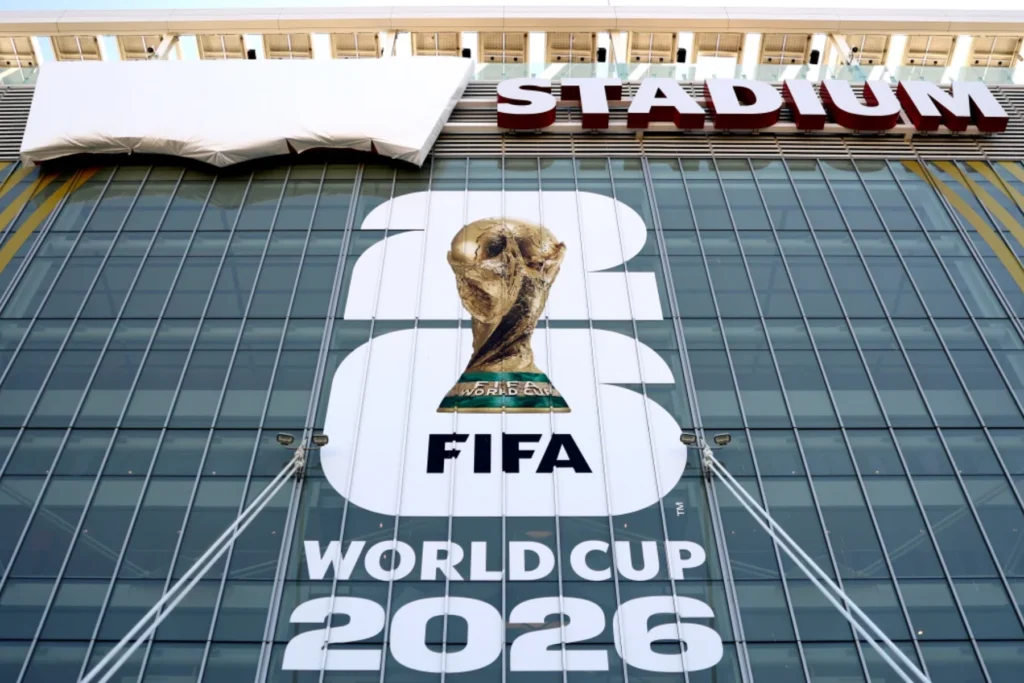
As the FIFA World Cup unfolds across stadiums in the United States, Canada and Mexico, the more interesting story for Australian marketers and investors is not happening on the official sponsor boards. It is happening on TikTok and across social media, where brands with no contractual relationship to FIFA are generating roughly double the engagement of those who paid for the privilege.
That gap matters tells a story beyond where value actually sits in the modern sports economy, and Australian businesses watching from a distance should be asking whether they are positioned to capture it.
The numbers behind the moment
Global advertising spend tied to the 2026 World Cup is projected to reach 10.5 billion US dollars, according to marketing research firm WARC Media, just shy of the 12.6 billion recorded for the 2018 tournament in Russia. That is an extraordinary amount of capital chasing attention around a single sporting event, and it reflects something Australian football stakeholders have argued for years: football is not a niche sport competing for marginal advertising dollars. It is one of the largest commercial vehicles on the planet.
Yet the most engaging brand activity during this tournament has not come from the companies writing the biggest cheques. Market intelligence firm Meltwater found that non-sponsor brand collaborations generated nearly 61 million engagements in the buildup to the tournament, compared with 33 million for official sponsors. Since the tournament began, non-sponsor brands have surpassed 57,000 social media mentions against just over 43,000 for sponsors.
Lego, which holds no official sponsorship, accounted for 82% of the most engaging non-sponsor posts across platforms. Nike, also outside the official sponsor tier, generated more than 70 million YouTube views for a campaign featuring Erling Haaland and Cristiano Ronaldo alongside Kim Kardashian and LeBron James. Its rival Adidas, an official sponsor constrained by FIFA’s brand guidelines, managed roughly 7 million views for a comparable campaign.
Why this should matter to Australian capital
The lesson here is not that sponsorship is worthless. It is that the value of football as a commercial asset is no longer confined to the official channels that have traditionally controlled access to it. A brand with creative freedom, cultural fluency and the speed to act on a real-time moment can now outperform a brand that paid tens of millions of dollars for exclusive rights.
“A big takeaway from this World Cup is that you don’t need an official sponsorship to own the cultural moment anymore,” Meltwater CEO John Box said. “The brands that will win the next tournament aren’t necessarily the ones with the biggest budgets, but instead the ones who are set up to see what’s trending in real time, the creativity to connect it back to your brand, and the speed to act before the moment passes.”
For Australia, that is a meaningful signal. The AFC Women’s Asian Cup, held on home soil earlier this year, generated record attendance and unprecedented engagement for women’s football in this country. Football Australia and the state federations have spent the months since making the case for sustained government and private investment in facilities and pathways to capitalise on that moment. What the World Cup advertising data demonstrates is that the commercial opportunity around football extends well beyond what governing bodies control. A brand does not need to be a Football Australia partner to build genuine equity in the sport’s cultural moment. It needs to understand the audience and move faster than the official sponsors can.
The cost of restriction, and the value of nerve
Some of the tournament’s most successful brand moments have come directly from the limitations FIFA imposes on non-sponsors. Levi’s, whose naming rights branding at Levi’s Stadium in Santa Clara had to be covered for tournament matches, turned the restriction into the most commented and shared post in the company’s history by leaning into the absurdity on social media. Gillette did the same at its Massachusetts stadium, designing its mandatory cover to resemble shaving foam.
“What started as a naming rights sponsorship restriction at the Levi’s Stadium became the most commented and shared post in Levi’s history,” the company’s chief marketing officer Kenneth Mitchell wrote. Mentions of the brand rose 44% after the tournament began, with engagement nearly quadrupling once the stadium covering campaign launched.
There is a lesson in that for Australian companies considering football sponsorship at any level, from the A-Leagues down to state league naming rights deals already common across Football Victoria, Football SA and Football Queensland competitions. Constraint handled with genuine creative nerve can generate more value than an unrestricted but conventional campaign. The companies thriving in this tournament are not simply spending more. They are reading the cultural moment and reacting to it with speed and irreverence that larger, more risk-averse sponsors struggle to match.
A market still undervalued
Andrew Rohm, professor of marketing at Loyola Marymount University, frames the split as a contest between “the expected and the unexpected.” Companies unconstrained by FIFA’s rules are simply having more fun, and audiences are responding to that authenticity.
That dynamic should be read by Australian investors and brand strategists as evidence of an underpriced asset. Football’s audience in Australia has grown substantially, driven by the Asian Cup, the Socceroos’ continued World Cup qualification and a women’s game generating record broadcast and attendance figures. The commercial infrastructure around the sport in this country, sponsorship rates, broadcast deals, naming rights, remains comparatively modest next to that of the AFL and NRL. The American experience suggests the ceiling for football-adjacent commercial value is far higher than current Australian sponsorship pricing reflects, particularly for brands willing to move with creativity rather than simply buying the largest available signage package.
As Jared Watson, assistant professor of marketing at NYU’s Stern School of Business, put it, audiences are responding to brands that feel adversarial to the commercialisation of the game itself, even as that commercialisation accelerates. FIFA’s introduction of mandatory in-game hydration breaks, criticised by fans as a thinly veiled advertising mechanism, has only sharpened that appetite for brands seen as standing apart from the money grab.
For Australian businesses weighing whether football deserves a larger share of marketing budgets, or whether the sport represents a genuine investment opportunity beyond marketing spend, the message from this World Cup is consistent. The capital is already flowing toward football at a scale most other sports cannot match. The only open question is which brands move quickly enough, and with enough creative conviction, to capture the value before the moment passes them by.