





Global Institute of Sport hosts Masterclass on Athlete Management and Engagement

The Global Institute of Sport (GIS) held an Industry Masterclass on Athlete Management and Engagement, featuring guest speakers Brad Lloyd and Stefani Chinn.

This is part of its broader course offering, which includes a Master’s in Sports Business and Sports Analytics through the University of Newcastle.

The Masterclass addressed four themes: the day-to-day operations of player management, the construction of authentic athlete brands, the role of agents, and the impact of data.

The Panellists

Brad Lloyd is the founder of Apogee Sports Advisory, which develops micro-credentials in sport, and previously served as General Manager of Football at Carlton Football Club and as a player agent.

Stefani Chinn is a sports marketing consultant specialising in ambassador program design and formerly served as Senior Vice President of Global Marketing and Communications at the World Surf League (WSL).

Player management: the daily operations

Lloyd outlined the complexities of player management, drawing on his experience as General Manager at Carlton, highlighting the role of “list management.”

This involves negotiating player contracts and managing the composition of the list, including age profile and positional spread, to align with the club’s broader requirements.

Player welfare also falls within this remit, with a high-performance manager tasked with ensuring athletes remain fit and available.

“It’s all about attraction and retention,” Lloyd explained.

He noted that communication with club shareholders is a constant part of the role, with “talking up and down” the organisation requiring a strong team.

“Getting people, you trust with their credentials in these roles is paramount,” Lloyd explained.

Building Authentic Brands

Chinn addressed the construction of athlete-focused marketing strategies, arguing for a shift away from organisation-centred approaches.

“What was needed to do from a fan, athlete and commercial perspective was lead with an athlete-first approach.”

For this Chinn emphasised the importance of understanding athletes beyond their on-field performance.

“Knowing the athlete first is such an important piece, there is so much to the athlete than just how they play,” she said, also cautioning against an overreliance on social media metrics: “What we say is fit over followers, followers is a metric, but not a central one.”

Role of Agents

Lloyd addressed the function of agents, noting that while contract negotiation is central, agents must first understand the player and assess whether an opportunity is a suitable fit.

“I find if you get the agent onboard quickly, they will work with you,” Lloyd said.

Chinn distinguished between agents and managers: “Practically, in sports less governed, there are less agents and more managers”,

“It’s important to get the manager onside… the management team is critical” Chinn highlighted.

She noted that within the WSL, relatively few athletes have formal management, making direct engagement with players important.

The Impact of Data

Lloyd underscored the value of organised, accessible data that allows analytics to support and verify observations made within the team and the club’s image.

Though, he did stress that data-focused staff need to communicate their analysis clearly into club strategy.

Chinn discussed the evolution of data use in marketing, noting it was once used in a limited capacity, described as “spots and dots,” to determine audience reach.

Its current application allows more targeted decisions, resulting in what she described as “incredibly informed decisions.”

Though not football-focused at its core, the Masterclass offered insights applicable across codes.

Football’s scale means the club and agent-based environment is ever-present.

As individual athlete identities grow more prominent within sport, lessons from individually driven codes, offer valuable insight for a growing market.

These findings from other codes can be adopted into football; to benefit the whole system, it would be restrictive to not take these into account.

Previous ArticleNext Article

GIS Sydney connects students with Australia’s sporting industry

The Global Institute of Sport (GIS) is giving students new opportunities to build careers in Australia’s growing sports industry. Combining academic study with direct access to sporting organisations, venues and industry professionals. Based at Allianz Stadium and the Sydney Cricket Ground, GIS Sydney places students at the heart of Australia’s sporting landscape. The campus gives students the chance to study while surrounded by major sporting organisations and events, creating a direct connection between education and the industry they hope to join.

Students also benefit from regular access to experienced sports professionals. More than 50 guest speakers have shared their expertise with GIS students, including representatives from FIFA, Red Bull, Cricket Australia and the AFL. These sessions give students a valuable insight into the different roles and career pathways available across the sports sector. GIS Sydney delivers programs including Sports Analytics and International Sports Business in partnership with the University of Newcastle. The courses combine academic learning with opportunities for students to develop practical skills that they can take into the workplace.

Industry experience forms another important part of the student journey. GIS provides students with 140 hours of relevant work experience, allowing them to apply their knowledge in professional settings. Students have secured placements with organisations including the Professional Football Scouts Association, Football Coaches Australia and Basketball NSW.

GIS also works with Yakka Sport to create paid employment opportunities for students while they study. This allows students to gain workplace experience while developing professional networks within the sporting community. The opportunities extend internationally, with GIS Global Sports Summits giving students access to sporting organisations and venues in destinations including London and Miami.

For students pursuing careers in sport, GIS Sydney is creating a pathway that combines education, practical experience and industry connections. By bringing students closer to the people and organisations shaping the sector, GIS is helping the next generation turn their interest in sport into professional opportunities.

GIS Sydney continues to connect students with Australia’s sports industry

Following the launch of its Sydney campus in 2025, the Global Institute of Sport (GIS) is continuing to establish itself in the nation’s sports industry. A leading provider of degrees and executive education in sport, GIS provides students the chance to study at two of Australia’s biggest sporting venues: Allianz Stadium and the Sydney Cricket Ground (SCG).

Programs such as Sports Analytics and International Sports Business are delivered in collaboration with the University of Newcastle, and feature the chance for students to gain exclusive access to the sports industry.

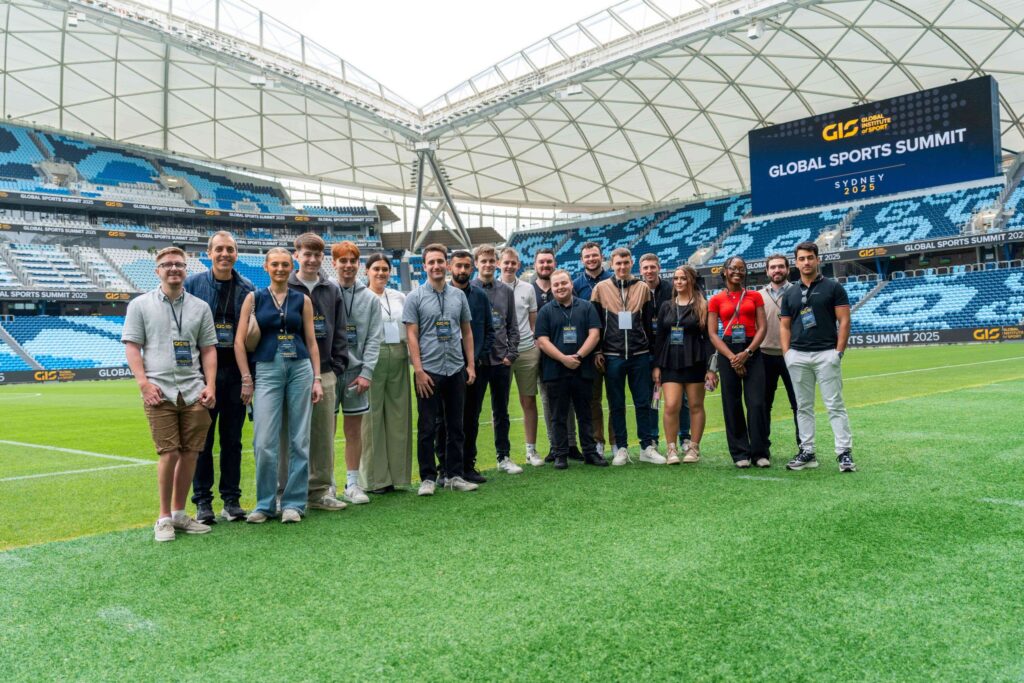
More than 50 guest speakers have shared their experience with students studying at GIS Sydney, representing organisations like FIFA, Red Bull, Cricket Australia, and the AFL. While learning about the regional and national sports industry in the classroom, students have also had the chance to gain an international perspective through GIS’ signature Global Sports Summits, which have given Sydney students access to iconic sporting venues around the world from London to Miami.

Outside of the iconic venues students can call their classrooms, the organisation prioritises the real, industry placements needed to put theory into practice by providing each student with 140 hours of relevant work experience throughout their studies. Included in this are several sporting organisations who are keen to welcome GIS students on board, including the Professional Football Scouts Association (PFSA), Football Coaches Australia, and Basketball NSW.

GIS also has a partnership with popular network and app Yakka Sport to connect students with paid employment opportunities while they study.

Behind these advancements at the GIS Sydney campus is an Industry Advisory Board which features a host of experienced figures from the world of sport. Included in the Asia-Pacific branch is Chair James Rosengarten, GM of the Melbourne Renegades; Kevin Jang, Managing Director of CAA Stellar Korea; and Brad Lloyd, GM of the Carlton Football Club.

Since launching, GIS’ Sydney campus has ultimately combined its locations and industry connections to provide the next generation of sports professionals with the knowledge, network, and confidence to tackle the rapidly evolving sports industry.

Most Popular Topics

Editor Picks

Send this to a friend