

New South Wales NPL clubs share Victorian counterparts’ fears of recommencement

Despite the existence of a desperate desire to see training resume for footballers across New South Wales, such a move may do more damage that good.

As of 12.00am Friday the 22nd of May, COVID-19 induced restrictions were eased and clubs began informing their members of the intended timeline for a potential return to full training in the coming weeks. Currently, all training must be undertaken in line with the Public Health Order issued by the New South Wales State Government.

That order has informed the Return to Training Guidelines issued by Football New South Wales. Those documents outline the overarching goal of allowing football training to recommence whilst also ensuring safe and positive conditions for all players, coaches and officials.

More specifically, a set of clear guidelines have been constructed in order to ensure that safety. At each session there is a requirement to:

  • have gatherings of no more than 10 people at any time.
  • have appropriate social distancing of at least 1.5m between people at all times.
  • allow for at least 4m2 for all participants at all times.
  • maintain reasonable levels of hygiene to minimise the risk of infection.

Should all go well, the intention is for game simulation, contested ball and social activity before and after the sessions to once again be permitted in the near future.

It has been a bold undertaking and one that required a set of somewhat strict measures to even be approved at a government level. However, with drill based sessions a far cry from a return to trial matches and eventual competitive play, any conviction that football is officially back in New South Wales and not threatened by COVID-19, is far from convincing.

Whilst it will be heartening to see young kids back on the pitch and enjoying the beautiful game, the ramifications of a return to play in Australia’s semi-professional landscape are challenging and potentially crippling.

The governing body in New South Wales has been categorical in its current position, “all football activities are suspended through to 31 May 2020 and no decision has been made in relation to Football NSW’s NPL Competitions for the 2020 season.” No doubt, with players now gradually returning to limited training, a statement of intention in regards to what happens post May 31, will surely be looming in coming days.

Should competition recommencement be the crux of that statement, clubs will potentially be placed in a precarious and life threatening position. As is the case with their Victorian counterparts, a number of NPL clubs have already approached Football NSW expressing a desire to cancel the season.

Sponsors have been lost, the doors of once profitable social clubs have remained pad locked for over two months and many clubs seem unlikely to be able to meet their wage bill for 2020. Throw in a potential return to play without spectators, where the clubs may in fact be forced to trade even deeper into the red.

The costs of venue hire would remain, payments for officials and security requirements may potentially be lessened but still in existence and revenue from gate takings and food/beverage sales would be zero. Thus, NPL clubs across New South Wales may well be asked to operate at a substantial loss should their federation demand a return to play.

Should a positive Coronavirus test cause a second shut down of the season, it will have all been for nothing. The best laid plans could be torpedoed in an instant; leaving clubs lamenting the recommencement and knowing things had actually worsened thanks to their return to the field. The shutting down of Waverley College, an Eastern Suburbs private school, on May 26th displayed just how fraught with risk a return to any organised activity where increased social contact occurs actually is.

New South Wales’ students had only returned to school in a full-time capacity the day prior and despite all best intentions to have children back in a safe and comfortable environment, for Waverley College, the recommencement of classes was a sheer waste of, and a potentially dangerous, time.

Football New South Wales needs to consider such realities when contemplating a recommencement of play. As keen as I am to have Blacktown City challenging for the NPL1 title, doing so whilst clubs continue to lose money and have their long term existence threatened may well be enough to sway its decision towards conceding defeat to COVID-19.

It would be a sad decision for football, yet one that may well need to be made.



Previous ArticleNext Article

Football NSW workshop offers clubs rare insight into elite talent pathway as development gap comes under scrutiny

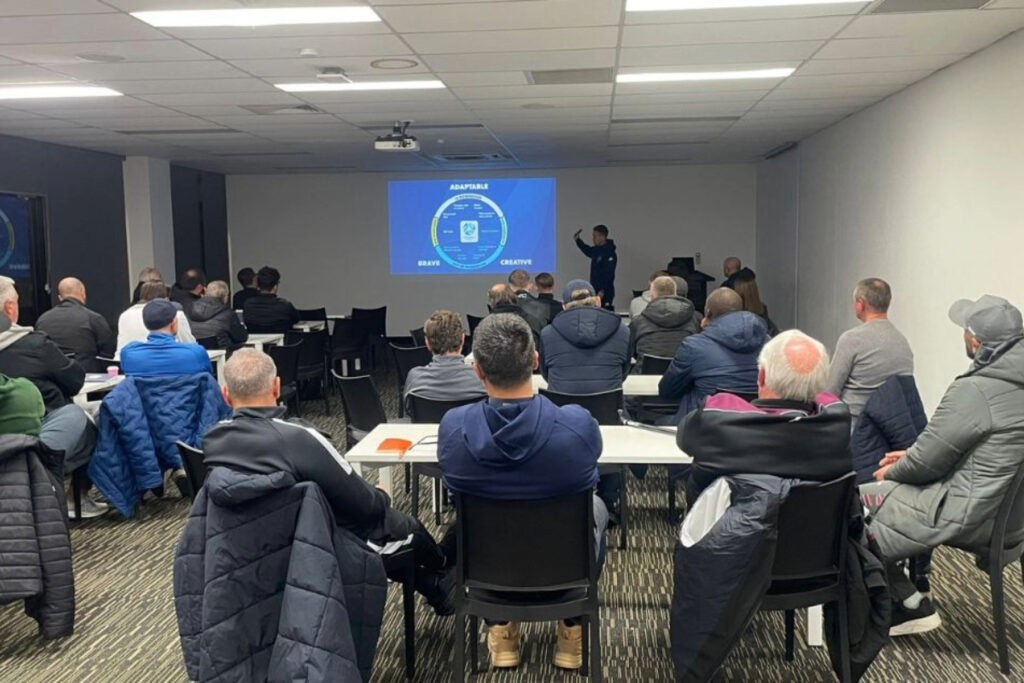
Football NSW has delivered a Club Capability Building Workshop designed to give community club coaches direct exposure to the methodology underpinning the state’s elite Talent Support Program, in an initiative that addresses one of the more persistent structural problems in Australian football development.

The workshop, led by Player Development Managers Phil Myall and Nadine Sheils, who oversee the technical direction of the Boys and Girls Talent Support Programs, combined classroom presentation with pitch-side observation of live TSP fixtures. Coaches from clubs including Rydalmere FC attended sessions covering talent identification processes, player development models, coaching methodology, Individual Development Plans and player profiling based on technical traits and competencies.

The structure of the day, moving coaches from theory into a live competitive environment, reflects an attempt to close a gap that has long shaped the relationship between community clubs and elite talent pathways in Australian football. Club coaches typically operate with limited visibility into how state-level development programs actually function in practice, relying on secondhand information, accreditation course material or assumptions about what elite environments look like. The workshop replaced that distance with direct access.

Why the gap matters

Talent Support Programs exist to identify and accelerate the state’s most promising young players, but the players who enter those programs come from community clubs first. If the coaching methodology and development philosophy applied within elite pathways is poorly understood at the community level, the two systems risk operating with misaligned expectations of what good development actually looks like.

This means a player developed in a club environment that does not share the technical language or coaching priorities of the elite pathway may find the transition into a Talent Support Program more difficult than it needs to be, not because of any deficiency in the player but because the systems around them were not speaking to each other.

Football NSW’s decision to bring club coaches into direct contact with TSP methodology, including observation of live matches rather than theoretical instruction alone, represents an attempt to narrow that gap at the level where it matters most. Rydalmere FC’s Head of MJDL, Michael Canale, said the experience offered a clear reference point for his own club’s program.

“It was great to see how the FNSW Talent Support Program operates and the level of alignment from the methodology and match environment,” Canale said. “For us at Rydalmere FC, I took away ideas that we can look to build into our own programme. It provided a really clear reference point and an opportunity to reflect on how we can continue to strengthen our environment moving forward.”

A model for industry-wide capability

The workshop also points to a broader question facing football governing bodies as participation continues to climb nationally. As more players enter community football and the demand for genuine development pathways grows, the capability of community coaches becomes a determining factor in whether that growth translates into improved player outcomes or simply more players moving through under-resourced environments.

Football NSW’s approach, embedding observation and direct engagement with technical staff alongside structured presentation, offers a model that other state federations grappling with similar capability gaps may look to replicate. The collaborative element of the day, where coaches from different clubs compared notes and aligned their understanding of TSP application, also suggests an organisation attempting to build a shared development language across its club network rather than treating elite pathway knowledge as something that remains internal to Football NSW staff.

Whether that shared language translates into measurable improvement in player outcomes at community level will depend on how consistently workshops like this one are delivered, and whether the ideas coaches take away are genuinely implemented rather than simply observed. For now, the initiative represents a concrete step toward addressing a gap that has shaped Australian football development for years, the distance between what elite pathways do and what community clubs understand about how and why they do it.

Inaugural 2026 UEFA Walking Football EURO Cup begins

On 25 June, senior players from across Europe will take part in the first UEFA Walking Football EURO Cup at UEFA HQ in Lyon, Switzerland.


It’s everyone’s game

When thinking about football, fans tend to imagine the fast-paced, adrenaline-pumping action of the professional game. That is where excitement and drama is, usually, at its highest.

But growing within the wider football landscape is a version of the game which, rather than focusing on speed, instead champions enjoyment, health and participation for senior participants.

Walking football is proof that football truly belongs to everyone. UEFA’s commitment to staging the inaugral tournament on 25 June reflects the organisation’s understanding that a love for the beautiful game stays despite age, injury, or mobility issues.

Alongside the 2026 UEFA Walking Football Euro Cup is the release of the UEFA Walking Football Toolkit. This aims to provide more information about the game, benefitting associations, leagues and clubs and encompasses contributions from national associations of England, the Faroe Islands, France, Gibraltar, Portugal, Poland and Sweden.


A brief history of walking football – and its importance

From its beginnings in the UK in 2011, walking football has since expanded across Europe and the world to give senior players a chance to be socially and physically active – all within a safe, minimal-impact environment.

And the game – despite its more steady nature – is gathering real pace here in Australia.

In October 2021, Football Australia introduced the first ever Seniors Football Week. Also, just last month, Brisbane Roar hosted the 2026 IWFF Walking Football World Championships at Perry Park – the first time the tournament has taken place in the entire Southern Hemisphere.

The implication, therefore, is that walking football will continue to grow and welcome more members of the community with a desire to dust off their old boots and join a team.

From youth teams to walking football, everyone in the pyramid shares the same love for the game. And there is no reason why, when speaking about the cohesive football development, that walking football shouldn’t be included in future planning and strategic visions.

Most Popular Topics

Editor Picks

Send this to a friend