

Why an Australian football Netflix series is needed

Netflix boast just under 200 million subscribers worldwide and have released several sports documentaries over the last few years. However, we are yet to see an Australian football Netflix series – an opportunity that should be taken advantage of.

There is a market for these types of documentaries as Netflix is not the only streaming service that features sport docuseries. Amazon Prime has produced also produced documentaries on Manchester City and Tottenham Hotspur.

One of the most popular football docuseries has been Netflix’s Sunderland ‘Til I Die. The show which provided a behind the scenes view of the club was one of the most watched programs on Netflix in the UK during the week of the release of the second season.

Sunderland has received global recognition off the back of the popularity of the show.

Stewart Donald, owner and former chairman of Sunderland told ChronicleLive that there are lots of reasons why the documentary is good for the club.

“My initial thought with it was, there aren’t many football clubs that can have a global brand, but if you’ve got a Netflix documentary and it goes right, you can get that out to the world and maybe you might get a few people who come along and get emotionally involved in Sunderland who otherwise wouldn’t have,” he said.

“If our name goes out to 20 or 30 million people on Netflix, or however many it might be, that can only be good for the club.”

There are several possibilities for an Australian football docuseries. The show could follow a single A-League club’s season, in the same vein to the Sunderland or Manchester City programs.

Other documentaries have focused on a season of a series or championship as a whole. Netflix’s Formula 1 docuseries Drive to Survive involves several different teams and features a different storyline each episode.

One million households streamed Drive to Survive within the first 28 days of season two’s release according to research agency Digital-i.

An A-League version of this could cover the biggest storylines and moments of the season.

Documentaries have also focused on the national team of a sporing organisation such as Amazon Prime’s The Test which documents the Australian cricket team’s redemption following the ball tampering scandal in 2018.

A series that follows the qualification process of an Australian team for a FIFA World Cup would be a particularly interesting documentary series given the high stakes involved.

The exposure gained from an Australian football Netflix series could be a great opportunity to either introduce people to Australian football or reinvigorate their love for the game.

Drive to Survive has seen an increase an interest for the sport in the US, which is not a traditional market for Formula 1.

Earlier this year Renault Formula 1 Driver Daniel Ricciardo appeared on The Daily Show with Trevor Noah where he discussed the impact that Drive to Survive has had in the US.

“I definitely feel F1 is becoming much more of a thing here in the States. Drive to Survive put it on the map,” he said.

“I spend a bit of time in the States, and up until a year ago, not really anyone would say ‘Hi’ to me – not in a bad way, but they wouldn’t recognise me for being an F1 driver.

“And now it’s all: ‘We saw you on Netflix, it was great, Drive to Survive.’ We wear helmets, so not many people can see our faces a lot of the time.

Given the younger demographic of streaming service users, a docuseries could create a new generation of fans for football in Australia. Depending on the success of the series, it could even inspire more young Australians to play the world game.

At an event for 188Bet in March 2020, F1’s Managing Director of Motorsport Ross Brawn, said that the Netflix series had seen positive impacts for the sport.

“What we’ve discovered is it’s been very appealing to the non race fan: in fact it turned them into race fans,” Brawn said.

“Some of the promoters in the past season have said they’ve definitely measured the increase in interest in F1 that has come from the Netflix series.

“And while Netflix in itself wasn’t for us a hugely profitable venture, in terms of giving greater coverage for F1, it’s been fantastic.

While Football Federation Australia, the A-League and its clubs would not be able to demand the millions of dollars that other clubs and organisations are paid for their participation in a documentary, it could provide a cash boost for the organisations.

Ryan Reynolds has partnered with fellow actor Rob McElhenney to purchase Welsh soccer club Wrexham AFC, who compete in the fifth tier of English football, the National League.

Part of Reynolds and McElhenney’s takeover bid involves plans for a documentary series that follows the events of the team.

Bloomberg spoke to Ampere Analysis analyst Richard Broughton, who said that it would not be unreasonable for a streaming service to pay several hundred thousand pounds per hour for the broadcast rights to a show.

An Australian football Netflix series would be extremely beneficial for the sport in this country.
Previous ArticleNext Article

Football Has the Audience. Does It Have the Commercial Strategy?

Soccerscene has launched Survey 4: Commercial Confidence in Football, calling on clubs, sponsors, governing bodies, commercial leaders and football industry professionals to assess whether the game is making the most of its enormous commercial potential.

Football has the audience, participation base and community reach to be one of Australia’s most powerful commercial platforms. But does the industry have the commercial strategy, professionalism and infrastructure required to turn that potential into sustainable growth?

That is the question at the centre of Soccerscene’s latest industry research.

The survey examines how attractive grassroots football is to potential commercial partners, what industry professionals believe is limiting football’s commercial potential, and whether clubs are presenting themselves professionally enough to sponsors.

It also explores what sponsors value most when engaging with football – from community reach and participation scale to brand alignment, values and purpose – as well as whether improved facilities could directly contribute to stronger sponsorship outcomes.

Is football fully capitalising on its commercial opportunity?

Football continues to provide brands with access to highly engaged communities across grassroots, community and elite environments. Yet the commercial landscape remains fragmented, with clubs operating with vastly different levels of resources, capability, governance, media infrastructure and commercial expertise.

Soccerscene’s survey is designed to capture the industry’s perspective on where the opportunities exist – and where football may be leaving commercial value on the table.

The research will look specifically at four key areas:

  • Commercial attractiveness – How attractive is grassroots football as a commercial partnership?
  • Commercial barriers – What is holding football back from reaching its full commercial potential?
  • Club professionalism – Are clubs presenting themselves effectively and professionally to sponsors?
  • Sponsor value – What are sponsors really looking for when they invest in football?

The survey also asks whether better facilities would have a direct impact on sponsorship outcomes, highlighting the potential relationship between infrastructure, commercial presentation and investment.

Have your say

Soccerscene is encouraging football clubs, sponsors, commercial professionals, governing bodies, administrators, media professionals and industry stakeholders to participate.

The findings will contribute to Soccerscene’s ongoing program of industry research, designed to provide a clearer picture of the challenges and opportunities facing football and the organisations operating within it.

Take the Survey: Commercial Confidence in Football

Complete the Commercial Confidence in Football Survey here

The survey will close on 30 August 2026 at midnight, with responses received before the deadline included in the final analysis.

Football has the audience. The question is whether it has the commercial strategy to match.

Football Queensland’s Logan hub plan rejected by council

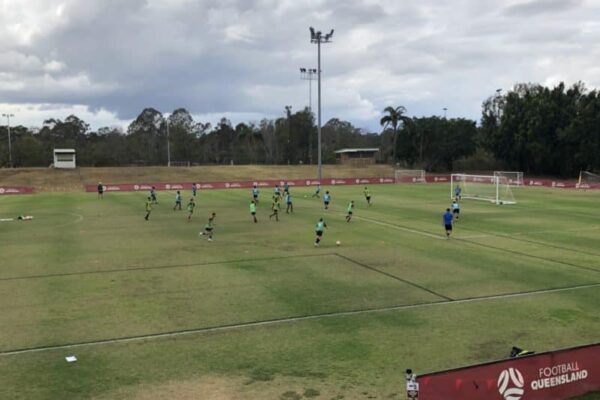
Football Queensland’s plans for a major new football hub at Meakin Park have been rejected by Logan City Council. The proposed $76.1 million redevelopment aimed to create a state home for football in Queensland.

Council unanimously rejected Football Queensland’s request for longer-term leases and additional land at the Slacks Creek site. The decision leaves the organisation’s current leases in place. The proposed development would have delivered new playing fields, elite training facilities and a dedicated home for Football Queensland.

Three-stage development

The first stage of Queensland Football’s development carried an $8.5 million price tag. It would upgrade fields, lighting, drainage and irrigation across Meakin and Mappas parks. The goal was to create a six-field, international-standard training venue.

The second stage represented the largest investment. Football Queensland planned to spend $55.3 million on a new headquarters at the adjoining Queens Park site. The facility would include a Women and Girls Academy, sports science facilities, sports medicine and strength and conditioning services.

A third $12.3 million stage would add an indoor futsal academy and two synthetic fields. Football Queensland said the project could create a major football precinct for the region. It also saw the facility playing a role in Queensland’s preparations for Brisbane 2032 and beyond.

Lease decision creates roadblock

Queensland’s governing body sought a 25-year lease with an option for another 25 years. Chief executive Robert Cavallucci said longer tenure was essential to secure government funding and move the project forward. The organisation has around three years remaining on its existing leases.

Council took a different view. Concerns included community access, funding certainty, future costs and the level of use at the existing facilities. Councillors also questioned whether a long-term arrangement would deliver enough benefit to Logan residents and grassroots clubs. Logan Council has now ordered a review of Football Queensland’s performance under its current lease.

Grassroots football at the centre

The decision highlights a wider issue for football infrastructure. Major facilities can provide elite pathways, sports science and high-performance opportunities, but unless councils can ensure local players and clubs can access the fields, they will be rejected.

Meakin Park already serves several sporting organisations, including football users and community sporting groups. Football Queensland said it had invested almost $2 million at Meakin Park and Mappas fields. It also argued the precinct operates at around 130 per cent capacity. For Queensland football, the challenge now is finding a model that can deliver high-performance facilities while expanding access for the community.

The proposal may have been rejected, but the need for better football infrastructure remains. With participation growing and Brisbane’s 2032 Olympic Games approaching, the debate over where and how Queensland builds its next generation of football facilities is unlikely to disappear.

Most Popular Topics

Editor Picks

Send this to a friend