


AI to Transform Premier League with Microsoft Deal

The Premier League and Microsoft have announced a five-year strategic partnership aimed at transforming how 1.8 billion fans across 189 countries engage with the world’s most-watched football league.

As the League’s official cloud and AI partner, Microsoft will modernise its digital infrastructure, elevate live match experiences, and streamline internal operations using cutting-edge technologies.

At the centre of the collaboration are the Premier League’s new fan-facing digital platforms, built on Microsoft’s cloud and AI tools to deliver more personalised and intuitive experiences.

Fans can explore a new Premier League Companion, powered by Microsoft Copilot. This tool taps into Azure OpenAI to provide insights drawn from over 30 seasons of data, 300,000 articles, and 9,000 videos which gives supporters around the globe a smarter way to learn about their favourite clubs, players, and matches.

Accessible via the revamped official Premier League app and website, the Companion will continue to evolve during the upcoming season.

Future updates include AI features such as open-text Q&A in fans’ native languages, with audio and text translation capabilities.

Later in the season, the platform’s Fantasy Premier League section will also integrate Microsoft AI, offering users their own personal “assistant manager” to help optimise their squads and chase victory.

Beyond fan engagement, Microsoft’s Azure AI Foundry and OpenAI technologies will enhance match coverage with real-time data overlays and deeper in-broadcast analysis. Historical content will also become more accessible through innovative archive tools.

On the backend, the League’s technology infrastructure is migrating to Microsoft Azure to deliver greater scalability, security, and innovation. Internal operations will be further supported by Microsoft 365, Dynamics 365 and Power Platform tools, improving collaboration and enabling data-driven decision-making across departments.

Richard Masters, chief executive of the Premier League spoke about the innovative partnership.

“We are delighted to welcome Microsoft as a partner of the Premier League. This partnership will help us engage with fans in new ways — from personalised content to real-time match insights,” Masters said in a press release.

“We look forward to working together over the next five years to deliver more innovative experiences to all Premier League supporters around the world.”

Judson Althoff, executive vice-president and chief commercial officer at Microsoft discussed how the company will change the football experience for fans.

“We are pleased to partner with the Premier League to bring innovative and interactive experiences to football fans around the world,” Althoff said in a press release.

“By leveraging our secure cloud and AI technologies—including Azure AI Foundry Services with Azure OpenAI, Microsoft 365 Copilot, and Dynamics 365 —we will transform how football is experienced, delivered, and managed on and off the field.”

With Microsoft’s expertise driving a next-generation digital ecosystem, the Premier League is setting a new standard for fan engagement and operational excellence.

As football continues to evolve in the digital age, this collaboration ensures supporters worldwide enjoy a smarter, more immersive experience of the game they love.
Previous ArticleNext Article

Sydney FC bolsters business strategy with third-year ABCC partnership

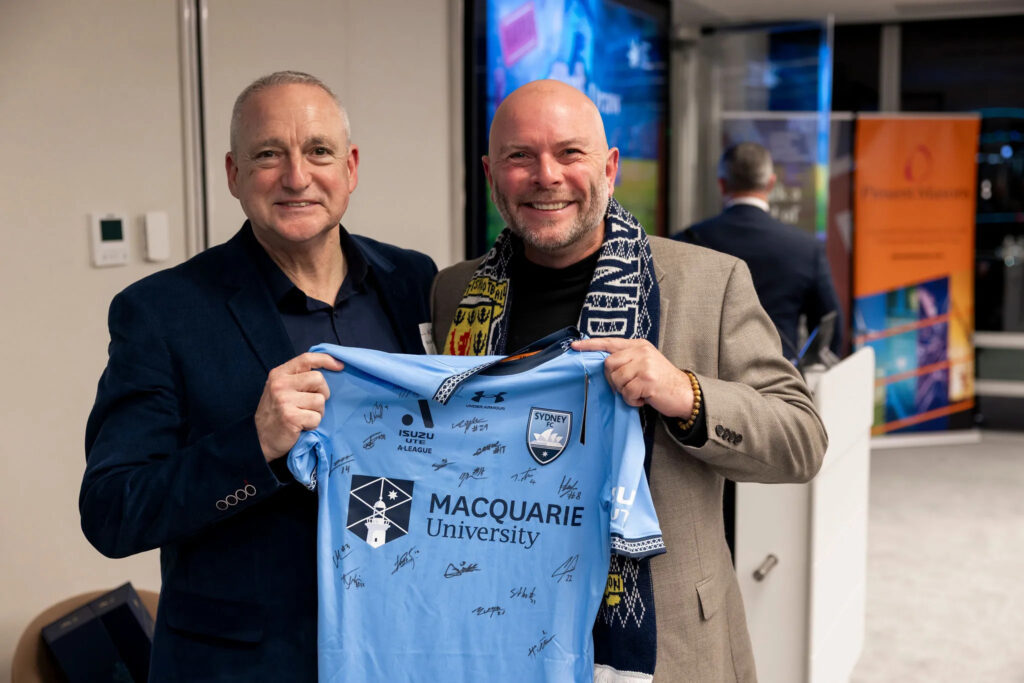
Sydney FC is extending its partnership with the Australian British Chamber of Commerce (ABCC) for a third year, strengthening the connection between the club’s corporate network and the wider business community.

The partnership will give ABCC members access to Sydney FC’s Business Club, it’s new The Collective networking platform and a range of events throughout the 2026/27 season.

ABCC members had already been attending Sydney FC matches and networking through hospitality, and last season the organisations built on that connection by collaborating on a pre‑World Cup business event featuring former players and football industry figures.

ABCC Chief Commercial Officer Paul Wright said the partnership had provided members with opportunities to engage with the club and its business community.

“We are delighted to continue the strong partnership between the Australian British Chamber of Commerce and Sydney FC for the third consecutive year,” Wright said.

Sydney FC Commercial and Marketing General Manager Matt Pound said the relationship was creating opportunities beyond traditional matchday hospitality.

“There’s a large appetite for collaboration between the Sydney FC business club and those within the ABCC, with numerous partnership opportunities being developed through this collaboration,” Pound said.

The continued partnership will also see Sydney FC benefit from member introductions through the ABCC, while the club will contribute speakers to selected Chamber events and feature in its quarterly magazine.

For Sydney FC, the partnership provides another established business network through which to develop its broader commercial strategy, following the recent launch of The Collective.

The club is increasingly positioning its corporate relationships around networking and business development, using football and its existing commercial community as a platform for connections beyond sponsorship and matchday hospitality.

Football must set financial rules of engagement following FIFA Forward Enterprise crisis

Never before has football had such deep access to capital, or faced such complex questions about what that means for the future of the sport.

Private equity firms are investing in clubs, institutional investors are moving into stadiums and sports infrastructure, and clubs are looking beyond broadcasting and matchday revenue towards property, hospitality, entertainment and technology.

The question is no longer whether football needs investments. It’s what happens when investment starts influencing the way the game is run.

The issue came sharply into focus this year when FIFA proposed creating FIFA Forward Enterprise, a new FIFA-owned subsidiary that would bring together its commercial and event operations. The concept would effectively place the World Cup, the crown jewel of global football and FIFA’s blue chip stock, inside an investable structure. 

The proposal envisaged raising up to $6 billion by selling minority, non-controlling stakes in the subsidiary to external investors, based on an initial valuation of $29 billion. FIFA said the additional capital would help increase development funding for its 211 member associations.

The proposal triggered a governance crisis, while major questions about Gianni Infantino’s tenure as FIFA President continue.

UEFA, CONCACAF and (to a lesser-extent) the AFC were among the confederations to object, variously stating they had learned about the proposal through media reports rather than through FIFA’s own consultation process.

Amid a firestorm of criticism, the proposal was ultimately abandoned.

Now, Gianni Infantino has proposed an independent review of the organisation’s governance framework for major strategic initiatives, including how responsibility is divided between the president, Bureau, Council and Congress.

That makes this bigger than one investment proposal.

It’s a debate about who should control football’s commercial future.

Capital isn’t the enemy

There is an obvious argument in favour of private investment.

Football is an expensive business.

At club level, the relationship between capital and football is becoming increasingly sophisticated and complex.

RC Lens recently brought infrastructure investor Entrepreneur Equity Partners into its ownership structure, with the club saying the investment will fund development around the Stade Bollaert-Delelis and help create new revenue opportunities beyond matchdays.

Alas, there is a cost that comes with the capital. 

Investors ultimately expect a financial return. This won’t always conflict with supporters’ interests, but it can create different priorities.

Whereas a supporter might value affordability, identity and competitive success, an investor might instead look at property development, hospitality, commercial growth and the long-term value of an asset.

Neither perspective is inherently wrong.

But problems begin when financial objectives and football objectives stop overlapping and start pointing in different directions.

The ownership question

Chelsea provides a useful example of how quickly football ownership can change.

Clearlake Capital has now taken full control of the London club after acquiring the stakes previously held by Todd Boehly and Mark Walter, in a transaction that values the club at around $9.5 billion including debt. Todd Boehly only invested in the club four years ago.

That does not mean Chelsea’s new ownership structure is better or worse than before.

It demonstrates something important about modern football.

Football is becoming an asset class

That is perhaps the biggest change.

Football is no longer simply something wealthy individuals buy because they love the sport.

It is increasingly being viewed by institutional investors as an asset class with multiple potential revenue streams.

That means the investment opportunity can extend beyond owning a club.

There is private capital in stadiums, infrastructure, media rights, technology, sponsorship businesses and surrounding property.

It also explains why the FIFA proposal was so significant.

FIFA was effectively exploring whether the enormous commercial value of its competitions could be packaged into an investable structure.

FIFA argued investors would hold minority positions and would not receive control over sporting decisions or governance. It also argued the additional commercial value could increase funding available to football associations around the world.

That is a legitimate commercial proposition.

But once an asset is valued in the billions and external investors are being invited to participate, questions about control inevitably follow.

Who decides which commercial opportunities are pursued?

What happens when investors want one thing and football stakeholders want another?

And perhaps most importantly, who ultimately gets the benefit from football becoming more valuable?

The danger isn’t investment. It’s misalignment.

Football should not pretend it can grow without capital.

Football today requires enormous amounts of it.

The challenge is ensuring investment strengthens the sport rather than gradually redefining what the sport means to fans.

There are good reasons for clubs to develop their stadiums, diversify revenue and attract institutional capital.

There are also good reasons for supporters, players, federations and communities to ask what they receive in return.

FIFA’s recent episode demonstrates how quickly these questions can become political as well as financial.

The fact FIFA is now considering an independent governance review following such backlash shows the debate is not simply about whether the investment proposal was commercially sensible, but also about how decisions of that scale should be made.

That may be the most important question for football’s next financial era.

Private capital is here to stay. The tap isn’t turning off.

So, it’s critical football determines its rules of engagement before the next billion-dollar proposal lands on the table.

Most Popular Topics

Editor Picks

Send this to a friend