Football NSW calls on clubs to Make It Red for Heart Health Round

Football NSW is calling on clubs and associations across the state to register for the 2026 Make It Red campaign, joining a national awareness movement aimed at reducing heart-related deaths on sporting grounds ahead of Heart Health Round on the weekend of June 5 to 7.

The campaign, developed by the Heartbeat of Football Foundation, asks sporting clubs to wear red, raise funds and build awareness around heart disease and sudden cardiac arrest, which is the leading single cause of disease burden and death in Australia for both men and women, and one that health authorities say is largely preventable through modifiable risk factors.

The call to action comes as the Foundation continues its work to map and register Automated External Defibrillators across NSW sporting facilities, a project that has already engaged twelve football associations and fed data into both the NSW Ambulance GoodSAM registry and NSW Health’s public AED map. The availability of a functioning, registered AED on site is among the most significant determinants of survival following sudden cardiac arrest, with survival rates declining sharply for every minute without defibrillation.

Football NSW is encouraging clubs to engage with the campaign across three areas. Clubs can register for the Make It Red campaign to help fund research, education and prevention programs. Participants, particularly those aged over 35, are encouraged to seek a free heart health screening test from their local GP or enquire about hosting a Heartbeat of Football testing day. Clubs are also urged to ensure their grounds have active, accessible AEDs in place, with guidance available through Football NSW’s Rescue Ready Guide.

The Make It Red campaign runs from June 5 to July 12, with Heart Health Round taking place across the opening weekend. Clubs can register and access participation resources at makeitred.org.

Previous ArticleNext Article

Football West’s NAIDOC ball competition turns Indigenous art into a road safety message, and a rare form of representation

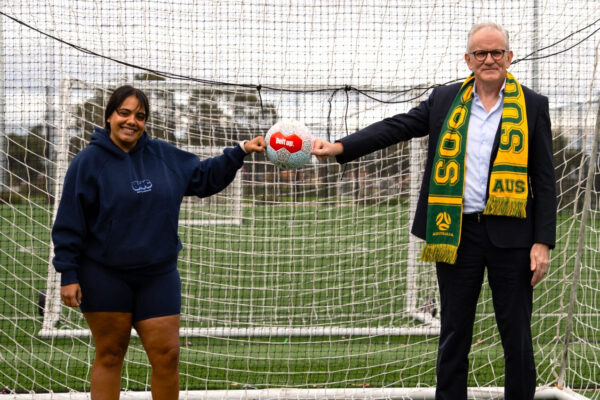
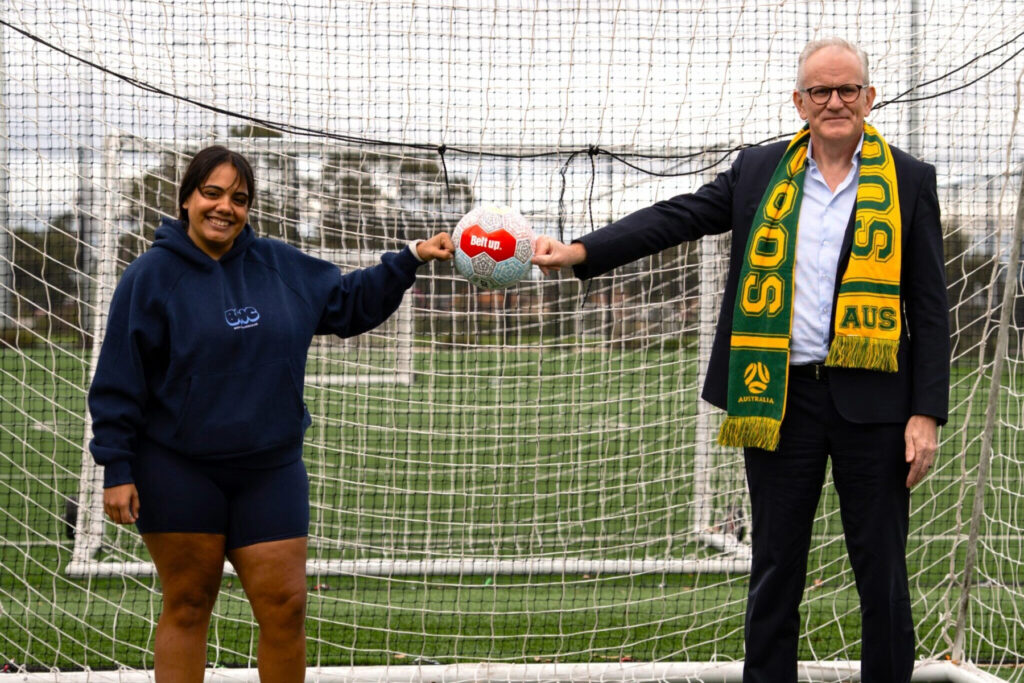
Football West has opened its 2027 NAIDOC Ball Design competition, inviting members of Western Australia’s Aboriginal and Torres Strait Islander communities to submit artwork that will end up printed on 500 footballs and distributed to schools, clubs and communities across the state. It is a small competition with a modest prize, a $1,000 voucher and a set of ten footballs for the winner. But what it is actually doing sits somewhere more significant than a design contest.

The 2027 edition is a joint initiative between Football West, the Insurance Commission of Western Australia and, for the first time, Football Futures Foundation. The winning design will carry the Insurance Commission’s Belt Up road safety message alongside the artwork, with the footballs distributed during NAIDOC Week, which runs from 4 to 11 July next year.

Football Futures Foundation CEO Michael Kerr framed the partnership as an extension of work the Foundation already runs across the state.

“Through programs such as Dreamtime Spirit and Yilkari, supported by former Matildas goalkeeper Lydia Williams, we are working alongside Aboriginal and Torres Strait Islander communities to create football opportunities that are culturally safe, community-led and built around genuine belonging,” Kerr said.

A message that travels further in a football

Road trauma in Australia isn’t evenly distributed. Indigenous Australians are consistently found in national research to be two to three times more likely to be killed in a road transport crash than non-Indigenous Australians, a disparity driven in part by higher rates of pedestrian and passenger injury and compounded by the realities of remote and regional life, longer travel distances, older vehicles, and limited access to emergency care when something goes wrong. Seatbelt non-use remains one of the most consistent contributing factors in that gap.

The Insurance Commission has invested more than 2 million dollars in the Belt Up campaign over its seven years, and its Chief Investment Officer, Steve McKenna, has been explicit about who the message is aimed at.

“About 170 people die on the road each year in Western Australia,” McKenna said. “About 60 per cent of those are male. Of that total, 17 per cent aren’t wearing seatbelts when they die.”

Generic road safety advertising struggles to reach communities where trust in government messaging is not automatic and where the delivery channel matters as much as the message itself. A football, carrying artwork made by a member of the community it is meant to reach, distributed through a sport that already has deep informal roots in many Aboriginal communities, moves in a way a billboard cannot. That is not incidental to the campaign. It is the entire design logic.

Whose stories get told

Jarnda Councillor-Barns, the Ellenbrook artist who won the 2026 competition, used the colours of the Aboriginal and Torres Strait Islander flags in her design, with circular patterns representing gatherings and connecting pathways representing the journeys, knowledge and skills each player carries.

“I really wanted to amplify the stories that are in the Football West community, whether you’re based metro or rural like I was, and how everyone in a team comes with their own stories,” Councillor-Barns said.

Her own football story reflects exactly the kind of informal, community-rooted participation the competition is built to recognise. She grew up in Broome playing social games whenever she could, and has family connections to the Jambinu team, a regional Indigenous women’s side based in Geraldton, despite never being formally registered with a club herself.

“Soccer is a sport that brings people from all walks of life together, creating a larger family built on respect, teamwork and shared passion,” she said.

Football West’s David Williams, a former Socceroo who now heads the National Indigenous Boys Under-16s program, said initiatives like this had value beyond the artwork itself.

“For the creativity of artists to be involved with sport goes a long way,” Williams said. “The more initiatives we have with this kind of stuff, the better.”

That is a modest way of describing what is, functionally, a form of representation that Indigenous communities in Australian sport have not always had. Governing bodies commission Indigenous rounds, jerseys and acknowledgements regularly. Fewer hand the creative authorship, and a public platform for it, directly to community members with no requirement that they already hold a formal position within the sport.

Insurance Commission Chief Investment Officer Steve McKenna, reflecting on the 2026 winning design at its unveiling, saw something in it that spoke to the broader purpose of the exercise.

“You see the Socceroos playing, and look across the team, and a ball like this, the designs, it reflects what Australia’s all about,” McKenna said.

In the meantime, five hundred footballs carrying a community-made design and a road safety message will reach further into regional and remote Western Australia than most government campaigns manage on their own. Whether that message changes behaviour on the roads that data suggests still needs the most attention is the harder, longer question the competition cannot answer by itself.

Northern NSW Football’s Leadership Program Reaches 98 Graduates as Sport Moves Toward 2027 Gender Parity Targets

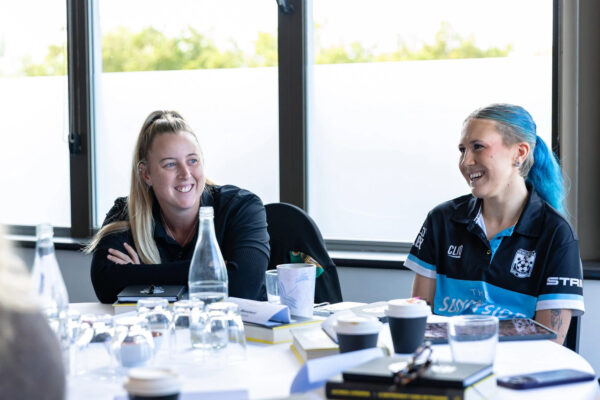
Northern NSW Football has concluded its 2026 Women’s Leadership Program, with 13 participants taking the total number of graduates to 98 women across the region since the program launched in 2023. The five-week program combined online modules with a two-day conference at Rydges Resort in the Hunter Valley, bringing together club volunteers, committee members, administrators and NNSWF staff from Newcastle, Macquarie, Northern Inland and Football Mid North Coast zones.

The program’s growth has been uneven year to year. It launched with two intakes in 2023, drew 25 scholarship recipients in 2024,then settled to 12 in 2025, which brought the cumulative total to 85 before this year’s cohort of 13.

The program was facilitated by Ann Odong, who founded The Women’s Game, Australia’s first dedicated women’s football website, in 2008,and later spent six years as Football Australia’s Media and PR Manager steering the Matildas’ program through multiple World Cups and Olympic Games,before moving into independent consulting work.

A pipeline built against a 2027 deadline

The program fits within a wider set of national targets football and the broader sport sector have committed to reaching within the next twelve months. Football Australia’s Our Game initiative, launched in 2021, set a goal of 50:50 gender parity across players, coaches, administrators and referees by 2027.Separately, the federally backed National Gender Equity in Sport Governance Policy requires all funded national and state sporting bodies to reach 50 per cent women or gender-diverse board directors by 1 July 2027, with funding to be withheld from organisations that fall short.As of the most recent Australian Sports Commission data, 22 per cent of chief executives and 25 per cent of board chairs across 65 federally funded national sporting organisations were women.

Programs built around confidence, networking and committee-level skills, the model NNSWF has run since 2023, are the mechanism most sporting bodies are relying on to close that gap, since board and executive vacancies typically draw from an organisation’s existing pool of committee members, volunteers and administrators rather than external recruitment.

This year’s cohort

University of Newcastle FC’s Charlotte Carey, one of this year’s participants, said the program had given her the confidence to pursue a career in football while developing skills applicable across other areas of her life. Fellow participants included representatives from Cooks Hill United, Westlakes Wildcats, Newcastle Olympic, Lake Macquarie City FC, Western Wolves, Gunnedah and District Soccer Association, Wauchope FC and Stockton Sharks, alongside three NNSWF staff members.

NNSWF Participation and Women’s Football Officer Jamie Bressan said the program had continued to provide women across the game with an opportunity to connect and build leadership skills, with topics covering effective communication, personality styles and team dynamics. Bressan pointed to the network the program builds among participants, drawn from clubs and committees across the region, as one of its central functions rather than the training content alone.

The 2026 cohort’s spread across four zones, Newcastle, Macquarie, Northern Inland and Football Mid North Coast, continues a pattern of the program drawing participants from outside the Hunter region’s largest population centres, consistent with its original design to make the conference and online components accessible to women in regional and remote parts of northern NSW through funded travel and accommodation.

Most Popular Topics

Editor Picks

Send this to a friend