


Community Spirit Shines on AFC Grassroots Football Day 2026

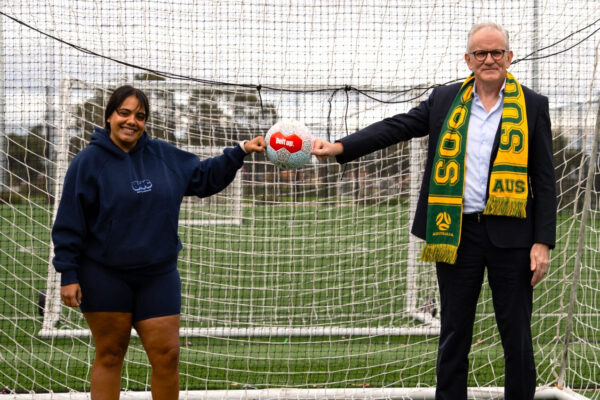
This week, Football Australia (FA) celebrated AFC Grassroots Football Day 2026, championing the people and communities who continue to hold up a safe, inclusive and supportive environment in the football landscape.

‘For all, for life’

In collaboration with Football NSW, Canterbury Football Association and community club, Balmain & District Football Club, the day reflected the very best of what football provides.

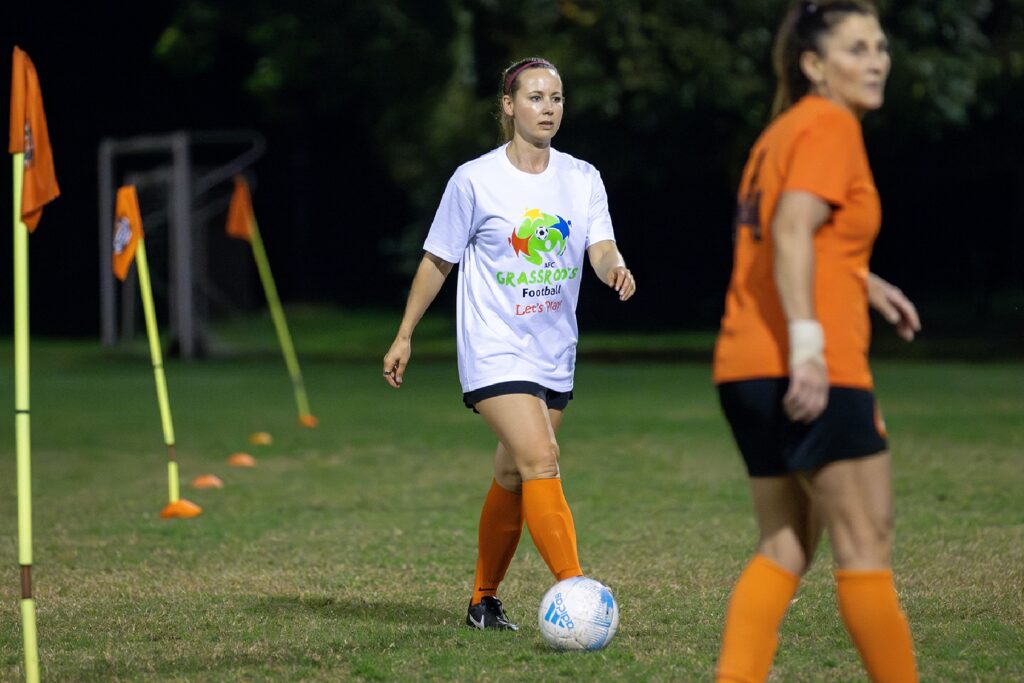
The event brought in participants of all ages – from 4-74 years-old – and reached a total of 400 people. Girls-only programs, all-abilities sessions and over-age football ensured all were catered for.

Such a diverse range of participants builds on a wider drive during FIFA World Football Week, which seeks to promote the sport not just as the dazzling lights of 100,000-seater stadiums, but as a way to foster community spirit and social development.

Furthermore, FA support through its Club Changer program was a welcome addition to the action, emphasising the organisation’s commitment to nurture a real love for the game across communities in Australia.

“Through Club Changer we support our clubs to provide a safe, fun and enjoyable environment where everyone is welcome; whether that be as a player, volunteer, referee or supporter,” explained National Program Manager Club Development at FA, Grace Lambourne.

“Everyone should feel they belong and are welcome to play, stay, and love the game.”


A welcome celebration

While the upcoming FIFA World Cup will no doubt inspire millions of future Socceroos and Matildas, events like the AFC Grassroots Football Day represent something beyond just inspiration.

It is a platform. An opportunity to express a love for football and to connect with others while doing so.

And connections between the professional and grassroots game is more important than ever if Australia is to nurture the next generation of talent.

This is particularly clear in the rise of women’s football across the nation. Since the FIFA Women’s World Cup, female participation rose by 32%, and registrations for the MiniTillies Program skyrocketed from 264 in 2023, to 1223 in 2024.

The professionals spark passion. But communities turn that passion into playing time.

That is why celebrating grassroots football – and the volunteers and families who sustain it – is a vital part of Australia’s football future. Together, FA and the AFC are creating strong foundations built on positivity, engagement, and inclusivity for all with a love for the beautiful game.

Previous ArticleNext Article

Regional carnival puts Football West’s Country Pathway in Focus

Football West’s first State Regional Carnival has done what many federation pathway initiatives promise but do not always deliver: it brought regional players into a central high-performance environment and made them visible on equal terms, at least for a weekend.

Almost 160 players from six Football West Regional Academy zones: South West, Goldfields, Great Southern, Mid West/Gascoyne, Pilbara and Kimberley, were brought to the Sam Kerr Football Centre in Queens Park for the three-day event last week. For the governing body, the carnival is now being positioned as a formal part of its talent identification and development pathway.

Football West general manager of football David Lewis said the carnival had highlighted the standard of regional football and the role country programs continue to play in the state game’s future. He described the event as an “important part” of the development pathway and thanked players, staff, volunteers and families who travelled from around WA to attend.

From event success to system performance

Western Australia’s structural constraint is distance. Regional players face layered costs that metropolitan players usually do not: long-haul travel into Perth, additional accommodation, time away from school and work, and repeated trips if selected into subsequent camps. Those costs are not incidental. They influence who can stay in the system.

That is why the next stage of this initiative matters more than the launch optics. If identified players cannot progress because the second and third steps of the pathway carry prohibitive financial or logistical burdens, then early identification becomes a limited intervention.

In governance terms, the carnival has shifted Football West’s accountability point. The federation has now demonstrated it can convene regional talent at scale. The policy obligation is to show what proportion of those players can be retained and advanced across the following 12 to 24 months, and on what support settings.

Infrastructure is in Place; Distribution as the Issue

The use of the Sam Kerr Football Centre means WA now has a purpose-built football base capable of hosting large-format pathway activity in one location. That removes one of the traditional constraints often cited in state development systems. Once infrastructure is available, attention moves to distribution: who accesses the environment, how often, and under what conditions.

If Football West wants this carnival to function as a durable pathway mechanism rather than a showcase event, several design questions become central. What are the progression criteria after carnival selection? What travel and accommodation support is available for players invited back into metro-based programs? How is regional representation balanced across age groups and cohorts? What protections exist to prevent early dropout linked to cost rather than capability?

A broader shift in Australian pathway policy

The Football West carnival also reflects a wider trend in Australian football administration. Federations are increasingly moving from ad hoc regional scouting to more formal, event-based talent aggregation tied to defined development structures. The logic is straightforward: centralised assessment improves comparability, increases selector confidence, and reduces the chance that players are missed because of location alone.

Yet national and state systems alike continue to confront the same bottleneck. Identification has improved faster than inclusion in later stages. The policy challenge is less about finding players than funding continuity for players whose families absorb higher participation burdens.

Football West does not need to prove that regional football has quality; that case has already been made repeatedly by player outcomes and now by event scale. It needs to publish evidence that regional players can convert recognition into progression at rates that are not materially depressed by geography or household income.

That means performance should be measured against more than attendance and event satisfaction. Over time, the federation will likely be judged on transition rates from regional carnival cohorts into advanced programs, retention across seasons, gender balance in progression outcomes, and the level of practical support delivered to remote participants.

For now, the inaugural carnival can be read as a constructive step with genuine strategic value. It created a focal point for regional talent and signalled administrative intent. Whether it becomes consequential policy will depend on what Football West builds around it next: transparent progression settings, repeatable support, and a funding model that does not turn distance into exclusion.

What Football Queensland’s link with Green Room Futures Means as Pathway Strategy Broadens

Football Queensland has signed a multi-year extension and expansion of its partnership with Green Room Futures, formalising the private provider as the state body’s “Official US College & Tour Partner” and adding an annual United States tour for Football Queensland Academy players to the existing college-placement program.

From advisory model to integrated pathway

The agreement marks a substantive evolution in the governing body’s pathway architecture rather than a standalone sponsorship announcement. The two organisations have worked together since at least 2024, when Football Queensland first appointed Green Room Futures as its preferred US college partner and began rolling out athlete information sessions across metropolitan and regional centres. The new arrangement embeds that relationship more deeply into the academy ecosystem by linking advisory services with an international touring product.

In its announcement, Football Queensland said the expanded partnership would offer academy players exposure to US college environments, international competition and broader education-and-sport decision-making support. Chief executive Robert Cavallucci said the relationship had already assisted Queensland athletes to pursue opportunities overseas and that the introduction of an annual tour would strengthen development outcomes for players across the state’s regional footprint. Green Room Futures director Matt Wade said the expansion reflected strong demand for structured US pathways and would provide athletes with more direct insight into student-athlete systems.

A constrained domestic market

For Football Queensland, the strategic rationale means a collegiate model is now an established part of the global football labour market, particularly for players seeking a dual track in education and high-performance sport. In an Australian landscape where professional opportunities remain selective and uneven, college pathways provide a parallel route with different risk settings for families. That logic has been gaining institutional acceptance across the country, and Football Queensland’s move suggests it sees formal international exposure as a competitive differentiator within domestic talent development.

The policy and governance questions are equally clear. The public announcement outlines ambition, but provides limited operational detail on affordability, cohort selection and support settings for regional participants. In practical terms, these details will determine whether the program functions as a broad-based development mechanism or as a premium pathway accessed primarily by households able to absorb compounding costs.

International youth tours involve direct and indirect expenses that typically include flights, insurance, accommodation, tournament costs, travel preparation and time-off-work burdens for families, with regional players often carrying additional domestic travel requirements before departure. Green Room Futures’ publicly available materials also indicate paid service structures within broader college-placement support. None of that is unusual in this market segment; it is, however, central to any serious assessment of access and equity outcomes.

The expanded partnership therefore sits at the intersection of football development strategy and distributional policy. If the tour becomes an informal gatekeeper to college-facing visibility, then financial design features move from administrative detail to core pathway governance. Without those mechanisms, even merit-led programs can produce systematically narrow outcomes because the input conditions are unequal.

For Football Queensland, the outcomes are likely to turn on implementation transparency over the next one to two intake cycles. A cohort profile that is geographically concentrated or socioeconomically narrow would invite predictable criticism, particularly given repeated statewide positioning in Football Queensland’s academy communications. Conversely, early publication of eligibility frameworks, financial assistance settings and regional participation targets would strengthen claims that the program is designed as a genuine statewide pipeline rather than a metropolitan premium add-on.

There is also a broader sector trend at play. Australian sporting bodies increasingly rely on specialist private partners to deliver pathway components once managed internally or left to informal networks. The model can improve expertise and execution speed, but it also shifts part of the development interface into commercial structures. In that context, governing bodies carry a heightened obligation to disclose how partner-delivered opportunities align with public-facing participation commitments, especially where youth athletes and family finances are involved.

What comes next

Well-structured US pathway programs can materially improve athlete decision quality, reduce information asymmetry, and create legitimate post-school options in a constrained professional market. Exposure to college environments can help families evaluate trade-offs around education, migration and sporting progression with greater clarity. For some players, that can be decisive.

The question for Football Queensland is whether the benefits are distributed in a way consistent with its statewide mandate. The announcement establishes intent and strategic direction; the next phase requires publication-grade detail. For a program framed around opportunity, credibility will depend less on partnership language and more on measurable participation design: who is selected, who is supported, and who is priced out.

Most Popular Topics

Editor Picks

Send this to a friend