


DAZN invests in women’s football with Saudi Women’s Premier League

DAZN and Saudi Women's League

DAZN, the world’s largest sports entertainment platform, announced a ground-breaking milestone in Saudi women’s football. The Saudi Women’s Premier League signed its first international broadcast arrangement with DAZN to make it available to fans worldwide, only excluding MENA.   

With its extensive coverage of the men’s Roshn Saudi League, DAZN has already committed to displaying the finest of Saudi Arabian football. This new arrangement strengthens DAZN’s commitment to football in the Kingdom while also promoting the women’s game to new and current audiences across the world. 

Hannah Brown, DAZN’s co-CEO in Women’s Sport, commented on the deal and outlined the companies initiative behind investing in the league.

“DAZN has an unparalleled commitment to the growth and development of women’s football,” she stated via press release.

“The addition of the Saudi Women’s Premier League allows us to further elevate the game, and support women and girls who play and watch football. We have been following closely the progress of the women’s game in Saudi Arabia since they launched their first national league in 2020, and we are thrilled to support the league in the next phase of its development.”  

“DAZN is the home of women’s football. We are the exclusive global broadcaster for the UEFA Women’s Champions League and Spain’s Liga F, alongside broadcasting top-flight domestic women’s football in Germany, Italy and France.

“We hold further rights in key international markets for these leagues as well as the UK and US leagues, making our women’s football portfolio the most comprehensive in the world. We are continually developing our product, distribution channels and partnerships to increase reach and scale engagement in women’s football.” 

DAZN has committed to broadcasting a minimum of two league matches a week to help broaden the awareness and reach of Saudi Arabian women’s football across the world.

Previous ArticleNext Article

NSW Football Associations Unite Behind AED Mapping Project for Statewide Safety Network

Twelve football associations across New South Wales have joined a statewide effort to map and register Automated External Defibrillators across sporting facilities, in a project that its organisers say will significantly improve emergency response times and save lives at community sport venues.

The Heartbeat of Sport AED Mapping Project, backed by funding from the Minns Labor Government to the Heartbeat of Football Foundation, represents the first comprehensive research into AED placement across NSW sports grounds. The data collected will be provided to NSW Ambulance and its GoodSAM team to enrich the existing AED registry available to ambulance and public first responders, and will feed into NSW Health’s newly released public AED map.

The project has drawn active participation from associations spanning the breadth of the state’s football community, including Eastern Suburbs, Manly Warringah, Granville, Southern Districts, Nepean, Northern Suburbs, Football Canterbury, Bankstown, Hills, Sutherland Shire, North West Sydney Football and Football South Coast.

When seconds matter

The urgency behind the project is not theoretical. At Doyalson Wyee Football Club, a 70-year-old player survived a sudden on-field cardiac arrest because an AED was available on site. The outcome of that incident – and the many others like it that occur across community sport each year – depends entirely on whether a defibrillator is accessible, charged and registered in the systems that emergency responders rely upon.

Sudden cardiac arrest kills without warning. The survival rate drops by approximately ten percent for every minute without defibrillation. In a community sport setting, where professional medical staff are rarely present, a registered and accessible AED is the difference between a player walking off a pitch and one who does not.

The mapping project addresses a gap that has existed largely unexamined. More than 2,400 defibrillators have been deployed across NSW sports and recreation facilities through the Local Sport Defibrillator Grant Program, with grants of up to $3,000 available to eligible organisations. But a device that exists without being registered in emergency response systems provides significantly less value than one that is accurately mapped and immediately locatable by ambulance crews responding to a call.

By encouraging clubs to complete AED registration surveys, the twelve participating associations are ensuring that the equipment already on their grounds is activated within the broader emergency infrastructure – translating a physical asset into a functional one.

Regional communities and the equity of safety

The project’s expansion of the #HeartHealthMatters Program, which brings CPR and AED familiarisation training to sporting organisations with a particular focus on regional areas, addresses a dimension of safety preparedness that often receives less attention than equipment access alone.

Knowing a defibrillator exists on site is insufficient if the people present during an emergency do not know how to use it. Regional clubs, which frequently operate with smaller volunteer bases and less access to formal training programs, face a compounded risk – less equipment, less training, and longer ambulance response times due to geography. The program’s regional focus acknowledges that safety infrastructure, like sporting infrastructure more broadly, is not evenly distributed.

The data gathered through the mapping project will also guide future investment decisions, identifying facilities that still lack AEDs and providing the evidence base for targeted grant funding to address those gaps.

Football associations that have already contributed AED data have demonstrated, in the words of the project’s organisers, strong sector leadership and a shared commitment to safeguarding participants at every level of the game.

For a sport that involves hundreds of thousands of players, officials and volunteers across the state each week, the ambition of the Heartbeat of Sport project is straightforward – that no preventable death occurs on a football ground because the right equipment was not there, or could not be found.

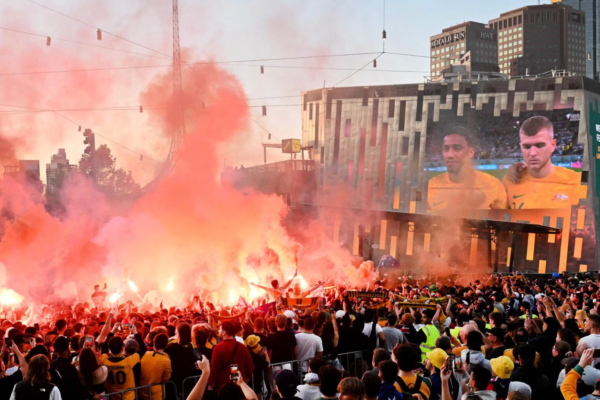
Decision overturned: FIFA World Cup 2026 to return to Federation Square

Following the announcement earlier this week that Federation Square would not return as a live site for this summer’s FIFA World Cup, Football Victoria announced yesterday that the decision has now been overturned.

Widespread support prevails

The football industry moves swiftly. Whether it’s a deadline-day transfer or cut-throat managerial changes, a lot can happen in a short time span.

And this proved true once again in Melbourne this week.

On Wednesday, Melbourne Arts Precinct announced that it will not proceed as a live site during this year’s tournament.

But following widespread backlash to the decision to not use Federation Square as a live site, the initial verdict will no longer go ahead.

“In the past 24 hours, Victorians demonstrated just how important our national teams are to the fabric of our community,” said Football Victoria CEO, Dan Birrell, via press release.

Furthermore, Birrell highlighted that support for a swift overturn also came from those outside the football landscape.

“The response extended far beyond football participants and supporters, reflecting the wider community’s recognition of the signficance of the tournament and the role these moments play in bringing people together.”


Community comes first

Having Federation Square as a live site during this year’s World Cup ensures that Melburnians wanting to back the Socceroos, can do so as one unit.

But even those who won’t be cheering for Australia, and will instead be adorning another nation’s colours, will still be able to unite and show their pride.

This is what live football is all about.

A variety of communities and nationalities which – despite supporting opposing sides – can come together under a shared love of the game. As Birrell continued to explain, this is a fundamental part of why the decision to overturn bares such importance.

“Football is a game that transcends age, background, language and culture.”

“It brings people together from all walks of life and creates moments of connection that are incredibly powerful, particularly uring global tournaments like the FIFA World Cup.”

The Socceroos will kick off their World Cup campaign against Turkey on June 14.


Most Popular Topics

Editor Picks

Send this to a friend