


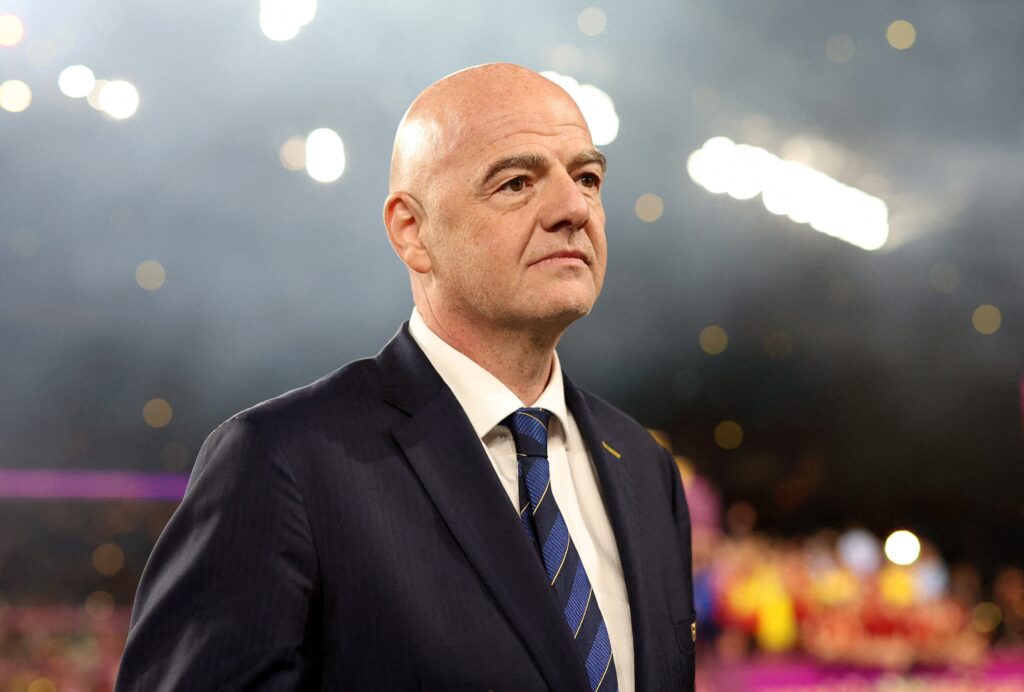
Gianni Infantino was never supposed to become football’s all-powerful figure. Yet he emerged from the chaos of FIFA’s 2015 corruption crisis. He was UEFA’s general secretary and was a close friend of Michel Platini. The crisis exposed the corruption and reckless behaviour at the highest levels of FIFA. Heads rolled. Careers ended. Trust in football’s global governing body was shattered.
In February 2016, Infantino won the FIFA presidency. He promised to rebuild trust. Nine years later, the question is no longer whether Infantino has transformed FIFA. The more uncomfortable question is what he has transformed it into.
His expansion of the World Cup from 32 to 48 teams was a masterstroke for broadcast revenue. FIFA’s cut of ticket sales rose from 10 to 30%, and FIFA’s commercial power has exploded.
FIFA’s revenues are expected to reach $19.5 billion ($14 billion USD) during the next four-year cycle, while Infantino has repeatedly strengthened his position among the 211 national associations that ultimately decide who runs world football.
His political survival has become almost as impressive as FIFA’s financial growth, and that is where the real story begins.
FIFA is richer than ever. So why does football feel short-changed?
The numbers are staggering. FIFA expects to generate at least $18 billion ($13 billion USD) in revenue across the 2019–2026 four-year cycle. The inaugural expanded Club World Cup alone added close to $3 billion ($2 billion USD) to FIFA’s revenue.
That is an extraordinary amount of money for a governing body whose purpose is to develop football across the world. FIFA has always maintained that it is a non-profit organisation and that much of its revenue is reinvested into football. My biggest issue is that the math doesn’t line up.
FIFA says its Forward program will reach $3.75 billion ($2.7 billion USD) during the 2027–30 cycle. That money helps fund the operations and development of FIFA’s 211 member associations. On a simple division, that works out to roughly $4.4 million per association per year.
For smaller football nations, that can be transformational. For established football nations carrying enormous professional, grassroots and infrastructure costs, the picture is very different.
Take Football Australia, which reportedly recorded a $15.4 million loss in its last financial year. Of FIFA’s projected revenue, 19% will be earmarked for member associations.
FIFA obviously has major tournament costs, employees, administration and other expenses. But its reserves tell another story. Across the last two cycles, FIFA’s predicted increase in reserves was approximately $139 million ($100 million USD).
In reality, it added approximately $3.3 billion ($2.4 billion USD). Member associations aren’t getting the funding they need. How much reserve is needed for a non-profit? But this is where politics comes into play.
Top footballing nations such as Brazil, France and England get one vote. But so do governing bodies representing some of the smallest footballing nations.
Their financial contributions to FIFA are worlds apart, but their political weight is the same. Infantino knows that.
The price of supporting Infantino
Infantino’s salary in 2025 reached roughly $8.3 million ($6 million USD). Already more than well compensated, the idea then came to create the FIFA Forward Enterprise proposal. The plan would have created a commercial subsidiary capable of selling a stake in FIFA’s commercial operations to outside investors.
It was eventually withdrawn after public backlash from UEFA and CONCACAF, with the former threatening to boycott the tournament. Other confederations such as the AFC stopped short of rejecting the proposal publicly but expressed concern. Infantino reportedly stood to receive approximately $41 million ($30 million USD) from the transaction.
That is the point at which questions about FIFA’s commercial ambitions became questions about governance. Why should the president of football’s global governing body personally benefit from a commercial transaction involving FIFA’s most valuable assets?
Even if the transaction could be commercially justified, the optics were extraordinary. Therefore, UEFA’s opposition plays a critical role. UEFA has now taken its battle with Infantino beyond political disagreement.
It has decided to take the legal route. UEFA has issued documents in New York and Florida seeking criminal mismanagement tied to FFE. It is far too early to know whether FIFA or Infantino himself could face penalties. One of football’s most powerful confederations is openly challenging FIFA’s president. That does not mean UEFA can remove him, and that is the problem.
Infantino is wounded. But re-election is very possible
UEFA is openly at war with Infantino, and with Italy the latest to withdraw its support for the president, there is pressure on his candidacy at the March elections. Potential rivals could emerge with UEFA and potentially CONCACAF support.
But none of that guarantees Infantino’s defeat. Because the election is not decided by UEFA. It is decided by FIFA’s 211 member associations.
Major players within the AFC, including Qatar and Saudi Arabia, have not necessarily aligned with UEFA’s position on FIFA and with Saudi Arabia set to host the 2034 World Cup, while discussions around future World Cup hosting continue. The relationships between FIFA and powerful Asian associations will remain politically significant. Infantino only requires 106 votes for re-election.
Infantino has spent years building relationships with the associations that hold them. This is not about whether every association believes Infantino is the perfect president. It is about whether enough associations believe FIFA under Infantino delivers more for them than FIFA without him.
That is a very different question, and it is why I believe Infantino remains the favourite heading into March 2027.
The real losers are the fans
This is the part that gets lost in the politics. The fans and football supporters did not ask for FIFA to become a financial empire. They did not ask for endless expansion to the World Cup. They did not ask for more commercial complexity or for the organisation to sell its stakes. Fans did not ask for football’s governing body to become a battleground between federations and investors.
Fans want football, meaningful competitions and affordable prices.
They want trustworthy leadership, and they want to believe that the people running the game actually understand that football belongs to its supporters. Previous administrations were plagued by scandals, allegations of corruption and questions about governance. Infantino inherited that culture. The concern is that instead of dismantling the political machine, he has become exceptionally good at operating it. FIFA generates billions while its president earns millions.
Confederations and national associations fight over money and political influence.
Supporters are increasingly left paying the price.
That is the greatest contradiction in world football.
The danger is that FIFA becomes so financially essential to national associations that challenging its leadership becomes too costly and risky for confederations who hold the majority of the votes.
That is not healthy. A governing body should be accountable to football. Infantino’s greatest achievement may ultimately be that he has made himself incredibly difficult to replace. He has placed himself in hot water with his action, but if he wins again in 2027, the message for modern football is clear. The power isn’t with the people, with the fans. It’s in the votes and politics.