


Football Queensland launches FQ Facilities Hub

Football Queensland (FQ) has launched the FQ Facilities Hub, a dedicated space to house the release of a series of new infrastructure-specific facilities guides. The guides are designed to provide guidance and support to clubs across Queensland on the development and upgrade of facilities and infrastructure.

“We’re delighted to launch our Football Queensland Facilities Hub, a go-to spot for our clubs and volunteers across the state to access up to date and relevant information covering a variety of infrastructure and facility areas,” FQ CEO Robert Cavallucci said.

Designed to support the recently released state-wide Strategic Infrastructure Plan, FQ has released the first three in a suite of facilities guides which will be housed on the Facilities Hub; Football Facilities – Building Development Guide, Football Club Facility Development – Project Planning, and the Field Dimensions and Pitch Marking Guide.

“Today Football Queensland is also pleased to release three guides that have been developed to support our clubs, ahead of the release of a further two documents to assist Queensland clubs and venues in the development and upgrade of facilities. We’d like to acknowledge the significant work carried out by Football Victoria in the development of these facilities guides,” Cavallucci added.

“As the largest club-based participation sport in the state, infrastructure is vital to supporting the ongoing growth of our game here in Queensland, and only with appropriate infrastructure and facilities can we continue to deliver enjoyable participation experiences for all involved in football.”

FQ President Ben Richardson also commented on the release, highlighting the federation’s commitment improving the state’s footballing infrastructure as a long-term strategy.

“Football Queensland’s commitment to developing facilities of a high standard across the state was recently demonstrated with the release of the Strategic Infrastructure Plan, which outlines the priority infrastructure and funding required to drive progress towards the state’s critical facility needs,” FQ President Ben Richardson said.

“Within the Clubs and Community Pillar of Football Queensland’s Strategic Plan, we have also identified a focus on designing minimum standards for clubs, and making the job of the thousands of dedicated volunteers around the state easier.

“We’re confident that this new Facilities Hub on the Football Queensland website will support our clubs across Queensland in the development of appropriate infrastructure, while facilitating the growth of the game in the years to come.”


 

Previous ArticleNext Article

Eastern Suburbs Football Association Announces First All-Female Referee Course and Expanded Women’s Competition

The Eastern Suburbs Football Association has opened its 2026 season with three structural investments that reflect the growing ambition of community football associations to address participation, representation and development gaps simultaneously, beginning with the delivery of its first all-female Football Match Official Course.

The course, held at Matraville Sports High School and led by female liaison committee member Michelle Hilton and 2025 Referee of the Year Ariella Richards, brought 25 new female referees into the association ahead of Round 1. The initiative targets one of the most persistent imbalances in community sport, with women remaining significantly underrepresented in officiating roles at every level of the game, by creating a dedicated entry point separate from the mixed course environment that many women find unwelcoming.

The Women’s Premier League has also expanded, now featuring eleven teams and introducing a WPL1 and WPL2 structure following the first ten rounds of the season. The tiered format creates more competition opportunities for clubs across the region while providing a clearer development pathway for teams at different stages of growth. Returning clubs Randwick City, Glebe Wanderers, Easts FC and Sydney University join established sides in what the association describes as one of its most competitive women’s seasons. ESFA clubs have continued to perform strongly in state-wide competitions including the Football NSW Sapphire Cup, State Cup and Champion of Champions.

Building the next generation

The season opened with an inaugural Development League Gala Day for Under-9 to Under-12 boys and girls, bringing eight clubs together in a structured development environment ahead of Round 1. Sydney FC A-League Women’s players attended the event and engaged directly with young participants, a deliberate effort to connect grassroots players with visible examples of where the pathway leads.

“We are committed to creating more opportunities for clubs, players, coaches and referees to thrive, with a strong focus on participation opportunities to suit participants of all abilities and aspirations,” said ESFA CEO John Boulous.

The three initiatives, a new referee entry point for women, an expanded women’s competition structure, and a development-focused junior gala day with elite role models present, together reflect an association responding to the participation pressures the AFC Women’s Asian Cup has brought into sharp relief across Australian football.

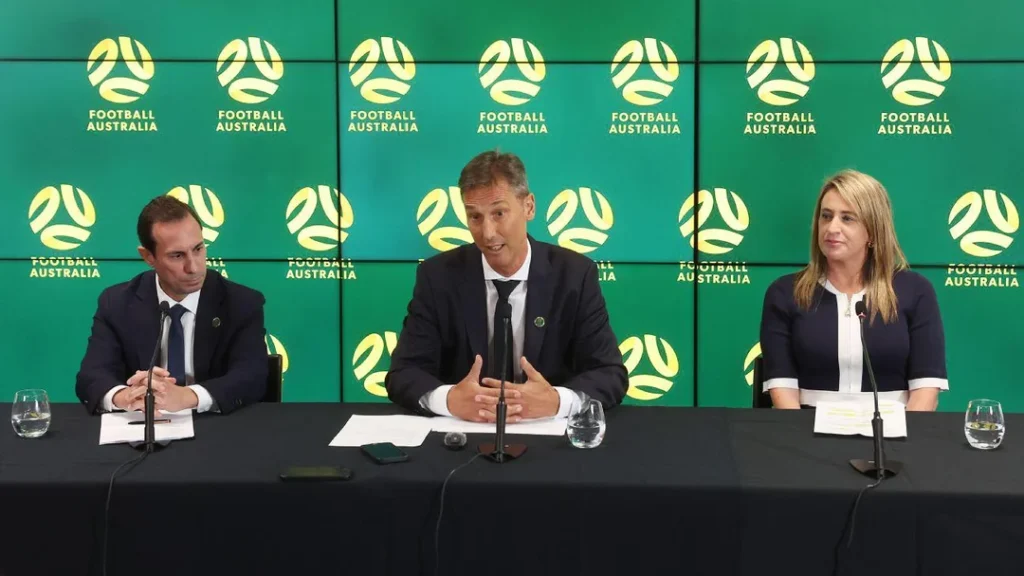
More Than One in Five Football Australia Staff to Lose Jobs Amid Growing Financial Losses

Australian football finds itself in a curious position.

From the outside, the game appears to be riding a wave of momentum. Attendances, visibility and public interest have all experienced significant uplift in recent years, while major international tournaments and growing discussion around football’s future continue to place the sport firmly within the national conversation.

Yet behind that momentum, Football Australia is now confronting a far more challenging internal reality.


A compounding deficit

Chief Executive Martin Kugeler has reportedly indicated the governing body’s projected financial losses for 2025 are expected to exceed the organisation’s reported $8.5 million deficit from the previous year. Accompanying the financial outlook are substantial organisational changes, with reporting from Tracey Holmes indicating more than one in five Football Australia employees are expected to lose their positions through restructuring measures.

The figures represent more than a difficult balance sheet. They point toward a significant period of recalibration inside the organisation responsible for overseeing the sport nationally.


Losing the wisdom of existing staff members

For governing bodies, restructures are often framed as strategic necessities for future sustainability. However, workforce changes on this scale also raise broader questions around the challenges of such a transition.

People are often the carriers of knowledge, relationships and long-term strategic understanding. When organisations undergo significant structural change, the effects can extend beyond immediate financial outcomes.


Contradicting timing

The timing is what makes the developments particularly notable.

Football in Australia has spent recent years discussing expansion, growth and long-term opportunity. The conversation surrounding the game has increasingly centred on future potential. Often headlining stronger pathways, larger audiences, infrastructure development and greater visibility.

Against that backdrop, news of deep financial losses and substantial staffing reductions creates a different conversation: one focused not on where the game wants to go, but on what may be required to sustain that journey. Therefore, this announcement points toward stagnancy, rather than growth.

Further detail surrounding Football Australia’s strategy and long-term direction will likely emerge over coming months. For now, the developments serve as a reminder that growth stories are rarely straightforward.

Often, the periods that appear strongest from the outside can also be the moments organisations face their most significant internal tests.

Most Popular Topics

Editor Picks

Send this to a friend