




Growth Lighting Company Rhenac Launches New Product, The RML 400

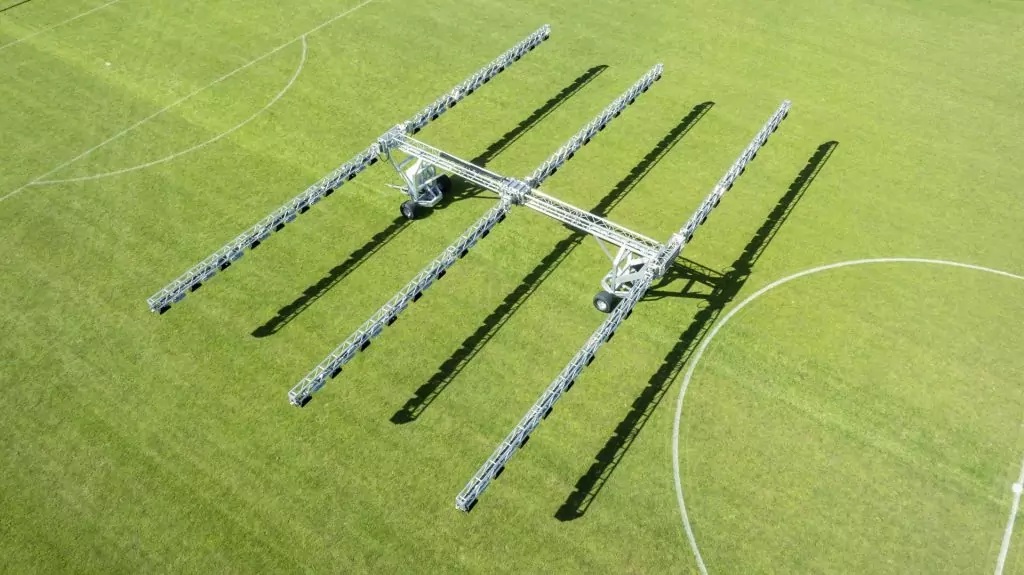
Rhenac, a growth lighting specialist company have released their latest product in their unique Complete Light Spectrum line, the RML 400, which delivers turf care across a 400 spm area using UV-C lighting equipment.

The RML 400, like all in the CLS range, is designed for businesses who want to maintain their sporting pitch with efficient and sustainable means — with industry-leading LED technology attached to a lightweight-rig design, the RML 400 provides state of the art turf growth under simulated conditions.

The LED system on the product stimulates natural sunlight using Rhenac-patented technology, which is backed by years of research and development in plat research at the Technical University of Munich (TUM) and used by several elite stadiums.

CEO of Rhenac, Horst Theisen explained the RML 400 lighting is not just about one monochromatic light: it’s much more.

“It’s about creating balanced light recipes that replicate natural sunlight and adjusting temperature to support every stage of turf growth,” he said via press release.

“Red light stimulates germination and shoot growth, while blue light promotes root development, shear strength, leaf structure and density. White light enhances overall turf health and vitality, while far red drives length growth.

“The ability to create bespoke recipes with this mixture of light, combined with infrared heating, ensures the optimal conditions for turf recovery, resilience and consistent playability.”

Rhenac prides itself on solving problems for their clients by using their already existing technology and adapting and personalising it in various ways.

Rhenac’s range of pitch care products and projects can be design specifically for stadiums and other customers, resulting in CLS equipment varying from compact frames for smaller pitches, to inbuilt structures and lighting for major venues.

Rhenac GreenTec

Rhenac sources their research and development through their engineering hub Rhenac GreenTec, founded to study and stay up to date in plant growth within climate chambers without natural light, to then use the data to update their products range.

Modern stadiums and training centres use Rhenac products to keep their pitch’s health and growth consistent all year round due to constraints like parts being under shade from stands, the demanding of training and play, as well as weather.

The results seen by those using the CLS range estimate a 100-percent boost to root growth with double the biomass, 40-percent fewer input requirements to the pitch, and 30-percent more playable hours, all done chemically-free.

The RML 400 is also equipped with analysers and real-time sensors that look deeper into the maintenance of the turf to help venue managers and grounds people to understand more about the reaction of the pitch to the light and its circumstances.

Alongside its advanced lighting technology, the RML 400 benefits from Rhenac’s collaboration with Turf Lighting Solutions who pioneer in single-row aluminium mobile lighting which ensures an easy-to-handle rig that’s practical for ground people to transport, deploy and store.

The RML 400 also includes intuitive controls, light sensor automation, smart remote operation from pitch side, using data-driven resources to ensure long-term reliability.

Turf Lighting Solutions

Turf Lighting Solutions is a subsidiary and partner of Rhenac who specialises in the development and design of the lighting and lightweight rigs (which TLS brought over with the partnership), delivering more than 600 rigs to 120+ stadiums, clubs, and sports venues worldwide.

TLS also designed and created some of Rhenac’s products like turf fans used to control temperature and improve airflow and spray cannons and air blowers for targeted treatment.

The company also consults and advises venue managers towards tailored services for each pitch’s unique conditions, and full lifecycle support from the initial enquiry to ongoing maintenance and optimisation.

Together, Rhenac have operated for over a decade with several decades of knowledge and industry experience from their team.

Previous ArticleNext Article

Regents Park Saints FC’s women’s game in 2026 and beyond

The New South Wales club has outlined that current facilities are not well-adapted for women and girls engaging with local football, putting long-term participation at risk. 


Keeping pace with rapid growth 

With participation numbers in women’s football rapidly increasing across New South Wales, appropriate infrastructure becomes all the more essential. And for the women and girls looking to join local teams like Regents Park Saints FC, there is growing concern that facilities are struggling to keep up with the modern game. 

Outdated infrastructure, lack of privacy and minimal space in changing rooms have been highlighted as the main issues currently facing the upcoming generations of young female footballing talent. 

Regents Park Saints FC Club Secretary, Vanessa Thorburn, emphasised the benefits to having updated facilities for all players associated with the club. 

“Any updates to our changing rooms are going to benefit our players, but also any other players that use our club,” Thorburn explained via video press release issued Monday. 

Of course, the proposals are not just about addressing present concerns, but about planning for the future of the women’s game and establishing the right environment to nurture young talent.

“The Matildas did a great job of promoting girls in football and I think that it’s something that has really taken off and you see so much more interest in it. We like to think that our club will grow the future Matildas one day,” Thorburn continued. 


How can the 2026 AFC Women’s Asia Cup play a role? 

With the 2026 AFC Women’s Asia Cup just around the corner, the next few months represent a pivotal point for the development of the women’s game in Australia. 

In the past, participation and match attendance has increased following major tournaments like the 2023 FIFA Women’s World Cup. For example, between the 2022/23 and 2023/24 season, average attendances at ALW matches shot up from 1,233 to 2,117. It is clear that the Matildas can play in creating nationwide support for women’s football. 

As Australia will host the tournament this upcoming March, there is potential for it to act as a springboard for change across the nation’s football pyramid. 

What remains important to remember is that creating buzz among fans is not enough to sustain long-term progression. The football-fever which will arise when the Matildas kick off in March this year will hopefully infect not only future stars, but the current governing bodies with the power to implement real change in the women’s game. 


Coach Education Exchange unites Football NSW and Japan FA

The education program was a roaring success for the 14 coaches who made the trip, demonstrating Japan’s high-quality infrastructure and development systems from which football bodies across Australia can take inspiration. 


A valuable partner

The 2026 FNSW Japan Coach Education Exchange comes as the latest display of the strong connection between footballing worlds in Australia and Japan. 

14 Football NSW coaches travelled to Japan for unique insights into what makes the J-League and WE League tick. With both of these leagues being renowned for their distinct footballing identities, elite development pathways, and technical excellence, the program serves as a valuable opportunity for Football NSW to gain new ideas and know-how moving forward. 

During the visit to Japan, the coaching cohort visited several different clubs, including: 

  • Cerezo Osaka
  • Tokyo Verdy
  • JEF United Chiba
  • Urawa Red Diamonds
  • Gamba Osaka

Learning from international expertise

The trip was not, however, merely about uncovering the secrets to club or commercial success. 

Visits to the JFA Academy Sakai emphasised Japan’s commitment to creating elite pathways for talented young players across the country. They believe in nurturing players not only to be talented footballers, but to be confident leaders through their education and lodging system. 

“He or she being gifted does not always have his or her talent blossom. By providing those who have a talent with a good environment and encouraging them to make efforts, we nurture players who can shine in the world,” they explain via the JFA official website

Further meetings with Director of Coach Education at the JFA, Kimura Yasuhiko, as well as Head Coach of Japan’s Men’s National Team, Hajime Moriyasu, highlighted the wealth of knowledge which Australia can access during collaborations with the JFA. 

“The opportunity to meet and hear from a national team head coach operating at the highest level of international football proved both humbling and motivating, underscoring the value of global connection and shared learning in coach development,” Football NSW said via press release. 

Following the success of the 2026 FNSW Japan Coach Education Exchange, the objective should now be to transform insights into action. For Football NSW, or any other football association in Australia seeking to develop the game for current and future generations in the region, the lessons learned from international partners must be applied with real conviction and commitment.


Most Popular Topics

Editor Picks

Send this to a friend