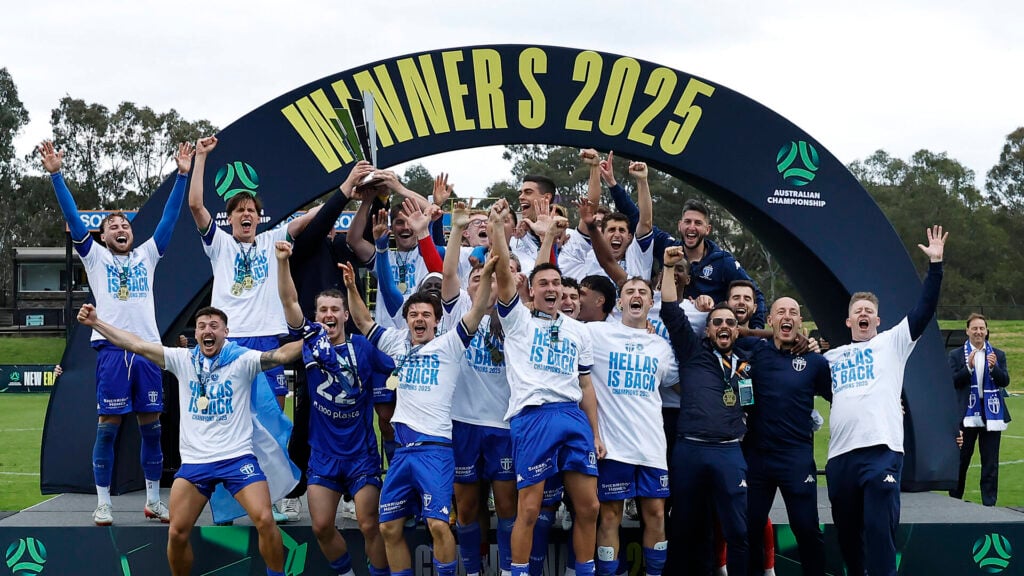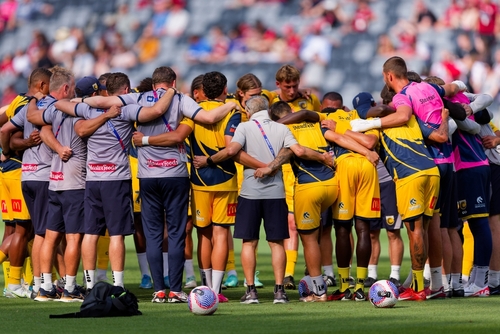
South Melbourne signs New Balance teamwear deal after Australia Cup triumph

South Melbourne FC has secured a two-season teamwear partnership with New Balance and Australian elite teamwear partner Belgravia Apparel, strengthening the club’s commercial portfolio as their Australian Championship title defence begins.

The agreement will see New Balance supply high-performance apparel for South Melbourne’s players and staff, both on and off the field, beginning with the club’s Australian Championship campaign.

The deal follows South Melbourne’s historic Australia Cup triumph and comes as the club looks to build on its increased national profile while pursuing another title.

South Melbourne head of operations George Kouroumalis said the partnership reflected the club’s ambitions and offered an opportunity to strengthen its identity beyond matchdays.

‘We are incredibly proud to partner with Belgravia Apparel for the next two seasons. Having New Balance, an elite brand with strong global presence associated with South Melbourne, reflects the ambition of our club and the opportunities ahead,’ said Kouroumalis.

Belgravia Apparel CEO Brian Waldron said the company was pleased to bring its football experience to the partnership, pointing to its relationships with clubs across Australia and New Zealand.

For South Melbourne, the deal puts a globally recognised sportswear brand behind the club at a time when its Australia Cup win has brought it greater national attention.

The agreement also connects South Melbourne to a broader teamwear network. Belgravia Apparel and New Balance began their strategic alliance in 2020, supplying performance apparel to sporting organisations across the region.

The club said its new home kit would be launched the following week, giving supporters their first look at the partnership in action.

Previous ArticleNext Article

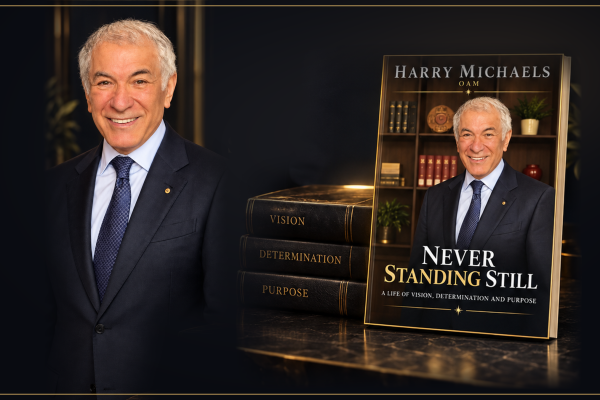
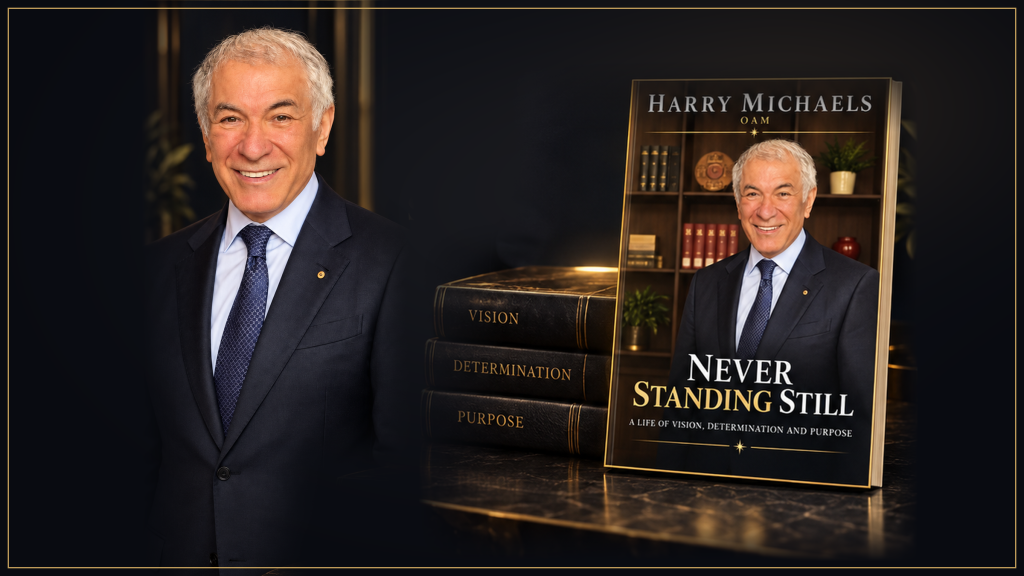
Harry Michaels – Never Standing Still

It’s hard to imagine that so much life experience can be packed into one person’s voyage of discovery but in the case of Harry Michaels it has all materialised.

Michael’s recently, published autobiography is the fascinating account of a man who was determined to succeed in life, whatever the obstacles.

Significantly, his early life at the age of nine was smeared with the tragic loss of his father. Many people would have found it extremely difficult to ever recover from such a bitter experience but not Harry Michaels.

Incredibly, something in the makeup of this young man encouraged him to achieve greatness in honoring the life of his father.

There is a constant message in the book that Michaels would honor his father’s memory forever by achieving perfection in his life endeavours.

Michaels achieved many milestones in his life and football was to become a central theme after he first kicked a ball with his peers in the narrow streets of Cyprus, followed by playing in the school team when he stayed with his aunt in London for a few years after his father’s death.

Australia is the lucky country and when Michaels and his family migrated to Australia, this country was to become infinitely better for it.

In a relatively short space of time, Michaels and his family adjusted to life in their adopted country and when Harry acquired a part in the Channel Ten sitcom, Number 96, the sky was the limit for his future plans.

He became a household name in the living rooms of Australian television viewers and eventually succeeded in entering the cut-throat world of production with the Greek Variety Show.

His biggest success was with Aerobics Ozstyle which originated in 1997 when he witnessed some people doing exercise routines for a television show on the beaches of California and subsequently instigated a pilot television show in Australia.

Currently, it is experiencing a huge revival on Youtube.

Michael’s great love for football naturally led him into the broadcasting arena of the world game and from 1982-2006, he covered NSL and international matches for SBS, including the 1993 World Youth Cup in Australia, Australia v Argentina World Cup qualifier featuring the immortal Diego Maradona, the 1997 World Cup qualifier between the Socceroos and Iran and 2005 elimination match in Sydney between Australia and Uruguay which received some of the highest ratings of any sporting contest ever televised in Australia.

Perhaps, the most dramatic event of all was the coverage of the Pratten Park riot in 1985 at a match between Sydney Olympic and Sydney City.

If this wasn’t enough, Michaels also financed Wollongong Wolves in the 1988 NSL season and was successful in attracting the talents of Paul Mariner, Alan Brazil and Trevor Francis to the club as guest players which led to the first major title won by an Illawarra club since South Coast United led by the mercurial, Jim Kelly, won the 1963 NSW State League grand final in front of a record Australian club attendance of 30,500.

He was the President of Sydney Olympic from 1991-1993 and made a major impact on the club.

Michaels never wanted to be praised for his contribution to football and very people knew he introduced Ericsson Australia, Nanda Spaghetti, Coca Cola, Winfield, Beach Fashions, and Westend Beer Company as sponsors of the NSL, while never asking for any financial reward.

Also, when the broadcasting company which produced the A-League faltered half way through the 2023/24 season, it was Harry Michaels who stepped in to fill the void.

Ironically, Harry was not asked to tender for the broadcasting rights in the following season.

It was something he found hard to accept but successful people like Harry don’t dwell on such events and seek the next challenge.

Hence the title of his book, ‘Never Standing Still’ is a true reflection of a man who let’s no barrier stand in the way to achieve his next goal where others would have given up long before.

Appropriately, his true worth and contribution to the community was duly recognised when he was awarded the Order of Australia Medal in 2004 for his services to broadcasting and football.

This book should be read by all people who want to be inspired by a story where adversity was converted to positives and all football administrators who would learn how the man Harry Michaels became a winner and a highly respected public face in Australian society for his unselfish community contribution.

What is an A-League licence actually worth?

South Melbourne’s push to enter the A-League has reopened an old debate about who gets to play at the top level of Australian football. Beneath the arguments about history, identity and sporting merit sits a more consequential business question: what should a place in the competition actually cost?

Following its Australia Cup triumph, the debate and discussion around South Melbourne’s bid to enter the A-League has reignited. Co-president Bill Papastergiadis has indicated the club is open to discussing a licence fee, while arguing it does not need an equity stake in the Australian Professional Leagues (APL).

The question is whether entry to the A-League should be treated purely as a commercial asset to be purchased, or whether it should also provide a pathway for clubs capable of bringing genuine value to the competition.

The Price of Admission

A licence offers access to a national platform, broadcast exposure, sponsorship opportunities and the country’s highest domestic competition. The APL is entitled to protect that value and ensure any new entrant has the financial resources, infrastructure and governance to sustain a professional operation.

South Melbourne should not receive a free pass because of its history, supporter base or Australia Cup success. Winning a knockout competition is not the same as demonstrating the capacity to operate a professional club across an entire season.

But a licence fee should not become a barrier that protects the competition’s existing membership at the expense of its future.

There is also a risk that licence fees become little more than short-term sugar hits for the competition, delivering an immediate injection of cash without addressing the longer-term challenge of building sustainable clubs, growing audiences and increasing recurring commercial revenue.

Assessing the Value of Established Clubs

South Melbourne is not starting from scratch. It has an established supporter base, a home at Lakeside Stadium and a storied history in Australian football. Its profile and recent success give the APL a tangible proposition to assess, rather than a business plan built entirely around projected growth.

Nor is South Melbourne necessarily alone. Other established Australian clubs may have the supporters, facilities, community connections and ambition to make a credible case for joining the professional ranks. Not all would be ready, and maybe not all would strengthen the A-League. But that is precisely why the league needs clear, consistent criteria to assess potential entrants on their financial capacity, infrastructure and commercial potential as well as what they could contribute to the competition.

That contribution should count. New audiences, local rivalries, sponsor appeal and stronger connections between community and professional football all have value. An established club may offer a different proposition from launching a new team and trying to build a supporter base from the ground up.

There are, of course, significant costs involved. South Melbourne would need to demonstrate how it could fund professional men’s and women’s programs, generate sustainable revenue and protect its existing operations. A licence fee must be considered alongside the rights, obligations, access to central revenue and commercial opportunities that come with entry. The price cannot sensibly be separated from what a club receives in return.

The Promotion and Relegation Question

This is also where the debate connects to the lack of promotion and relegation. If the system is considered financially unviable under the A-League’s current structure, clubs and supporters deserve a clear explanation. What are the specific financial, stadium, broadcast or governance barriers? What would need to change to make it possible? It is simply down to the licence fees that have already been paid by the existing A-League clubs?

Promotion and relegation is clearly not an immediate or realistic solution, and introducing it would not automatically create a healthier competition and ecosystem. But if it remains off the table, Australian football needs to offer ambitious clubs something more tangible than an uncertain promise of expansion.

Providing a Clear Pathway

A transparent licensing process, published entry criteria and a clear explanation of what clubs must demonstrate would at least provide a pathway to work towards. Clubs investing in players, facilities and academies need to understand what it takes to reach the top. Supporters deserve to know how their clubs can progress, too.

The A-League needs entrants capable of surviving and investing for the long term. It also needs to recognise the value that established clubs can bring. If the price of entry is focused primarily on extracting the largest possible payment, the league risks overlooking opportunities to grow its audiences, strengthen rivalries and deepen its connection with Australian football.

South Melbourne’s bid is an opportunity to test that balance. The question is not whether the club should simply be handed a place in the A-League, but whether Australian football can develop a licensing model that rewards financial responsibility while recognising the value of clubs that have already built something worth bringing to the national stage.

It seems a licence must have a price. But if the A-League wants to grow sustainably, it must also explain what that price is designed to achieve and provide a clearer answer to clubs and supporters asking how the pathway to the top is meant to work.

Most Popular Topics

Editor Picks

Send this to a friend