



The future is looking bright for NSW female referees

Football NSW

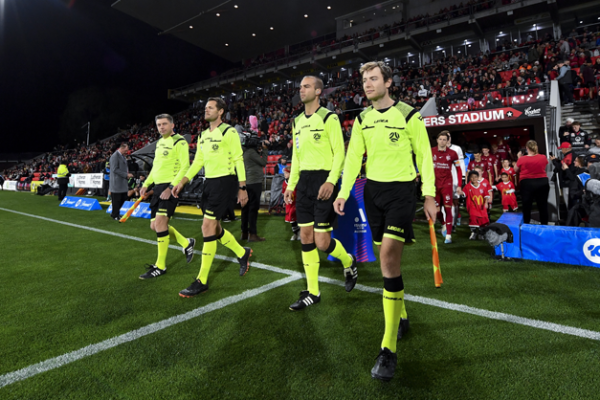
The NSW Football Legacy Fund is set to have a huge positive impact of female referees going forward, with a significant funding boost.

The NSW State League Football Referees have been given $14,371 thanks to the recent legacy fund.

The grant will help develop NSW female refereeing to a more advanced level, which will see the number of female referees in NSW increase. New electronic communication technology and other useful refereeing equipment will now be available in-game to NSW female referees for the upcoming NPL NSW Women’s season beginning in March.

NSW State League Football Referees Secretary, Wayne Lenardon, further highlighted how important this NSW Football Legacy Fund will be to ensure female refereeing in NSW develops further.

‘’This grant goes hand-in-hand with member-funded co-contributions towards development of female referees,’’ Lenardon said via press release.

It is hoped that the legacy fund will help increase the number of female referees officiating in the National Premier Leagues NSW Women’s competition. As it stands, women’s NPL NSW competitions are largely officiated by men. NPL NSW are now actively trying to change this by giving female referees the support and resources needed to officiate.

The NSW Football Legacy fund will also help provide female referees with coaching materials specifically targeted to female match officials.

In a sport that has been, and still largely is, dominated by men, the upcoming FIFA Women’s World Cup to be played in Australia and New Zealand has the potential to inspire a generation of young women to be part of football going forward, whether that be as a player or a match official.

It is thus vitally important that Football Australia and the various state football organisations capitalise on the buzz that the FIFA Women’s World Cup will undoubtedly deliver and give these young girls and women the very best opportunities to achieve their dreams.

The NSW Football Legacy Fund is an example of how the development of upcoming female referees can be achieved through a supportive network and refereeing technology that will help realise their potential of becoming a great referee at the highest level of the game.
Previous ArticleNext Article

Murray United calls Football Victoria review following wave of State League forfeits

Murray United has called on Football Victoria to undertake a comprehensive review of State League football after a series of fixture forfeits left the regional club questioning the integrity of the competition and the long-term sustainability of its senior pathway.

In correspondence sent to Football Victoria, Murray United outlined concerns following what it says has been an unprecedented number of forfeited fixtures during the 2026 State League season. According to the club, its senior men’s program has been impacted by five forfeited rounds, equating to 10 matches. This includes the club’s last two fixtures, significantly disrupting competition across both senior and reserve grades.

The club and its chairman Pedro Afonso, argue the consequences extend far beyond missed fixtures, affecting player development, community engagement and confidence in the State League system.

“This is extraordinary, unacceptable, and completely inconsistent with the integrity and intent of Football Victoria’s State League competition,” Afonso said to Football Victoria.

“This impact extends well beyond lost fixtures. It has damaged player morale, member engagement, volunteer morale, sponsorship and club revenue, and the reputation of the sport and competition itself.”

Located at the club’s $20 million facility in Wodonga, Murray United has invested heavily in creating a regional football pathway. However, repeated forfeits have limited opportunities for players, coaches and supporters to participate in home State League fixtures.

The club has hosted just three home rounds this season despite the significant investment made into facilities and matchday operations.

“Our players, coaches, members, supporters, sponsors and the sport expect a legitimate State League competition, not one regularly disrupted by forfeits,” Afonso said.

“Our confidence must be restored by Football Victoria.”

While the immediate concern centres on this season, Murray United believes the issue reflects broader structural challenges facing regional football within Victoria’s State League system. Between the north-west and south-east competitions, there are 14 divisions of State League football in Victoria.

Among its recommendations, the club has called for Football Victoria and its Football Development Committee to undertake a formal review of the State League Seven North West competition, including club compliance and the frequency of forfeits.

Murray United also questioned whether the current competition structure provides an appropriate development environment for ambitious regional clubs. The club could be promoted to division six due to a large proportion of fixture forfeits. But fearing further cancellations, the club is requesting a review to be placed in an even higher division where clubs are willing to travel to Wodonga.

“We believe we should be sensibly placed in a competition that reflects our playing standard, facilities, player and coach pathways and our ambitions,” Afonso said.

The club has requested that Football Victoria assess its senior program using grading principles similar to those recently applied within senior women’s competitions, with consideration given to placement in a competition more suited to its football program and long-term objectives.

Alongside competition grading, Murray United has proposed stronger penalties for clubs that repeatedly forfeit fixtures. Recommendations include increased financial sanctions to $2,100 for senior teams alongside a three-point deduction per forfeit and compensation for host clubs to offset matchday operating costs.

The submission also encourages Football Victoria to review minimum participation standards across State League clubs, strengthen accountability measures and examine whether the existing league structure adequately supports regional football.

Afonso believes reform is necessary to ensure regional clubs are not disadvantaged within a statewide competition.

“We remain fully committed to providing quality football opportunities for our regional members and community and have heavily invested in facilities, player and coach development and volunteers,” he said.

The club has requested that Football Victoria provide clarity on the actions it intends to take before the commencement of the 2027 season, arguing that restoring confidence in competition integrity will be critical for the continued growth of regional football.


Kansas City Current receive financial backing for stadium expansion

The CPKC Stadium, home to NWSL side KC Current, will see a major financial injection transform its capacity from 11,500 to 18,000.


Leading by example

Amid the excitement, chaos and attention on the FIFA World Cup this summer, the football industry in the US has, once again, come into the spotlight.

But one story which truly represents the progress and development of football in the US is not within the men’s game, but the women’s.

Kansas City Current – a team who privately funded the world’s first purpose-built football stadium for a women’s professional team – is once again leading by example for women’s football in the US.

Only this time, their stadium plans will have the backing not just of the club, but of the Kansas City Council. A recently approved package of AUD 336 million (USD 235 million) will add 6,500 seats to the venue, an expansion which comes as a welcome development for fans who regularly fill the CPKC Stadium to capacity.


Big investment, fast expansion

The CPKC Stadium, however, is little over two years old, having reached its project completion in 2024. But after matches consistently sold out, expansion was always the next step in the inspirational journey of the KC Current.

Co-founders and co-owners, Angie and Chris Long, outlined what the coming investment will mean for both club and community.

“We are proud to continue investing in Kansas City’s future and grateful for the partnership that makes this chapter possible,” the Longs said.

“The success of the Current and the Riverfront benefit our entire community, and we are honoured to help create a lasting legacy for a city that has given so much to us.”

The public funding for the project takes it to AUD 2 billion (USD 1.4 billion). Such financial commitment, of course, reflects the welcome backing from the Kansas City Council.

Yet, more importantly, it shows that women’s football is one of the most rapidly growing industries in the sporting world. In just a few years, the KC Current went from a 3,200 capacity stadium to one which boasts 18,000.

Who knows, in the coming seasons, where this rapid rise will lead to next.

Most Popular Topics

Editor Picks

Send this to a friend