

Why a collaborative One Football Strategy is critical for the game

Matildas

In a move that signals a potential shift in how effectively the game is governed here, Football Australia (FA) has teamed up with Australia’s nine Member Federations to release the One Football Strategy.

Developed collaboratively over the past 18 months through copious in-person working group meetings, the release of the One Football Strategy is a first of its kind for Australian football that ambitions to bring together FA and the Member Federations in a unified fashion to take Australian football to new heights by 2026.

Made up of nine separate governing bodies – New South Wales, Northern NSW, the Australian Capital Territory, Queensland, South Australia, Western Australia, Victoria, Tasmania, and the Northern Territory – the Member Federations have often earned criticism which takes aim at the inconsistencies in governance between each state.

However, with Member Federations now provided with and agreeing to an official framework to align and contribute to, the establishment of the One Football Strategy bodes well for a game that has long seen its supporters calling for a greater volume of concrete answers and less idealistic rhetoric.

Motivated by a shared purpose of bringing communities together through football, the vision of Football Australia and its Member Federations is to ultimately inspire people to live and love the game. For FA, fulfilling these aims requires adhering to the 15-year vision outlined in 2020’s XI Principles, with FA Chairman Chris Nikou reaffirming the strategy’s importance:

“The One Football Strategy 2022 – 2026 provides a framework by which we can now measure success as a game. It will require a collective focus, progressive thinking and discipline from the game’s governing bodies to bring this plan to life.

“We are committed to this Strategy and will deliver it with our Member Federations and stakeholders in an effective and impactful manner.”

Significantly, the One Football Strategy resolutely articulates how FA and the nine Member Federations will implement these changes. Moreover, by 2026, FA envisions the following for Australian football:

  1. We are on track to hit our target of 50/50 gender parity in participation by 2026
  2. A National Men’s 2nd Tier Competition is established and continues to evolve
  3. A Women’s Australia Cup has been established and connects the pyramid for women’s football
  4. The A-League Men and Women has expanded and continues to provide valuable match minutes for player development
  5. Our clubs are excelling in Asian competitions
  6. Club Licensing is raising the standards of clubs nationally
  7. A modern and progressive domestic transfer system is driving the domestic football economy
  8. An aligned and coordinated domestic match calendar connects and unites Australian football
  9. Our National Teams are qualifying regularly for World Cups
  10. A digital transformation has taken place throughout the game
  11. Australian football structures are more streamlined and effectively servicing the football community
  12. Our fans are more engaged through innovative products and world class experiences

To achieve these ambitions, FA has aligned with the state federations to establish a strategic vision divided into four pillars:

  1. Participants & Clubs
  2. Elite Teams & Pathways
  3. Fans
  4. Unifying Football

Participants & Clubs

The One Football Strategy’s First Pillar is rooted in the goal of making football the most accessible sport in Australia. Fundamentally, participation retention and subsequent development (especially among women and girls), support for clubs and volunteers, and creating accessible pathways are intrinsically key to building a sustainable football ecosystem and identity.

For FA and the Member Federations, success means expanding on the 1,421,804 participants, 2,345 clubs, 130,251 female outdoor participants, and 417,415 male outdoor participants that play the game. More specifically, FA have outlined the following as indicators of success:

  • 2% YOY increase in grassroots NPS
  • 400,000 additional women & girls playing football
  • Improving the football product/ experience
  • 60% of the change room nationally are “female-friendly”
  • Programs that will promote social cohesion, improve health outcomes and celebrate diversity in Australian society

Elite Teams & Pathways

In order to successfully “reimagine the Australian football player development ecosystem”, FA and the Member Federations have prioritised enhancing methods of player identification; improving youth playing pathways and opportunities for coaches; renewing the national curriculum; embracing big data to drive player development; and refining the NPL competitions for girls and boys

In addition to producing world class teams, players, coaches, referees, and administrators, the One Football Strategy identifies the necessity of strengthening pathways and competitions. This relates directly to Principle IV of the XI Principles, which reaffirms that a connected football pyramid effectively translates grassroots development into players coming through the A-Leagues, prospective National Second Division, and beyond. To ensure this occurs, FA and the Member Federations have stated that Pillar Two’s success will look like:

  • FIFA Top 5 Matildas
  • FIFA Top 25 Socceroos
  • Representation at all World Cups for National Teams
  • A modern domestic transfer system
  • An established National Second Tier competition
  • Build state-wide national academies

Fans

It’s been an inarguably chaotic and disenchanting few years to be an Australian football fan, particularly in light of the obvious nullifying of momentum caused by the COVID-19 epidemic. However, to attract and grow an inspired fanbase who love and are invested in Australian football, whilst re-engaging football adherents who have opted to step away from the sport, is a task of major importance for FA and the Member Federations.

Growing passion for the Socceroos and Matildas must be an organic process, but there can be no shying away from the advantages posed by the Socceroos’ World Cup journey in Qatar and the Matildas’ home World Cup next year. The One Football Strategy shows that FA and the Member Federations are looking to “optimise the fan experience” and “establish innovative products to drive fan engagement”, with success determined by:

  • An increase in the NPS score for fans
  • The Socceroos and Matildas becoming Australia’s favourite national teams
  • A thriving National Team Membership Program
  • Minimum 70% capacity in average of all Matildas and Socceroos home matches
  • 5% YOY increase in average spend per fan

Unifying Football

Fundamentally, the heart of the One Football Strategy’s message and purpose is within the goal of uniting the game to unlock the world game’s true potential within Australia. The effective implementation of the One Football Strategy can only be truly measured in 2026, however the potential afforded to the sport by FA and the Member Federations coming together to achieve greater alignment and to maximize operational efficiencies is inherently positive for football.

What success will look like for Pillar Four:

  • Creating a new and fit-for-purpose governance and administration model for Australian football
  • Streamlined service delivery and removed duplication across Australian football structures
  • Increased revenues for the game, and lower the cost of football for participants
  • Improved service levels to the grassroots

Less problems to fix, overlapping of responsibilities and detractions from the goal that unites all of the game’s stakeholders is way overdue, and no doubt would have required major self-reflection and self-analysis on the part of FA and the Member Federations. Fans will be hoping that the outcome of this intense collaboration leads to brighter days ahead.
Previous ArticleNext Article

Sam Kerr Leads a Renewed Matilda’s Force into Asian Cup Quest on Home Soil

When the CommBank Matildas take to the pitch at Perth Stadium on the 1st of March, it won’t just mark the start of their AFC Women’s Asian Cup campaign, but rather the beginning of a new chapter in one of Australian sport’s most powerful stories. West Australian superstar Sam Kerr returns to captain a Matildas squad that fuses a golden core with the next wave of national team talent, all under the guidance of newly appointed Head Coach Joe Montemurro.

For Montemurro, this is more than a new year. It’s Australia’s pathway to the FIFA Women’s World Cup in Brazil next year, and an opportunity to galvanise a squad shaped by both legacy and evolution. Announced this week, Australia’s 26-player squad features eight Asian Cup debutants- Winonah Heatley, Clare Hunt, Kahli Johnson, Jamilla Rankin, Charlize Rule, Amy Sayer, Kaitlyn Torpey, and Jada Whyman. They join decorated veterans and household names like Steph Catley, Ellie Carpenter, Emily van Egmond and, of course, Kerr herself.

Kerr leads the line for a fifth Asian Cup campaign. Catley and Carpenter will provide experienced leadership as vice-captains. After a year marked by injury absences, Mary Fowler’s return offers real attacking spark; she’s joined by the fit-again goalkeeper Jada Whyman, both ready to write their own comeback stories in the green and gold.

Montemurro, making his tournament debut as national team boss, sees the squad as a careful blend of proven experience and potential gamebreakers. “Selecting a squad is never easy, but it’s a privilege to bring together players who truly represent the identity and spirit of the CommBank Matildas,” he explained. “We have a strong mix of experienced leaders who understand what it means to wear green and gold, alongside younger players who have earned their opportunity and will play a vital role in our future.”

A NEW GENERATION EMERGES

The expanded squad speaks to a new era for Australia. With eight newcomers earning a debut call-up, Montemurro can draw on depth that former coaches could only dream of. Michelle Heyman, Holly McNamara, Remy Siemsen, and Kahli Johnson add attacking options. Charlize Rule and Jamilla Rankin bring fresh faces to a reinforced backline.

Montemurro knows squad size is only an asset if it’s used strategically. With a tightly packed schedule- up to six games in 21 days- he and his staff will look to rotate effectively and ensure every player makes an impact. “Our goal is to have players that are playing regularly, that are healthy and ready to contribute,” he said. “Given the nature of the tournament, we don’t have the luxury to bring players back to fitness during camp. Everyone here is ready now- and every player will be needed.”

THE ROAD AHEAD: PERTH, GOLD COAST, SYDNEY

The opening fixture against the Philippines in Perth is more than just another group-stage game; it’s a chance to stamp authority and set the tone for the rest of the competition. The Matildas then head east, with group matches on the Gold Coast and in Sydney, as they chase a spot in the knockout stages.

Perth hosts 10 matches in total, including two quarter-finals and a semi-final. A capacity home crowd will give Kerr and her side the platform they crave. Montemurro hopes this environment fires his squad to new heights. “Hosting a major home tournament is an honour we do not take lightly. We are ready, focused and determined to make the nation proud.”

“If you look at the composition, everyone here is selected for a reason. No one’s just making up the numbers,” Montemurro said. He paid tribute to those in the A-League who narrowly missed out, reiterating Australia’s bright future. “There’s so much talent; we just need to keep exposing them to international competition.”

Mary Fowler’s selection after rehabbing her ACL is a calculated risk. Her role, whether as starter or super-sub, will only become clear once the games begin. Kerr, too, returns hungry, her fitness and form at Chelsea providing optimism. “There’s a real buzz in her voice about coming home and playing for the fans,” Montemurro said.

ARE THE MATILDAS READY TO LIFT THE TROPHY AGAIN?

This is the central question as Australia’s Golden Generation meets its next wave. With a deep squad, home advantage, and the likes of Kerr, Fowler, Catley and van Egmond on deck, belief runs high. Fans can expect signature attacking football, quick transitions, and the kind of show-stopping moments that have defined this team in the modern era.

Beyond the headlines, the squad’s diversity and balance give Montemurro flexibility in style and tactics, but the basics remain.

“We want to dominate games and be in charge of our destiny,” said Montemurro.

The Participation Boom Councils Didn’t Plan For Is Hitting Football Hard

Football in Australia isn’t being held back by passion, participation, or community support. It’s being held back by local government failure. From a CEO perspective, the warning signs are no longer subtle — they’re screaming. Confidence towards councils is collapsing, clubs are done believing the rhetoric, and the people carrying the game every weekend are telling us the same thing: councils don’t understand football, don’t consult properly, and don’t plan for growth. This isn’t opinion anymore. It’s measurable. And it should embarrass every policymaker in the country.

Football in Australia isn’t struggling because of a lack of passion. It isn’t struggling because communities don’t care. And it certainly isn’t struggling because participation is declining.

Football is struggling because, at the local government level, confidence is collapsing. What is more, the people closest to the game can feel it.

Soccerscene’s latest survey on council readiness and football planning shows something deeply confronting: trust in councils is at its lowest point, and clubs no longer believe the rhetoric. Councils frequently speak about “supporting the world game” and “investing in community sport,” but the data tells a different story.

The people building the game every weekend, people such as presidents, coaches, volunteers and administrators, are telling us councils do not understand football demand, do not consult effectively, and do not plan for long-term growth. And that’s not an emotional opinion. It’s now measurable.

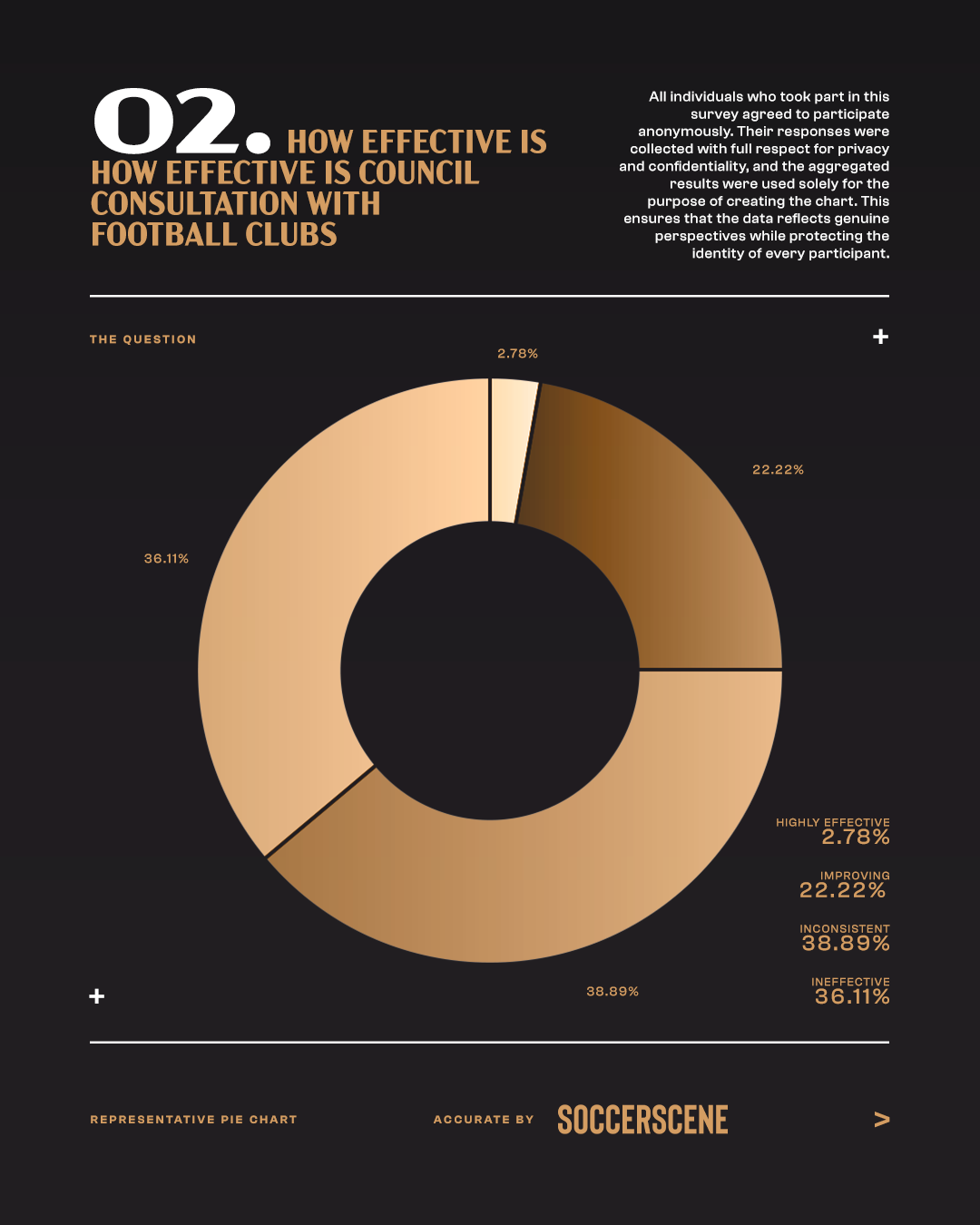
In our survey, over 61% of respondents said their council has limited or no understanding of football participation demand. Consultation outcomes were even worse: 74% said council consultation is inconsistent or ineffective. And when asked if facilities are being planned with long-term growth in mind, the answer should stop every policymaker in their tracks: more than 71% said planning is short-term or non-existent.

Results graphic from Soccerscene’s January industry survey:

This is not a small problem. This is a national warning sign.

Football is not a niche sport. It’s the world’s sport

Councils across Australia are making decisions as if football is still an emerging code, competing for scraps. That thinking is decades out of date.

Football is not only Australia’s largest participation sport in many communities – it is also part of the global economy of sport, the largest sport market on earth, and a cultural engine that connects Australia to Asia, Europe, Africa and the Americas.

When councils underinvest in football infrastructure, they’re not just failing local clubs. They’re failing an entire economic pipeline: participation growth, player development, coaching pathways, community engagement, multicultural integration, women’s sport, health outcomes, events, tourism, and commercial opportunity.

And yet, football is still treated as the code that should “make do”.

The Glenferrie Oval case: a perfect example of the imbalance.

Take the redevelopment of Glenferrie Oval and the historic Michael Tuck Stand in Hawthorn.

This is a major project with a total estimated investment of approximately $30 million, with the City of Boroondara allocating $29.47 million over four years to transform the site into a premier hub for women’s and junior AFL.

Let’s be clear: there is nothing wrong with investing in women’s sport. In fact, it’s essential.

But this investment is also a symbol of something football people have been saying quietly for years: councils understand AFL. Councils prioritise AFL. Councils know how to justify AFL.

They don’t do the same for football, despite its participation scale, multicultural reach, and global relevance.

Across the country, football clubs are being told there is “no funding,” that “planning takes time,” or that facilities “can’t be upgraded yet.” Meanwhile, we see multi-million-dollar grandstands, boutique ovals, and legacy infrastructure funded and delivered for other codes.

Football isn’t asking for special treatment.

Football is asking for fair treatment based on reality.

Councils are stuck in a domestic mindset – while football is global.

Here is the core issue: local councils are making decisions through a domestic sporting lens, while football operates in a global one.

Football isn’t just a Saturday sport. It’s a worldwide industry with elite pathways, commercial frameworks, international investment, and an ecosystem that Australia must compete within.

If councils don’t understand this, they will keep making decisions that shrink our competitiveness.

And this is where the stakes become real.

Australia is not only competing against itself. We are competing against countries like Japan and South Korea, who treat football as a national asset. They don’t leave football infrastructure to fragmented local decision-making without a clear national framework. They invest strategically, align education with delivery, and build systems that create long-term advantage.

We cannot keep pretending we are in the same conversation globally while our local facilities remain stuck in the past.

Clubs are carrying the burden – and it’s breaking the system.

The survey results point to a harsh reality: football clubs feel like they are carrying the weight of growth alone.

When asked what the biggest council-related challenge is, nearly 49% said funding is not prioritised, while others pointed to poor facility design, limited engagement, and slow planning processes.

This isn’t just an inconvenience.

It is creating volunteer burnout, club debt, stagnation in women’s participation, and barriers to junior growth. It is forcing clubs into survival mode – patching up grounds, sharing overcrowded facilities, and trying to grow in spaces that were never designed for modern football demand.

And when planning is short-term, the problem compounds. Councils aren’t just falling behind- they’re building the wrong solutions.

So what do we do? We stop reacting and start leading.

Football cannot keep waiting for councils to “get it” organically. That approach has failed.

What we need now is a national strategic response that is structured, intelligent, and relentless.

This is where football must learn from high-performing football nations  not just on the pitch, but in governance, philosophy, and decision-making.

A powerful example is Korea’s “Made in Korea” project, which was built to identify structural gaps, align stakeholders, and create a unified development philosophy. It wasn’t just a technical framework, it was a national alignment strategy.

Australia needs the off-field equivalent.

A National Football Facilities & Readiness Taskforce.

I believe the time has come to establish a National Football Facilities & Readiness Taskforce, made up of the most capable minds across the game and beyond it.

Not another committee. Not another meeting group.

A taskforce.

It should include leaders from football, infrastructure, urban planning, commercial strategy, government relations, and corporate Australia. We should be selecting the most intelligent and effective people in the country, not based on titles, but based on outcomes.

This taskforce should have one clear mission:

Educate, influence, and reshape how councils plan, consult, and invest in football infrastructure.

Alongside a taskforce, we need long-term strategic working groups embedded across the states, designed to:

educate councils on football participation demand and growth forecasting

standardise best-practice facility design and future-proofing

create consistent consultation frameworks

align football investment with economic, health and multicultural outcomes

build a national narrative that football is an asset rather than a cost

Because right now, the survey shows councils aren’t prioritising football for economic reasons. In fact, only 2.56% of respondents said councils should prioritise football due to economic benefits. This is not because it isn’t true, but because councils haven’t been educated to see football that way.

That is a failure of strategy, not a failure of the game.

This is bigger than facilities – it’s about Australia’s place in the world game.

If we want to be taken seriously as a football nation, we must build a country that treats football seriously.

Not just at elite level.

At local level – where the entire pyramid begins.

The message from the survey is blunt: football’s confidence in councils is collapsing. But within that truth is also an opportunity.

Because when trust hits its lowest point, change becomes possible.

The next step is ours.

We either continue accepting a system that doesn’t understand the world game – or we build one that does.

Most Popular Topics

Editor Picks

Send this to a friend