
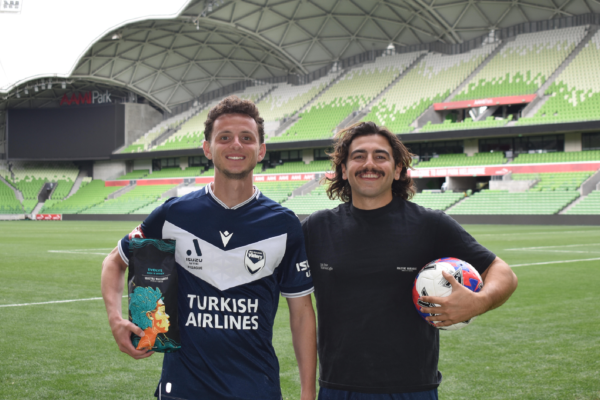


Deploy Football CCO Kurt Johnson: “We’re footballers at heart and know what it takes to build a ball”

Beginning in 2012, Deploy Football have emerged as a leading manufacturer of football products in Australia, with an intrinsic focus on supporting grassroots and community football.

Having built up an extensive network of partnerships with the likes Football NSW, Football Victoria, Brisbane City FC and the Macarthur Football Association among an array of others, Deploy have become a recognisable and reliable brand for footballs and football teamwear.

As opposed to being a sports manufacturer offering multiple product ranges from a variety of sports, Deploy is football-centric. With a staff of 10 committed football adherents Footballs and teamwear, and a locally-minded approach, the quality of Deploy’s products have led it to be one of the only Australian brands approved by a FIFA Pro Quality license.

In a chat with Soccerscene, Deploy Football Chief Commercial Officer Kurt Johnson spoke about the company’s grassroots focus, the importance of developing an array of program-specific products, and their belief in quality above all else.

What inspired the launch of Deploy Football?

Kurt Johnson: Deploy was started in 2012 because we saw a gap in the market for a high-quality, Australian-owned brand that really focused on designing and developing products for grassroots football in Australia.

We wanted to make sure that there was a brand that not only developed top-quality products but also really looked after grassroots clubs in terms of pricing and the customer service.

What separates Deploy Football’s products from other sports manufacturing brands?

Kurt Johnson: First and foremost, every single product we design and develop is tested rigorously before it goes on the market. We spend countless hours in factories globally – hand-selecting all of the materials and meticulously designing every single layer of every single football to ensure that it performs exactly as its intended to.

We have an array of program-specific products designed that suit our customer’s needs. For example, training footballs are designed specifically for the rigors of training, whereas match footballs are designed to perform for a matchday.

A key differentiator between us and the rest of the market is that we are an actual brand. We’re the developer and the manufacturer, we’re not a supplier. And the range has been designed for the development of footballers in the country, so, it’s a consistent range between training footballs and match footballs. It allows players to work on their touch knowing that they have the confidence that the ball is going to perform the way it’s meant to.

How did Deploy Football establish itself as a leading manufacturer of football products in Australia?

Kurt Johnson: We are known for having arguably the best quality footballs on the market. We have a 99% return rate of customers and a less than 1% return rate of faulty products. The community trusts us and we’ve built that over the past 10 years. Currently we have give or take 500 clubs that work with us right around the country.

It is evident that Deploy Football seeks to provide high quality products to ensure effective development and enjoyment for players. How important has Deploy’s partnerships with local associations been to supporting the football community in Australia?

Kurt Johnson: Firstly, we started our partnerships with associations – we partner currently with nine associations and they’re the backbone of our business. We love to partner up with associations because not only does it give us direct access to clubs but also, we love giving back to community football. And unfortunately, community football has traditionally never been looked after by corporate sponsors or big brands.

How significant is it for Deploy Football to provide quality products to local community football clubs and associations?

Kurt Johnson: Quality is our absolute number one goal. We pride ourselves on the quality of our products and the quality of our service, and we pride ourselves on being the best value for money brand on the market. We do not accept inferior quality products.

When we do our testing, we generally test for a solid two seasons before we introduce any new balls to our range, and we’re also known as a football innovator. We’ve innovated three balls; our Rapido E Liso which is a ball designed for summer football; our Heading Pro which is designed for heading education and to reduce the impact of concussions in heading; and the third one we’ve designed is specifically for walking football. So, we like to provide products that are specifically fit for purpose.

We’re footballers at heart and our development team knows what it takes to build a ball. We know what goes into the construction, design and manufacture.

Leading into a massive year for Australian football, with the 2022 Men’s World Cup in Qatar and 2023 Women’s World Cup on home soil, how exciting is the future for Deploy Football?

Kurt Johnson: The exciting thing for us is we’ve forged our business in Sydney metro and we’re proud to be arguably the largest brand in the Sydney metro market. The exciting thing for us as well is the opportunity to expand throughout the rest of the country. And the expansion will also come as participation increases off the back of the World Cups, especially in the female side, it’s exciting for us to be a part of that.

Players cherish their ball, when you were a kid and you got a brand-new one, some kids would sleep with it. We’re proud to know that there a kids who are now 15-years-old who have only ever used a Deploy football. The fact that we’re one of the only Australian brands to hold a FIFA Pro license is exciting for us to continue to be a world-innovator in football.

I spoke to Football Australia about a month ago and noted that the nation continues to produce some of the best players on earth in the men’s and women’s spaces; some of the best coaches on earth – why can’t we produce some of the best football innovators on earth?

The reality is we already do and already have. It’s now our job to tell the world just that.

Previous ArticleNext Article

Football NSW supports Female Coaches CPD as Women’s Football Surges

Football NSW has used the platform of the AFC Women’s Asian Cup to deliver a targeted professional development workshop for female coaches, bringing together scholarship recipients for an evening of structured learning and direct engagement with elite women’s football.

Held at ACPE last month, the session was open to female coaches who received C or B Diploma scholarships through Football NSW in 2025. Coaching accreditation carries a financial cost that disproportionately affects women, who are less likely to have their development subsidised by clubs or associations operating in underfunded community football environments. Scholarship access changes that equation at the point where many women exit the pathway.

Facilitated by Football NSW Coach Development Coordinator Bronwyn Kiceec, the workshop focused on goal scoring trends from the tournament’s group stage, with coaches analysing attacking patterns and exploring how those insights could translate into their own environments. The group then attended the quarter-final between South Korea and Uzbekistan at Stadium Australia.

The structure of the evening mattered as much as its content. Female coaches in community football rarely have access to elite competition environments as a professional resource. The gap between the level at which most women coach and the level at which the game is analysed and discussed tends to reinforce itself. Placing scholarship recipients inside a major tournament, as participants rather than spectators, closes that gap in a way that a classroom session cannot.

Female coaches remain significantly underrepresented across all levels of the game in Australia. The pipeline that will change that depends not only on accreditation access but on the professional networks, peer relationships and exposure to elite environments that male coaches have historically taken for granted.

The workshop forms part of Football NSW’s ongoing commitment to developing female coaches through scholarships and structured learning opportunities.

Record Pathway Breakthrough: Football NSW Report Highlights Power of Access and Equity

Playing soccer

Football NSW has released its 2025 Player Development Report, documenting a year of significant growth across its Talented Player Pathway programs for girls, boys and regional players, and offering the clearest picture yet of how the state’s talent identification infrastructure is reshaping who gets access to elite football development in Australia.

The report distinguishes between three streams: girls, boys and regional, where each operate under the umbrella of the Talented Player Pathway, which encompasses Football NSW’s Youth Leagues, Talent Support Program and state teams. Across all three, the numbers point to a system that is identifying more players, reaching further into the community, and producing more national team representatives than at any previous point in the program’s history.

A Girls Pathway Coming of Age

The girls program recorded some of its most significant outcomes to date in 2025, headlined by the inaugural Future Sapphires Program, a dedicated development environment for 2009, 2010 and 2011-born players that ran 140 training sessions, 16 high-level matches against boys teams, and identified 20 players for national team involvement across its first year alone.

The Talent Support Program conducted 494 player assessments across 119 club visits, with 117 additional games provided for TSP players throughout the season. At the Emerging Matildas Championships, Football NSW fielded three state teams, with the Under-15s Sky team claiming the championship, the Under-16s finishing as runners-up, and the Under-15s Navy placing third.

The pathway-to-national-team conversion rate was striking. Of the 23-player squad selected to represent the Junior Matildas at the AFC Under-17 Women’s Asian Cup Qualifiers, 13 were from Football NSW, a 56.5 percent representation rate from a single state federation.

“This report does not simply provide data and numbers,” said Girls Player Development Manager Nadine Shiels. “It highlights our progress and validates the standards we set.”

The equity implications of that pipeline are significant. Elite female footballers in Australia, have historically faced a narrower and less resourced development corridor than their male counterparts. Programs like the Future Sapphires and the TSP are structural interventions in that imbalance, reshaping access mechanisms that determine which players get seen and which do not.

Boys Program Deepens its Reach

The boys Talent Support Program underwent deliberate restructuring in 2025, reducing squad sizes from approximately 90 players and five teams to 54 players and three teams per age group, while extending match duration from 50 to 70 minutes. The intent was to raise the standard of the best-versus-best environment rather than simply widen it.

The results support that confidence. To date, 155 players who have participated in the boys TSP have transitioned to A-League academies, with approximately 35 progressing to A-League Men’s competition and a further 30 representing Australia at junior national level across the Under-17, Under-20 and Under-23 squads.

The 2025 season added four Talent Development Scheme matches for players born between 2007 and 2009, delivered in collaboration with Football Australia and targeting potential Junior Socceroos and Young Socceroos selection. The program also hosted the inaugural A-Leagues/TSP Tournament at Valentine Sports Park in December, featuring Melbourne City, Melbourne Victory, Western Sydney Wanderers, Sydney FC, Macarthur Bulls Academy and a TSP Select team.

“Our purpose is clear- not only to identify talent, but to prepare it,” said Boys Player Development Manager Philip Myall.

The Regional Question

Perhaps the most structurally significant section of the report concerns regional development- the stream that most directly addresses the geographic equity gap in Australian football’s talent pipeline.

Talent identification in Australia has historically concentrated in metropolitan areas, where NPL clubs, A-League academies and state federation programs are most densely located. Players in regional and rural NSW face a structural disadvantage that has nothing to do with ability and everything to do with geography. Fewer club visits, reduced access to high-performance environments, and reduced visibility to the coaches and scouts who determine national team selection saliently reflect a systemic barrier.

The 2025 regional TSP involved 241 players across 57 training sessions, 18 hub matches and 58 additional tournament games, with Football NSW coaches present at local association fixtures and regional tournaments including the Bathurst Cup and Country Cup. Regional players were also integrated into Elite Game Days at Valentine Sports Park, directly competing against metropolitan TSP cohorts and A-League academy players.

“The program has continued to enable identified players to progress and be part of the greater football elite player pathway,” said Regional Development Manager Andrew Fearnley, “with opportunity to progress and be identified into national youth teams.”

Most Popular Topics

Editor Picks

Send this to a friend