

Record Pathway Breakthrough: Football NSW Report Highlights Power of Access and Equity

Playing soccer

Football NSW has released its 2025 Player Development Report, documenting a year of significant growth across its Talented Player Pathway programs for girls, boys and regional players, and offering the clearest picture yet of how the state’s talent identification infrastructure is reshaping who gets access to elite football development in Australia.

The report distinguishes between three streams: girls, boys and regional, where each operate under the umbrella of the Talented Player Pathway, which encompasses Football NSW’s Youth Leagues, Talent Support Program and state teams. Across all three, the numbers point to a system that is identifying more players, reaching further into the community, and producing more national team representatives than at any previous point in the program’s history.

A Girls Pathway Coming of Age

The girls program recorded some of its most significant outcomes to date in 2025, headlined by the inaugural Future Sapphires Program, a dedicated development environment for 2009, 2010 and 2011-born players that ran 140 training sessions, 16 high-level matches against boys teams, and identified 20 players for national team involvement across its first year alone.

The Talent Support Program conducted 494 player assessments across 119 club visits, with 117 additional games provided for TSP players throughout the season. At the Emerging Matildas Championships, Football NSW fielded three state teams, with the Under-15s Sky team claiming the championship, the Under-16s finishing as runners-up, and the Under-15s Navy placing third.

The pathway-to-national-team conversion rate was striking. Of the 23-player squad selected to represent the Junior Matildas at the AFC Under-17 Women’s Asian Cup Qualifiers, 13 were from Football NSW, a 56.5 percent representation rate from a single state federation.

“This report does not simply provide data and numbers,” said Girls Player Development Manager Nadine Shiels. “It highlights our progress and validates the standards we set.”

The equity implications of that pipeline are significant. Elite female footballers in Australia, have historically faced a narrower and less resourced development corridor than their male counterparts. Programs like the Future Sapphires and the TSP are structural interventions in that imbalance, reshaping access mechanisms that determine which players get seen and which do not.

Boys Program Deepens its Reach

The boys Talent Support Program underwent deliberate restructuring in 2025, reducing squad sizes from approximately 90 players and five teams to 54 players and three teams per age group, while extending match duration from 50 to 70 minutes. The intent was to raise the standard of the best-versus-best environment rather than simply widen it.

The results support that confidence. To date, 155 players who have participated in the boys TSP have transitioned to A-League academies, with approximately 35 progressing to A-League Men’s competition and a further 30 representing Australia at junior national level across the Under-17, Under-20 and Under-23 squads.

The 2025 season added four Talent Development Scheme matches for players born between 2007 and 2009, delivered in collaboration with Football Australia and targeting potential Junior Socceroos and Young Socceroos selection. The program also hosted the inaugural A-Leagues/TSP Tournament at Valentine Sports Park in December, featuring Melbourne City, Melbourne Victory, Western Sydney Wanderers, Sydney FC, Macarthur Bulls Academy and a TSP Select team.

“Our purpose is clear- not only to identify talent, but to prepare it,” said Boys Player Development Manager Philip Myall.

The Regional Question

Perhaps the most structurally significant section of the report concerns regional development- the stream that most directly addresses the geographic equity gap in Australian football’s talent pipeline.

Talent identification in Australia has historically concentrated in metropolitan areas, where NPL clubs, A-League academies and state federation programs are most densely located. Players in regional and rural NSW face a structural disadvantage that has nothing to do with ability and everything to do with geography. Fewer club visits, reduced access to high-performance environments, and reduced visibility to the coaches and scouts who determine national team selection saliently reflect a systemic barrier.

The 2025 regional TSP involved 241 players across 57 training sessions, 18 hub matches and 58 additional tournament games, with Football NSW coaches present at local association fixtures and regional tournaments including the Bathurst Cup and Country Cup. Regional players were also integrated into Elite Game Days at Valentine Sports Park, directly competing against metropolitan TSP cohorts and A-League academy players.

“The program has continued to enable identified players to progress and be part of the greater football elite player pathway,” said Regional Development Manager Andrew Fearnley, “with opportunity to progress and be identified into national youth teams.”

Previous ArticleNext Article

What Football Queensland’s link with Green Room Futures Means as Pathway Strategy Broadens

Football Queensland has signed a multi-year extension and expansion of its partnership with Green Room Futures, formalising the private provider as the state body’s “Official US College & Tour Partner” and adding an annual United States tour for Football Queensland Academy players to the existing college-placement program.

From advisory model to integrated pathway

The agreement marks a substantive evolution in the governing body’s pathway architecture rather than a standalone sponsorship announcement. The two organisations have worked together since at least 2024, when Football Queensland first appointed Green Room Futures as its preferred US college partner and began rolling out athlete information sessions across metropolitan and regional centres. The new arrangement embeds that relationship more deeply into the academy ecosystem by linking advisory services with an international touring product.

In its announcement, Football Queensland said the expanded partnership would offer academy players exposure to US college environments, international competition and broader education-and-sport decision-making support. Chief executive Robert Cavallucci said the relationship had already assisted Queensland athletes to pursue opportunities overseas and that the introduction of an annual tour would strengthen development outcomes for players across the state’s regional footprint. Green Room Futures director Matt Wade said the expansion reflected strong demand for structured US pathways and would provide athletes with more direct insight into student-athlete systems.

A constrained domestic market

For Football Queensland, the strategic rationale means a collegiate model is now an established part of the global football labour market, particularly for players seeking a dual track in education and high-performance sport. In an Australian landscape where professional opportunities remain selective and uneven, college pathways provide a parallel route with different risk settings for families. That logic has been gaining institutional acceptance across the country, and Football Queensland’s move suggests it sees formal international exposure as a competitive differentiator within domestic talent development.

The policy and governance questions are equally clear. The public announcement outlines ambition, but provides limited operational detail on affordability, cohort selection and support settings for regional participants. In practical terms, these details will determine whether the program functions as a broad-based development mechanism or as a premium pathway accessed primarily by households able to absorb compounding costs.

International youth tours involve direct and indirect expenses that typically include flights, insurance, accommodation, tournament costs, travel preparation and time-off-work burdens for families, with regional players often carrying additional domestic travel requirements before departure. Green Room Futures’ publicly available materials also indicate paid service structures within broader college-placement support. None of that is unusual in this market segment; it is, however, central to any serious assessment of access and equity outcomes.

The expanded partnership therefore sits at the intersection of football development strategy and distributional policy. If the tour becomes an informal gatekeeper to college-facing visibility, then financial design features move from administrative detail to core pathway governance. Without those mechanisms, even merit-led programs can produce systematically narrow outcomes because the input conditions are unequal.

For Football Queensland, the outcomes are likely to turn on implementation transparency over the next one to two intake cycles. A cohort profile that is geographically concentrated or socioeconomically narrow would invite predictable criticism, particularly given repeated statewide positioning in Football Queensland’s academy communications. Conversely, early publication of eligibility frameworks, financial assistance settings and regional participation targets would strengthen claims that the program is designed as a genuine statewide pipeline rather than a metropolitan premium add-on.

There is also a broader sector trend at play. Australian sporting bodies increasingly rely on specialist private partners to deliver pathway components once managed internally or left to informal networks. The model can improve expertise and execution speed, but it also shifts part of the development interface into commercial structures. In that context, governing bodies carry a heightened obligation to disclose how partner-delivered opportunities align with public-facing participation commitments, especially where youth athletes and family finances are involved.

What comes next

Well-structured US pathway programs can materially improve athlete decision quality, reduce information asymmetry, and create legitimate post-school options in a constrained professional market. Exposure to college environments can help families evaluate trade-offs around education, migration and sporting progression with greater clarity. For some players, that can be decisive.

The question for Football Queensland is whether the benefits are distributed in a way consistent with its statewide mandate. The announcement establishes intent and strategic direction; the next phase requires publication-grade detail. For a program framed around opportunity, credibility will depend less on partnership language and more on measurable participation design: who is selected, who is supported, and who is priced out.

Football West’s NAIDOC ball competition turns Indigenous art into a road safety message, and a rare form of representation

Football West has opened its 2027 NAIDOC Ball Design competition, inviting members of Western Australia’s Aboriginal and Torres Strait Islander communities to submit artwork that will end up printed on 500 footballs and distributed to schools, clubs and communities across the state. It is a small competition with a modest prize, a $1,000 voucher and a set of ten footballs for the winner. But what it is actually doing sits somewhere more significant than a design contest.

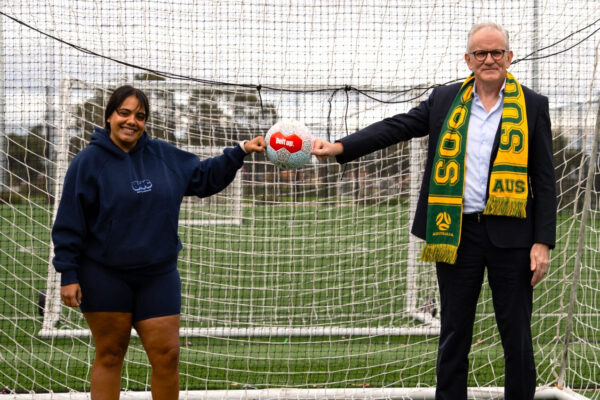
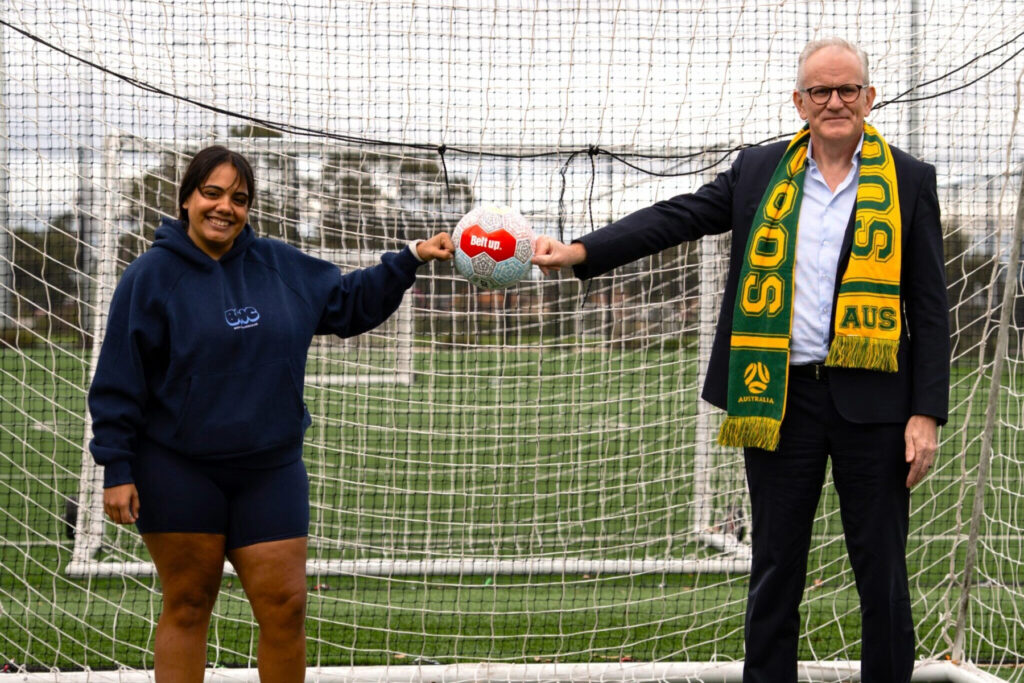
The 2027 edition is a joint initiative between Football West, the Insurance Commission of Western Australia and, for the first time, Football Futures Foundation. The winning design will carry the Insurance Commission’s Belt Up road safety message alongside the artwork, with the footballs distributed during NAIDOC Week, which runs from 4 to 11 July next year.

Football Futures Foundation CEO Michael Kerr framed the partnership as an extension of work the Foundation already runs across the state.

“Through programs such as Dreamtime Spirit and Yilkari, supported by former Matildas goalkeeper Lydia Williams, we are working alongside Aboriginal and Torres Strait Islander communities to create football opportunities that are culturally safe, community-led and built around genuine belonging,” Kerr said.

A message that travels further in a football

Road trauma in Australia isn’t evenly distributed. Indigenous Australians are consistently found in national research to be two to three times more likely to be killed in a road transport crash than non-Indigenous Australians, a disparity driven in part by higher rates of pedestrian and passenger injury and compounded by the realities of remote and regional life, longer travel distances, older vehicles, and limited access to emergency care when something goes wrong. Seatbelt non-use remains one of the most consistent contributing factors in that gap.

The Insurance Commission has invested more than 2 million dollars in the Belt Up campaign over its seven years, and its Chief Investment Officer, Steve McKenna, has been explicit about who the message is aimed at.

“About 170 people die on the road each year in Western Australia,” McKenna said. “About 60 per cent of those are male. Of that total, 17 per cent aren’t wearing seatbelts when they die.”

Generic road safety advertising struggles to reach communities where trust in government messaging is not automatic and where the delivery channel matters as much as the message itself. A football, carrying artwork made by a member of the community it is meant to reach, distributed through a sport that already has deep informal roots in many Aboriginal communities, moves in a way a billboard cannot. That is not incidental to the campaign. It is the entire design logic.

Whose stories get told

Jarnda Councillor-Barns, the Ellenbrook artist who won the 2026 competition, used the colours of the Aboriginal and Torres Strait Islander flags in her design, with circular patterns representing gatherings and connecting pathways representing the journeys, knowledge and skills each player carries.

“I really wanted to amplify the stories that are in the Football West community, whether you’re based metro or rural like I was, and how everyone in a team comes with their own stories,” Councillor-Barns said.

Her own football story reflects exactly the kind of informal, community-rooted participation the competition is built to recognise. She grew up in Broome playing social games whenever she could, and has family connections to the Jambinu team, a regional Indigenous women’s side based in Geraldton, despite never being formally registered with a club herself.

“Soccer is a sport that brings people from all walks of life together, creating a larger family built on respect, teamwork and shared passion,” she said.

Football West’s David Williams, a former Socceroo who now heads the National Indigenous Boys Under-16s program, said initiatives like this had value beyond the artwork itself.

“For the creativity of artists to be involved with sport goes a long way,” Williams said. “The more initiatives we have with this kind of stuff, the better.”

That is a modest way of describing what is, functionally, a form of representation that Indigenous communities in Australian sport have not always had. Governing bodies commission Indigenous rounds, jerseys and acknowledgements regularly. Fewer hand the creative authorship, and a public platform for it, directly to community members with no requirement that they already hold a formal position within the sport.

Insurance Commission Chief Investment Officer Steve McKenna, reflecting on the 2026 winning design at its unveiling, saw something in it that spoke to the broader purpose of the exercise.

“You see the Socceroos playing, and look across the team, and a ball like this, the designs, it reflects what Australia’s all about,” McKenna said.

In the meantime, five hundred footballs carrying a community-made design and a road safety message will reach further into regional and remote Western Australia than most government campaigns manage on their own. Whether that message changes behaviour on the roads that data suggests still needs the most attention is the harder, longer question the competition cannot answer by itself.

Most Popular Topics

Editor Picks

Send this to a friend