




Three-way global alliance set to take Australian football coaches and analysts to a new level

A new global partnership designed to take Australian football coaches and analysts to a new level of excellence was jointly announced today. Global Institute of Sport (GIS), Football Coaches Australia (FCA) and cutting-edge experiential learning firm XVenture have joined forces to provide unique opportunities for Australian football coaches and analysts to improve and accelerate their careers both here and abroad. Central to this collaboration is that upon completion of the immersive virtual reality based FCA XV Essential Skills Program, motivated Australian coaches and analysts can now be considered for entry into GIS’ pioneering MSc Football Coaching & Analysis Master’s degree. The FCA XV Essential Skills Program is made up of five modules covering:

  • Emotional Intelligence;
  • Leadership;
  • Communication;
  • Culture; and
  • Resilience.

The program is delivered in a self-paced online-based virtual world campus, with over 100 subjects brought to life as videos, podcasts, articles, websites and interactive e-books.

The modules cover universal themes and seamlessly integrate classic and contemporary models and thinking with each subject coloured with examples and cases from football, other sports and business globally.

This course aligns well with the themes of the MSc Football Coaching & Analysis Master’s program, which is also delivered in GIS’ inspirational campuses in the UK and US, which have Wembley, Etihad and DRZ PNK stadiums at their heart.

Brand new from January 2023, Australian coaching students will be able to study with GIS online with immersive face-to-face residentials once per year in Melbourne, including at the iconic Melbourne Cricket Ground. In addition, GIS, FCA and XVenture have pledged to provide mutual guest speaker, placement and study tour opportunities for coaches to learn from their combined network of global football industry leaders.

Previous GIS guest speakers have included Harry Kewell, Gareth Southgate, Steven Gerrard and Hope Powell.

Glenn Warry, CEO of Football Coaches Australia, said: “We’re delighted to partner with Global Institute of Sport to provide enhanced progression opportunities for Australian football coaches and analysts. Aligning and integrating Australian football coach education and tertiary education pathways for coaches and other sports professionals is an important part of our strategy to enhance best practice, networking and high-performance capabilities of current and future Australian coaches. The future opportunity of partnering with GIS and XVenture to presenting high-performance coaching programs at world-class stadiums is exciting for all.”

The author of the FCA XV Essential Skills Program, XVenture Founder and CEO, Mike Conway, stated: “Having the opportunity to partner with a global sports education provider who is committed to providing best-in-class learning opportunities is fantastic. My team and I are passionate about developing accelerated experiential learning programs and we’re looking forward to working with GIS academics and students.” Mike is currently also working as the emotional agility and mind coach for the Australian National Football team, the Birmingham Phoenix Women’s team and the Adelaide 36ers NBL team.

Sharona Friedman, GIS President, added: “The aim of this partnership is to create an environment that helps to provide better and increased opportunities for Australian coaches, not just domestically but also globally. On top of this, it will also facilitate enhanced learning and career opportunities for GIS students studying on campus in the UK and online across the globe.”

Previous ArticleNext Article

Netflix’s Women’s World Cup deal puts IMG’s technology in the spotlight

Netflix’s first exclusive football deal will see the next year’s FIFA Women’s World Cup at the centre of it’s live-sport strategy. The US-streaming service company has appointed IMG as its production partner for all 64 matches in Brazil, as well as more than 100 hours of live studio programming. The deal includes English and Spanish coverage for viewers within the US, and English and French-language coverage for those in Canada. IMG will also support Netflix’s coverage of the tournament’s draw in December.

The 2027 Women’s World Cup runs from June 24 to July 25 across eight host cities, and will be the first edition to feature 32 teams. The scale of the tournament makes it an ambitious first foray into sports broadcasting for Netflix – which means IMG’s involvement will be of great significance.

IMG’s production engine

IMG has built its reputation on producing and distributing live sport at scale. It’s Stockley Park, London facility includes broadcast studios, production galleries, edit suites and facilities for radio, podcasting, dubbing and visual effects. The company has worked across major properties including the Premier League, Major League Soccer and other international sporting events.

For a World Cup, this infrastructure provides more than a place to make television; it creates a central point where production teams can manage feeds, graphics, replays, commentary, editing and distribution while events are taking place thousands of kilometres away.

Remote production is the key

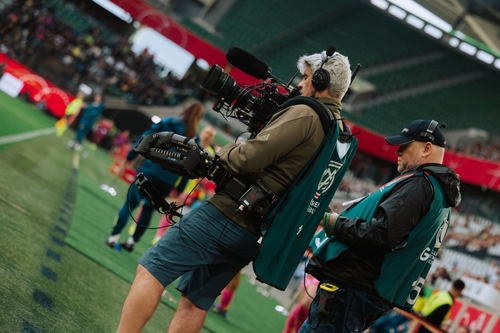
The most important technology for a tournament spread across eight Brazilian cities is connectivity. IMG has invested in remote-production workflows that allow production teams to work across locations, rather than putting every specialist inside each stadium. Its wider production operation has used fibre, satellite, cloud and IP-based connectivity to move live signals between venues and production centres.

That model can reduce the amount of equipment and specialist staff required at every venue while allowing senior producers, directors, replay operators and graphics teams to work from centralised facilities. IMG has also demonstrated long-distance IP production, including a 20,000-kilometre link between Tokyo and London that carried uncompressed, low-latency video. For Netflix, those capabilities are particularly relevant. The platform is building a single viewing experience for audiences in two markets, but the raw ingredients will come from stadiums spread across Brazil. A resilient network becomes just as important as the cameras themselves.

From stadium to stream

The technology chain does not end when the pictures leave the venue. A modern sports production operation has to manage ingest, replay, media asset management, graphics, audio, quality control, archiving and transmission. IMG’s facilities have been built around those workflows, with master control and transmission capabilities alongside post-production and archive operations.

That infrastructure also gives IMG the ability to turn the live tournament into a wider stream of content. A goal can become a replay, a highlight, a social clip or part of a studio package without waiting for the match to finish. For Netflix, that fits a platform built around on-demand discovery as much as live viewing.

A new test for Netflix

Netflix has already made a significant investment in football through documentaries and other programming. The 2027 Women’s World Cup takes it up a level. FIFA describes the agreement as the first competition Netflix has acquired in full, making the tournament a major test of its live sports operation. IMG therefore has a job that goes beyond producing 64 matches; it must help Netflix build the technical backbone for a month-long, multi-venue broadcast, while maintaining consistent production standards across languages and locations.

The viewer may simply press play and see a World Cup match appear instantly. Behind that button will be a complex network of cameras, connectivity, control rooms, production systems, people and data. That is the real significance of Netflix’s IMG deal: the streamer is bringing the tournament to its platform, but IMG is providing much of the machinery that can make a global football event feel seamless.

GIS Sydney connects students with Australia’s sporting industry

The Global Institute of Sport (GIS) is giving students new opportunities to build careers in Australia’s growing sports industry. Combining academic study with direct access to sporting organisations, venues and industry professionals. Based at Allianz Stadium and the Sydney Cricket Ground, GIS Sydney places students at the heart of Australia’s sporting landscape. The campus gives students the chance to study while surrounded by major sporting organisations and events, creating a direct connection between education and the industry they hope to join.

Students also benefit from regular access to experienced sports professionals. More than 50 guest speakers have shared their expertise with GIS students, including representatives from FIFA, Red Bull, Cricket Australia and the AFL. These sessions give students a valuable insight into the different roles and career pathways available across the sports sector. GIS Sydney delivers programs including Sports Analytics and International Sports Business in partnership with the University of Newcastle. The courses combine academic learning with opportunities for students to develop practical skills that they can take into the workplace.

Industry experience forms another important part of the student journey. GIS provides students with 140 hours of relevant work experience, allowing them to apply their knowledge in professional settings. Students have secured placements with organisations including the Professional Football Scouts Association, Football Coaches Australia and Basketball NSW.

GIS also works with Yakka Sport to create paid employment opportunities for students while they study. This allows students to gain workplace experience while developing professional networks within the sporting community. The opportunities extend internationally, with GIS Global Sports Summits giving students access to sporting organisations and venues in destinations including London and Miami.

For students pursuing careers in sport, GIS Sydney is creating a pathway that combines education, practical experience and industry connections. By bringing students closer to the people and organisations shaping the sector, GIS is helping the next generation turn their interest in sport into professional opportunities.

Most Popular Topics

Editor Picks

Send this to a friend