


Varied and adaptable in his work as a sports broadcaster, Ben Homer’s professional journey through the world of Australian sport is reflective of a shared experience for Australia’s sporting youth.
Hailing from Newcastle, Homer was raised in a sporting household that favoured rugby league and cricket, however his desire to push outside of what he knew to absorb and take part in other codes lead him to savour all that was available for him. With opportunities aplenty offered to the then youngster as a result of Australia’s diverse sporting landscape, Homer’s love of football was stirred organically and not passed down through family.
The multifaceted commentator attributes his love of football to the enduring legacy of SBS as a broadcaster, with Champions League mornings and World Cup tournaments (consumed in and around the A-League era which saw Shinji Ono, Emile Heskey and Alessandro Del Piero arrive) proving to be an immense drawcard for him.
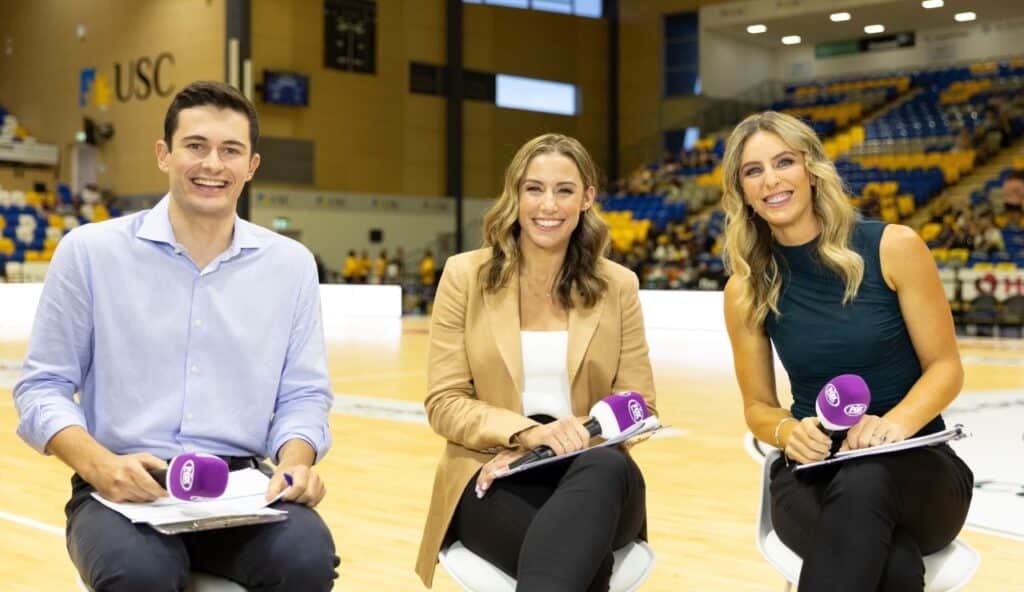
Splitting his time between broadcast work for Fox Sports and Network 10 where he covers football, rugby league, netball and cricket, Homer sat down with Soccerscene to chat about the year ahead for Australian football, his thoughts on Australia’s sporting ‘code wars’, and his own personal journey as a sports broadcaster.

How did you first get involved in the world of sports broadcasting? Where did the interest come from?
Ben Homer: I’ve always been interested in sport from when I was a kid. From when I was five or six, I remember my dad taking me down to watch the local footy team – which here in Newcastle is the Newcastle Knights, and obviously it’s a big rugby league town. That’s my first memory of going to a sporting event and it fuelled my passion in a lot of sports.
As a kid I used to play a lot of sports, including football, tennis, rugby league, hockey – I know some people really love watching sport but not playing it and vice versa – but for me I just loved having both of those intermesh. Playing them taught me a lot about the game and then I could watch it and understand it a whole lot better.
In terms of commentary, I used to play games of footy in the backyard with my brother or we’d play in the hallway with a soft football and I used to commentate games. But I didn’t really know at that point that I wanted to be a commentator, it was just what I used to do, even when we’d go to a mate’s place and play FIFA I used to commentate. But it wasn’t until I went into high school and did work experience at the local ABC that I realised I wanted to go into the journalism field. I went to watch some games that the local broadcast team commentated and that was where I found that passion for commentary.
What is it like for you to commentate multiple codes outside of football?
Ben Homer: I love calling different sports because it’s similar to why I played different sports as a kid – I get bored doing the same thing over and over again. So, to be able to cover so many different sports is so much fun but it’s also really challenging, because you have to know the correct terminology for those sports.
What I’ve really been working on this year as I’ve been calling netball, cricket, football and rugby league is adjusting to the sport on the day. Because it’s all well and good to be informed about the game you’re calling, but I found after doing it a bit and switching between sports that I need to sit down on the day of the game and identify exactly what I need to bring for that sport.
For rugby league, the energy and intensity is a lot higher throughout the game, and you’re building up as the match is moving into the attacking 20 most of the time. In football, it’s a lot different because something can happen completely out of no where and you’ve got to have that ability to go from 0 to 100 really quickly.
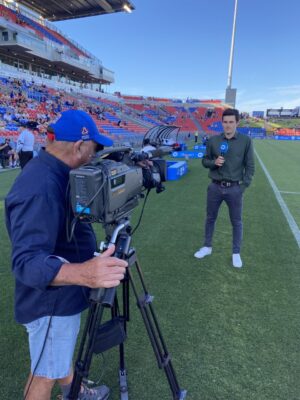
As a younger commentator, what has your experience been like coming through the broadcasting industry?
Ben Homer: I was really fortunate to receive some good advice when I first started commentating, and that was that you do have to work hard, but when you work hard you get a bit of luck that comes with that as well. One thing an ex-broadcaster mentor of mine Gerry Collins told me is that you need to have that ‘right place, right time’ experience.
I came through in 2015 right at the start of the live streaming of sport, which here in Newcastle was being initiated by this group called BarTV. That allowed me to get working on the NPL probably before a lot of competitions started the livestream. So it was really fortunate that I got in at that point and was able to make a lot of mistakes, learn a lot and develop my style.
That readied me for when the opportunity came up to commentate for the formerly named FFA Cup when Fox Sports decided to livestream the games that weren’t covered on their main channel. The great thing about that was the fact that I wasn’t immediately thrust into calling a game on TV straight away and had to work my way up since I started eight years ago.
Being from a sporting household where you played and followed more than just the one sport, how do you feel that shaped your view of Australia’s sporting landscape and how does football fit into it?
Ben Homer: Growing up, a lot of my friends that loved football did so because their parents loved it, and I come from a family where rugby league and cricket are the main sports. I always feel that we need more people that don’t grow up as football fans, falling in love with the game because that is where you attract that fan base. Because the people who are rusted on will always be fans of football because it’s in their blood. I think the more people the game can attract where you might have come from a rugby league family and you love the game is so important.
I get disappointed sometimes when people say that you can only like football, because you can support a whole range of different codes and still be interested in a variety. You don’t have to be a fan of just one code and that’s why I get annoyed at these code wars where it’s like ‘if you love the NRL, you can’t love the AFL’ – well why can’t you? The amount of things that you can learn from different sports and how they go about their game is so interesting. To push that aside for code war reasons is cutting your nose off to spite your face.

In your time working as a broadcaster for the A-Leagues you’ve seen the transition from Fox to now 10 ViacomCBS. What are your thoughts on where the A-Leagues are at under their new broadcaster?
Ben Homer: What I really like is the content with A-Leagues All Access and the KEEPUP app bringing back A-Leagues Fantasy which has been good to get back into. I just think it builds people talking about the game. To be fair, the first season in 2021-22 was just so challenging, not just for the A-Leagues and the APL but a whole range of sports trying to get crowds back in stadiums.
I was really invigorated seeing the Round 1 crowds; I know the PFA have put out a 10,000 average to work towards. If we can attain that this year that’d be superb, considering crowds were dwindling even prior to COVID, but I feel the league is in a really good position this year with Melbourne Victory getting good crowds, Sydney FC back at Allianz, the Wanderers getting their identity back under Marko Rudan, and the Central Coast Mariners under good leadership.
There’s a really good foundation this year for the A-Leagues to take off and I think that we’re going to see that over the next six weeks leading into the men’s World Cup. This is a wonderful opportunity because we talk about the mainstream media not really covering football but when it comes to a World Cup, it does.
The conversation leading into the World Cup about the Socceroos will maybe lead people to want to watch to see how the likes of Andrew Redmayne, Craig Goodwin, Jason Cummings, and Garang Kuol are going. And if the Socceroos get a result at the World Cup and the A-Leagues players are starring, well you already saw what happened with Redmayne following the World Cup qualifier against Peru – his profile just went massive after that.
If we can build those storylines after the World Cup and seep that back into the A-League, I just think that’s going to be really helpful to us getting back to those numbers that we saw in the gates five or six years ago.
How significant is this upcoming period going to be for women’s football in Australia?
Ben Homer: I just think it’s going to be amazing, and I went to France in 2019 and it was one of the greatest shows I’ve ever been to. And this’ll be the greatest show on earth that Australia has seen and perhaps it’ll be bigger than the Olympics in 2000, even though I can’t comment because I can’t remember the Olympics.
The thing about this World Cup is you’ve got countries coming to this tournament, some for the first time, and players coming off the back of what we saw with the recent EUROs and the ratings that that tournament generated. I think that the Women’s World Cup next year is going to be absolutely amazing, and regardless of how the Matildas go it is going to be such an amazing experience.
I think a lot of people in Australia don’t know what’s about to hit when the Women’s World Cup comes to Australia and New Zealand. It’s so good that we partnered with them because I don’t think we would’ve won the bid without them as FIFA were looking for a multi-country format.