

How Commonwealth Bank is set to ignite women’s football in 2023

CBA

Commonwealth Bank – the official naming rights sponsor of the CommBank Matildas – has partnered with FIFA as a FIFA Women’s World Cup 2023 Official Supporter for next year’s tournament.

The partnership reaffirms Commonwealth Bank’s commitment to investing into women’s football and sees them becoming one of the largest brand investors in women’s sport in Australia – which only further highlights the growth and trajectory of the game not only locally, but across the globe.

With the Matildas poised to co-host a historic tournament on home soil with New Zealand, CommBank and FIFA will work together on many initiatives and activations as the countdown to the largest women’s sporting event on the planet continue, most notably the CommBank FIFA Women’s World Cup 2023 Player Escort Programme, which will see 1,500 children aged 6-10 accompany players onto the pitch before matches in a once-in-a-lifetime opportunity.

Speaking with Soccerscene, Dianne Everett – General Manager of Brand & Creative at Commonwealth Bank – outlined the ambitions of the partnership and how Commonwealth Bank is looking to grow women’s football in Australia.

Commonwealth Bank has been named the Official Bank Supporter of the 2023 Women’s World Cup. What is the intended impact of this partnership?

Diane Everett: Our goal is to show young girls and women that they can do anything and achieve great things on the world stage.

We look forward to working with the FIFA Women’s World Cup 2023 in the lead up to this exciting event next year and inspire future generations of sporting superstars, from grassroots to elite playing levels.

Commonwealth Bank have been the naming rights sponsor for the Matildas for some time now. How successful has the partnership been so far?

Diane Everett: Our partnership with the CommBank Matildas is strong, with the team going from strength to strength on the international football stage. Match attendance and viewership for Matildas’ games has doubled since our partnership with Football Australia was announced last year.

We’re also supporters of the elite pathway and junior teams, the Young Matildas (under 20s) and Junior Matildas (under 17s), helping to grow the next generation of national football stars. Additionally, we also support the ParaMatildas, Australia’s national teams for players with cerebral palsy, acquired brain injury and symptoms of stroke, creating more opportunities for all to play.

We look forward to continuing to support the CommBank Matildas as they lead up to hosting the world on home soil in 2023.

The 2023 Women’s World Cup arrives at a critical time for Australian football where women’s football is on the precipice of exploding. How is CommBank looking to bring further attention to football in Australia in this period?

Diane Everett: Our tie-up with the FIFA Women’s World Cup 2023 will enable us to offer customers a range of offers and benefits that will drive further attention to football in Australia.

One of these initiatives is the CommBank FIFA Women’s World Cup 2023 Player Escort Programme. This grassroots initiative will enable 1,500 children across Australia and New Zealand to be part of the tournament and accompany players onto the pitch at the start of each match – a money can’t buy experience. There will be many more exciting activities announced in the road to FIFA Women’s World Cup 2023 that will drive further excitement and attention to football in Australia.

Undoubtedly CommBank’s partnership with the 2023 Women’s World Cup will ensure greater visibility on the tournament. How will CommBank be looking to promote the tournament in the lead-in?

Diane Everett: We have a range of initiatives and activities prepared for the road to the FIFA Women’s World Cup 2023 that will be announced in due course.

The CommBank FIFA Women’s World Cup 2023 Player Escort Programme – for example – will provide chances for customers and communities to get involved and secure spots as part of this initiative during the road to the FIFA Women’s World Cup 2023.

What initiatives will CommBank be driving to ensure the growth of women’s football in Australia throughout the next year?

Diane Everett: Stay tuned! We look forward to sharing more in lead up to the FIFA Women’s World Cup 2023.
Previous ArticleNext Article

The Participation Boom Councils Didn’t Plan For Is Hitting Football Hard

Football in Australia isn’t being held back by passion, participation, or community support. It’s being held back by local government failure. From a CEO perspective, the warning signs are no longer subtle — they’re screaming. Confidence towards councils is collapsing, clubs are done believing the rhetoric, and the people carrying the game every weekend are telling us the same thing: councils don’t understand football, don’t consult properly, and don’t plan for growth. This isn’t opinion anymore. It’s measurable. And it should embarrass every policymaker in the country.

Football in Australia isn’t struggling because of a lack of passion. It isn’t struggling because communities don’t care. And it certainly isn’t struggling because participation is declining.

Football is struggling because, at the local government level, confidence is collapsing. What is more, the people closest to the game can feel it.

Soccerscene’s latest survey on council readiness and football planning shows something deeply confronting: trust in councils is at its lowest point, and clubs no longer believe the rhetoric. Councils frequently speak about “supporting the world game” and “investing in community sport,” but the data tells a different story.

The people building the game every weekend, people such as presidents, coaches, volunteers and administrators, are telling us councils do not understand football demand, do not consult effectively, and do not plan for long-term growth. And that’s not an emotional opinion. It’s now measurable.

In our survey, over 61% of respondents said their council has limited or no understanding of football participation demand. Consultation outcomes were even worse: 74% said council consultation is inconsistent or ineffective. And when asked if facilities are being planned with long-term growth in mind, the answer should stop every policymaker in their tracks: more than 71% said planning is short-term or non-existent.

Results graphic from Soccerscene’s January industry survey:

This is not a small problem. This is a national warning sign.

Football is not a niche sport. It’s the world’s sport

Councils across Australia are making decisions as if football is still an emerging code, competing for scraps. That thinking is decades out of date.

Football is not only Australia’s largest participation sport in many communities – it is also part of the global economy of sport, the largest sport market on earth, and a cultural engine that connects Australia to Asia, Europe, Africa and the Americas.

When councils underinvest in football infrastructure, they’re not just failing local clubs. They’re failing an entire economic pipeline: participation growth, player development, coaching pathways, community engagement, multicultural integration, women’s sport, health outcomes, events, tourism, and commercial opportunity.

And yet, football is still treated as the code that should “make do”.

The Glenferrie Oval case: a perfect example of the imbalance.

Take the redevelopment of Glenferrie Oval and the historic Michael Tuck Stand in Hawthorn.

This is a major project with a total estimated investment of approximately $30 million, with the City of Boroondara allocating $29.47 million over four years to transform the site into a premier hub for women’s and junior AFL.

Let’s be clear: there is nothing wrong with investing in women’s sport. In fact, it’s essential.

But this investment is also a symbol of something football people have been saying quietly for years: councils understand AFL. Councils prioritise AFL. Councils know how to justify AFL.

They don’t do the same for football, despite its participation scale, multicultural reach, and global relevance.

Across the country, football clubs are being told there is “no funding,” that “planning takes time,” or that facilities “can’t be upgraded yet.” Meanwhile, we see multi-million-dollar grandstands, boutique ovals, and legacy infrastructure funded and delivered for other codes.

Football isn’t asking for special treatment.

Football is asking for fair treatment based on reality.

Councils are stuck in a domestic mindset – while football is global.

Here is the core issue: local councils are making decisions through a domestic sporting lens, while football operates in a global one.

Football isn’t just a Saturday sport. It’s a worldwide industry with elite pathways, commercial frameworks, international investment, and an ecosystem that Australia must compete within.

If councils don’t understand this, they will keep making decisions that shrink our competitiveness.

And this is where the stakes become real.

Australia is not only competing against itself. We are competing against countries like Japan and South Korea, who treat football as a national asset. They don’t leave football infrastructure to fragmented local decision-making without a clear national framework. They invest strategically, align education with delivery, and build systems that create long-term advantage.

We cannot keep pretending we are in the same conversation globally while our local facilities remain stuck in the past.

Clubs are carrying the burden – and it’s breaking the system.

The survey results point to a harsh reality: football clubs feel like they are carrying the weight of growth alone.

When asked what the biggest council-related challenge is, nearly 49% said funding is not prioritised, while others pointed to poor facility design, limited engagement, and slow planning processes.

This isn’t just an inconvenience.

It is creating volunteer burnout, club debt, stagnation in women’s participation, and barriers to junior growth. It is forcing clubs into survival mode – patching up grounds, sharing overcrowded facilities, and trying to grow in spaces that were never designed for modern football demand.

And when planning is short-term, the problem compounds. Councils aren’t just falling behind- they’re building the wrong solutions.

So what do we do? We stop reacting and start leading.

Football cannot keep waiting for councils to “get it” organically. That approach has failed.

What we need now is a national strategic response that is structured, intelligent, and relentless.

This is where football must learn from high-performing football nations  not just on the pitch, but in governance, philosophy, and decision-making.

A powerful example is Korea’s “Made in Korea” project, which was built to identify structural gaps, align stakeholders, and create a unified development philosophy. It wasn’t just a technical framework, it was a national alignment strategy.

Australia needs the off-field equivalent.

A National Football Facilities & Readiness Taskforce.

I believe the time has come to establish a National Football Facilities & Readiness Taskforce, made up of the most capable minds across the game and beyond it.

Not another committee. Not another meeting group.

A taskforce.

It should include leaders from football, infrastructure, urban planning, commercial strategy, government relations, and corporate Australia. We should be selecting the most intelligent and effective people in the country, not based on titles, but based on outcomes.

This taskforce should have one clear mission:

Educate, influence, and reshape how councils plan, consult, and invest in football infrastructure.

Alongside a taskforce, we need long-term strategic working groups embedded across the states, designed to:

educate councils on football participation demand and growth forecasting

standardise best-practice facility design and future-proofing

create consistent consultation frameworks

align football investment with economic, health and multicultural outcomes

build a national narrative that football is an asset rather than a cost

Because right now, the survey shows councils aren’t prioritising football for economic reasons. In fact, only 2.56% of respondents said councils should prioritise football due to economic benefits. This is not because it isn’t true, but because councils haven’t been educated to see football that way.

That is a failure of strategy, not a failure of the game.

This is bigger than facilities – it’s about Australia’s place in the world game.

If we want to be taken seriously as a football nation, we must build a country that treats football seriously.

Not just at elite level.

At local level – where the entire pyramid begins.

The message from the survey is blunt: football’s confidence in councils is collapsing. But within that truth is also an opportunity.

Because when trust hits its lowest point, change becomes possible.

The next step is ours.

We either continue accepting a system that doesn’t understand the world game – or we build one that does.

Creativity, wellbeing and benchmarking: Football NSW launches 2026 Girls Youth League season

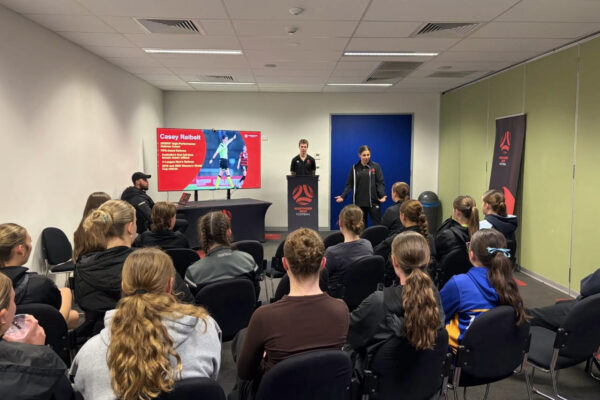
Over 200 technical directors and coaches descended on Valentine Sports Park this weekend to launch the 2026 Girls Youth League (GYL) and Girls Junior Development League (GJDL) season.

Two core themes dominated the conference: cultivating player creativity and integrating structured wellbeing programs.

Football Australia National Team Coaches Mike Cooper and Alex Epakis led the technical delivery. The duo ran practical sessions focused on intervention methods and decision-making. Their presence ensures the state league speaks the same tactical language as the national pathways.

Benchmarking the Future

The operational spotlight fell on the Club Standards & Benchmarking Framework. Now entering its third year, the policy carries significant weight. Football NSW briefed clubs on how 2026 performance metrics will directly dictate competition structures for 2027.

Football NSW Club Technical Development Manager Neil Mann emphasised the shift away from pure results-based assessment.

“The success of a youth development program should not be determined solely by league outcomes,” Mann said.

“It provides guiding principles to help clubs create positive environments… while allowing clubs to retain their own identity.”

Person First, Player Second

Wellbeing professional Holly Fuda delivered the keynote address. She challenged directors to embed mental health strategies into daily training, rather than treating them as tokenistic add-ons.

Football NSW Head of Football Development Ed Ferguson reinforced this cultural shift.

“The curiosity and contribution across both days is testament to our ecosystem,” Ferguson said.

“Every club in attendance highlighted their responsibility to develop better individuals through football. That puts us in a strong position to create environments built on trust.”

Most Popular Topics

Editor Picks

Send this to a friend