

Western Sydney Wanderers Liberty A-League side get extended commitment from Komatsu

Komatsu & Western Sydney Wanderers Liberty A-League

Komatsu will continue to be a principal sponsor of Western Sydney Wanderers in the Liberty A-League until at least 2026, with the global manufacturing and technological innovator committing to a further two years with the club.

The extension will see Komatsu featured on the right sleeve of the Wanderers women’s home, away, and third jerseys. Komatsu will also continue their ongoing support of a number of the Wanderers female-focused programs within the Western Sydney community.

Komatsu is a Japanese logistics company with over 100 years of experience. According to their website, they are committed to continuing the legacy of their founder.

“Meitaro Takeuchi, was an entrepreneur with an extraordinary humanitarian vision, committed to enhancing the community’s quality of life, developing future generations and growing with society. Determined to bring industrial technology to his country, Takeuchi created a new company by nurturing the skills of the people in the local community,” said via their website at komatsu.com.au. 

Komatsu Managing Director and CEO, Sean Taylor, reflected on his company’s communitarian beliefs and expressed how this deal is much more than just another sponsorship opportunity.

“Our partnership with the Wanderers represents more than just a name on the sleeve. A big focus for us at Komatsu has always been furthering diversity and inclusion, both in the workplace and the industry, and this sponsorship is a way for us to align ourselves with a strong sporting brand that also supports a diverse and inclusive workplace and allows us to shine a light on the diverse career opportunities available in mining and construction,” he said via press release.

“Women’s sport, and football in particular, at the moment is receiving the recognition it deserves, thanks to the FIFA Women’s World Cup on our shores and the Matildas continuing to be a dominant force. We’re looking forward to supporting the sport through the partnership with the Wanderers Women’s team.

“I’m excited to see what the next two years will bring for us and the Wanderers and wish them all the luck in the start of the new season.”

Western Sydney Wanders CEO Scott Hudson, also expressed the importance this deal has to their women’s program.

“We are delighted to be continuing our fruitful relationship with Komatsu after a successful first two years,” he added via press release.

“Like the Wanderers, Komatsu, are based in Western Sydney and we look forward to working closely with them over the next two seasons to continue to support our Women’s programs.”

Deals such as these are a vital way that clubs in the fast-growing Liberty A-League are able to help fund and back their programs. These long-term commitments provide clubs with ongoing financial security that in turn helps players to commit more time to their football. Hence, this deal will undoubtedly allow more female players to achieve professional status.

As women’s football in Australia sees huge development thanks to the Matildas run at the FIFA Women’ World Cup, it is great to see that the funding – so crucial to allowing professional sport to take place – is not just continuing but growing.

This is a new era for football in this country and the backing of pre-existing sponsors like Komatsu is a vital asset to allowing the game at all levels to not just survive but thrive.
Previous ArticleNext Article

All Six Female Officials at the 2026 World Cup Come From Concacaf, a Shift From Qatar’s Wider Spread

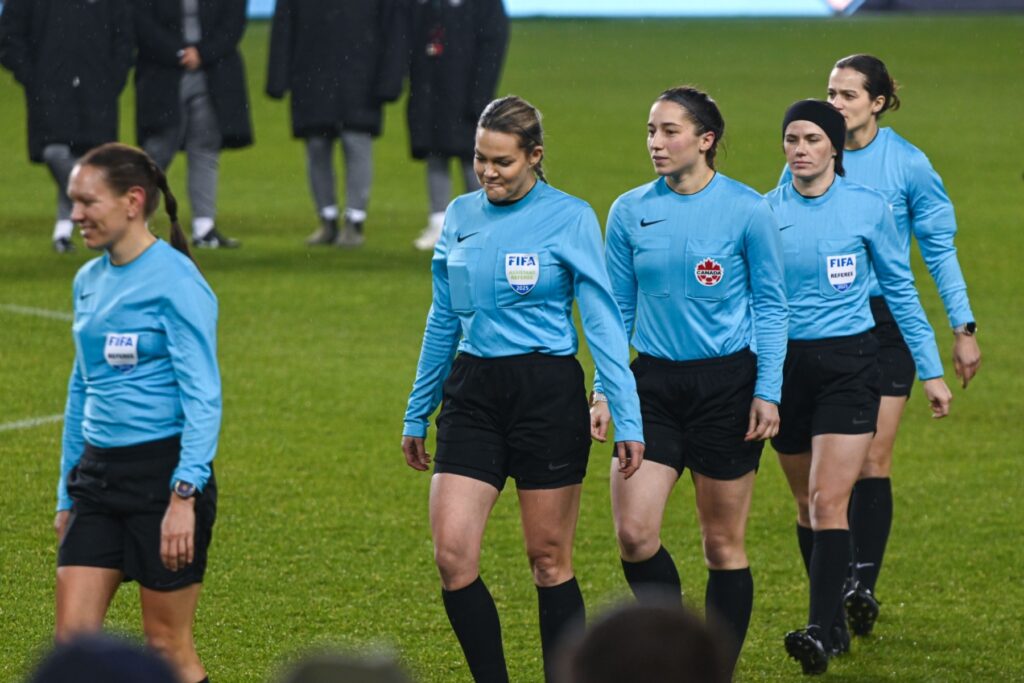
Six women are among the 170 referees, assistant referees and video assistant referees FIFA named to its 2026 World Cup officiating list in April, matching rather than exceeding the number appointed at Qatar in 2022. All six, however, come from countries within Concacaf, a change from four years ago, when the same total was drawn across five separate confederations.

Referees Tori Penso of the United States and Katia Itzel García of Mexico were joined by assistant referees Brooke Mayo and Kathryn Nesbitt, both of the United States, and Mexico’s Sandra Ramírez, along with Nicaragua’s Tatiana Guzmán as video assistant referee.Penso took charge of the Group A match between Czechia and South Africa on 18 June alongside Mayo and Nesbitt, the first all-female on-field trio to officiate a men’s World Cup match, becoming only the second woman to referee at that level, after France’s Stéphanie Frappart at Qatar 2022.García refereed Netherlands against Tunisia in Kansas City on 25 June to become the third woman, and the first Mexican woman, to referee a men’s World Cup match.

By contrast, Qatar’s six women were drawn from UEFA, CAF, AFC, CONMEBOL and Concacaf: Frappart of France, Rwanda’s Salima Mukansanga and Japan’s Yoshimi Yamashita as referees, and Brazil’s Neuza Back, Mexico’s Karen Díaz Medina and the United States’ Kathryn Nesbitt as assistants.

A pathway built through Concacaf’s development system

FIFA Chief Refereeing Officer Pierluigi Collina described the 2026 appointments as drawn from the largest group of World Cup match officials in the tournament’s history, the product of three years of monitoring, seminars and assessment, with selection based, in his words, on officials being “the very best in the world.”

Penso’s own record illustrates how that system has worked for Concacaf officials specifically. She joined the FIFA international panel in 2021, the same year she became the first woman to lead an all-female team in a men’s competition organised by Concacaf, refereeing a World Cup qualifier.She had already become the first woman in two decades to referee a regular-season Major League Soccer match, in 2020, and went on to take charge of the 2023 Women’s World Cup final, the first World Cup final overseen by an American referee.García’s path ran through Liga MX, where she became the first woman in more than 20 years to referee a men’s match in March 2024.

Australia’s own contingent at the tournament, referee Alireza Faghani and assistant referees Andrew Lindsay and George Lakrindis, along with video match official Shaun Evans, does not include a woman among its four officials,positioning the current pipeline into men’s World Cup officiating as one running through a narrower set of confederations than the sport’s broader referee development system overall.

Research on performance shows a mixed but instructive picture

The appointments sit alongside a growing body of research testing assumptions about female officials in men’s football. A study in the Journal of Human Sport and Exercise, examining five seasons of the Maurice Revello Tournament, found female referees were not weaker than their male counterparts in adjudicating men’s matches.Separate research by Atılgan and Tükel, cited in a 2025 study of fan perceptions of referees, found women outperformed men specifically at the decision-making stage, with men showing greater hesitation and avoidance.

Findings on physical output are less uniform. A systematic review of physical demands in high-level matches found male and female referees covered broadly comparable ground, averaging 10.5 and 9.9 kilometres respectively, with similar volumes of high-intensity running.A separate comparison of Spanish first and second division referees found male officials produced higher peak-intensity output than female referees across the shortest, most demanding windows of match play, a gap researchers linked to aerobic capacity and flagged as requiring further study at international level specifically.Academic research published this year estimates women still make up roughly one in ten of the world’s accredited match officials across all levels of the game.

FIFA’s next major appointment cycle for women’s officiating is already under way, with match officials named this year for the 2026 FIFA U-20 and U-17 Women’s World Cups as part of preparations for the 2027 Women’s World Cup in Brazil.

Northern NSW Football’s Leadership Program Reaches 98 Graduates as Sport Moves Toward 2027 Gender Parity Targets

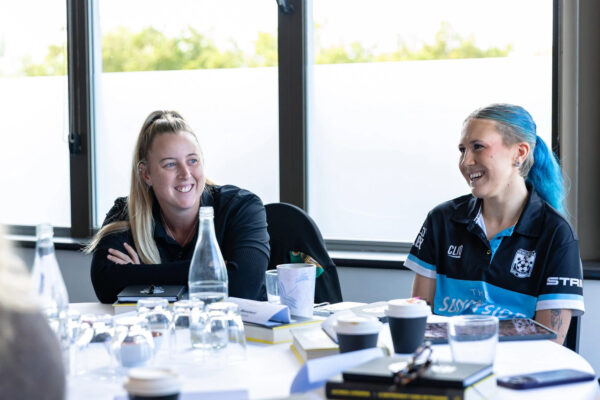
Northern NSW Football has concluded its 2026 Women’s Leadership Program, with 13 participants taking the total number of graduates to 98 women across the region since the program launched in 2023. The five-week program combined online modules with a two-day conference at Rydges Resort in the Hunter Valley, bringing together club volunteers, committee members, administrators and NNSWF staff from Newcastle, Macquarie, Northern Inland and Football Mid North Coast zones.

The program’s growth has been uneven year to year. It launched with two intakes in 2023, drew 25 scholarship recipients in 2024,then settled to 12 in 2025, which brought the cumulative total to 85 before this year’s cohort of 13.

The program was facilitated by Ann Odong, who founded The Women’s Game, Australia’s first dedicated women’s football website, in 2008,and later spent six years as Football Australia’s Media and PR Manager steering the Matildas’ program through multiple World Cups and Olympic Games,before moving into independent consulting work.

A pipeline built against a 2027 deadline

The program fits within a wider set of national targets football and the broader sport sector have committed to reaching within the next twelve months. Football Australia’s Our Game initiative, launched in 2021, set a goal of 50:50 gender parity across players, coaches, administrators and referees by 2027.Separately, the federally backed National Gender Equity in Sport Governance Policy requires all funded national and state sporting bodies to reach 50 per cent women or gender-diverse board directors by 1 July 2027, with funding to be withheld from organisations that fall short.As of the most recent Australian Sports Commission data, 22 per cent of chief executives and 25 per cent of board chairs across 65 federally funded national sporting organisations were women.

Programs built around confidence, networking and committee-level skills, the model NNSWF has run since 2023, are the mechanism most sporting bodies are relying on to close that gap, since board and executive vacancies typically draw from an organisation’s existing pool of committee members, volunteers and administrators rather than external recruitment.

This year’s cohort

University of Newcastle FC’s Charlotte Carey, one of this year’s participants, said the program had given her the confidence to pursue a career in football while developing skills applicable across other areas of her life. Fellow participants included representatives from Cooks Hill United, Westlakes Wildcats, Newcastle Olympic, Lake Macquarie City FC, Western Wolves, Gunnedah and District Soccer Association, Wauchope FC and Stockton Sharks, alongside three NNSWF staff members.

NNSWF Participation and Women’s Football Officer Jamie Bressan said the program had continued to provide women across the game with an opportunity to connect and build leadership skills, with topics covering effective communication, personality styles and team dynamics. Bressan pointed to the network the program builds among participants, drawn from clubs and committees across the region, as one of its central functions rather than the training content alone.

The 2026 cohort’s spread across four zones, Newcastle, Macquarie, Northern Inland and Football Mid North Coast, continues a pattern of the program drawing participants from outside the Hunter region’s largest population centres, consistent with its original design to make the conference and online components accessible to women in regional and remote parts of northern NSW through funded travel and accommodation.

Most Popular Topics

Editor Picks

Send this to a friend