




PTI Digital: The catalyst behind venue operations

London Stadium

Venues have become much more than just a place for a football match on a Sunday. They are in use now more than ever, for concerts, functions, sporting events and training.

However, it is not every day that there is a concert or a match, leaving an empty venue sitting their awaiting its next big event. This also has meant no revenue for a club or the owners of the stadium.

Many stadiums and venues have increased their attractiveness to the public with the introduction of other activities, restaurants, and entertainment within their premises. This also can have the added effect of diversifying the public attention toward the club, with football fans going to restaurants, mini-golf courses, and other entertainment venues before or after a match, and potential walk-ins at football matches from those who attend the new entertainment venues.

However, this can bring about new challenges to a club, with innovation needing to be seamlessly integrated into a football fans experience at the club, as businesses and football clubs strive for excellence. Particularly with the ability for many games, especially in Australia, to be watched either at home or at a local pub or club, the onus is on venues and football clubs to deliver a succinct and entertaining experience for fans, to keep them coming back week on week.

The increase in reliability on technology services to engage and improve the fans experience at a football match can be costly, difficult to navigate and clustered. Many clubs tend to be on the back foot, chasing efficiency to keep up with their demand, and not proactively setting up for success in the future.

Many clubs are integrating managed service providers, such as PTI Digital, to oversee and assist in maintaining and supporting a venue’s technical operations. PTI Digitals team of IT experts house a range of skills which allow for efficient administration, security, and networking services, all of which are vital in the diversification of a venue attractions. PTI Digital also reduce costs of a venue or club, by removing the need to recruit new IT staff, or training staff with a narrow operating window, only to take care of a handful of tasks. Clubs and venues have constant access to PTI Digitals team of well-versed IT experts, who can assist in tackling challenges across a variety of areas.

PTI Digital has imposed itself within the UK sport market, with a deep understanding of sports event operations, and currently has six active managed services operations at major UK sporting venues – including Norwich Football Club, Crystal Palace, London Stadium, and London Olympic Park. PTI focuses on quality of efficiency and cost saving, with the ability to remove the need for a CTO for many of the venues that PTI oversees.

Flexibility for individual clients of PTI is also a major principle, with different infrastructure, cultures, and economic viability all taken into consideration. PTI also ensures to add a human touch to their services, allowing clients to easily digest information on their end, and do not need everything translated from a PTI expert. This is crucial for board meetings and other executive discussions, in which discussions can be held in house, with access to the bank of knowledge which PTI Digital provides to their clients. This will allow more informed decisions for future expansion plans, refurbishments, and other stadium and venue alterations.

PTI Digital’s approach for clients is simple. There is a necessity to identify a long-term goal, which PTI Digital can help extract from a club, in which to focus resources for the future successes of the club. PTI also conduct a club analysis, to identify weak points, resources, and areas in which the club is performing well at from a brand point. PTI Digital will also analyse the difference between the vision of the club and where they are situated, allowing for a practical roadmap to be set in place, and ensuring flawless execution over a long-term period.

PTI Digital’s transformation pyramid investigates the role in which technology can and is encouraged to play in an organisation’s future strategy and planning. PTI’s clients can delve into the wealth of data, and digital and commercial operations initiatives, in order to kickstart new revenue pathways, which will drive future success for a football club or venue.
Previous ArticleNext Article

A-Leagues partners with Champion Data to enhance broadcast experience

The Australian Professional Leagues (APL) has appointed Champion Data as its official broadcast graphics partner in a three-season agreement designed to enhance coverage of the Isuzu UTE A-League Men and Ninja A-League Women. The partnership will introduce Champion Data’s live graphics technology across broadcasts on Network 10 and Paramount+, delivering real-time statistics, scores and visual insights to help fans follow the action.

Champion Data will use its proprietary GGi platform to connect match data with broadcast graphics and production workflows. The system will support the delivery of clear, engaging information throughout matches, giving viewers greater insight into key moments and performances. The agreement also strengthens the APL’s commitment to improving the broadcast presentation of women’s football. Champion Data will bring the Ninja A-League Women’s production standards into alignment with the men’s competition, supporting a more consistent viewing experience across both leagues.

The APL expects the partnership to enrich its broadcast offering as audiences seek deeper insights and more engaging ways to follow Australian football. The new graphics package will help viewers understand match developments, track statistics and connect with the stories unfolding on the pitch. Champion Data will manage technical delivery, train broadcast operators and provide live matchday support throughout the agreement. This end-to-end approach will help production teams deliver accurate information and consistent graphics across both competitions.

The partnership builds on Champion Data’s experience in sports data collection, analytics and broadcast technology. They currently provide statistics for the AFL, V8 Supercars and Tennis Australia alongside many others. By integrating live match information with on-screen graphics, the company will help bring the tactical detail and drama of A-Leagues football to television and streaming audiences.

As the APL continues to develop its broadcast product across television and digital platforms. The partnership positions Champion Data as a key technology provider for the next three seasons. The collaboration will combine data expertise and broadcast innovation to improve how fans experience Australian football, bringing greater clarity, context and insight to every match.

Netflix’s Women’s World Cup deal puts IMG’s technology in the spotlight

Netflix’s first exclusive football deal will see the next year’s FIFA Women’s World Cup at the centre of it’s live-sport strategy. The US-streaming service company has appointed IMG as its production partner for all 64 matches in Brazil, as well as more than 100 hours of live studio programming. The deal includes English and Spanish coverage for viewers within the US, and English and French-language coverage for those in Canada. IMG will also support Netflix’s coverage of the tournament’s draw in December.

The 2027 Women’s World Cup runs from June 24 to July 25 across eight host cities, and will be the first edition to feature 32 teams. The scale of the tournament makes it an ambitious first foray into sports broadcasting for Netflix – which means IMG’s involvement will be of great significance.

IMG’s production engine

IMG has built its reputation on producing and distributing live sport at scale. It’s Stockley Park, London facility includes broadcast studios, production galleries, edit suites and facilities for radio, podcasting, dubbing and visual effects. The company has worked across major properties including the Premier League, Major League Soccer and other international sporting events.

For a World Cup, this infrastructure provides more than a place to make television; it creates a central point where production teams can manage feeds, graphics, replays, commentary, editing and distribution while events are taking place thousands of kilometres away.

Remote production is the key

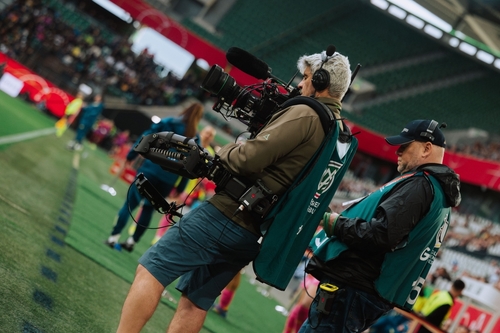
The most important technology for a tournament spread across eight Brazilian cities is connectivity. IMG has invested in remote-production workflows that allow production teams to work across locations, rather than putting every specialist inside each stadium. Its wider production operation has used fibre, satellite, cloud and IP-based connectivity to move live signals between venues and production centres.

That model can reduce the amount of equipment and specialist staff required at every venue while allowing senior producers, directors, replay operators and graphics teams to work from centralised facilities. IMG has also demonstrated long-distance IP production, including a 20,000-kilometre link between Tokyo and London that carried uncompressed, low-latency video. For Netflix, those capabilities are particularly relevant. The platform is building a single viewing experience for audiences in two markets, but the raw ingredients will come from stadiums spread across Brazil. A resilient network becomes just as important as the cameras themselves.

From stadium to stream

The technology chain does not end when the pictures leave the venue. A modern sports production operation has to manage ingest, replay, media asset management, graphics, audio, quality control, archiving and transmission. IMG’s facilities have been built around those workflows, with master control and transmission capabilities alongside post-production and archive operations.

That infrastructure also gives IMG the ability to turn the live tournament into a wider stream of content. A goal can become a replay, a highlight, a social clip or part of a studio package without waiting for the match to finish. For Netflix, that fits a platform built around on-demand discovery as much as live viewing.

A new test for Netflix

Netflix has already made a significant investment in football through documentaries and other programming. The 2027 Women’s World Cup takes it up a level. FIFA describes the agreement as the first competition Netflix has acquired in full, making the tournament a major test of its live sports operation. IMG therefore has a job that goes beyond producing 64 matches; it must help Netflix build the technical backbone for a month-long, multi-venue broadcast, while maintaining consistent production standards across languages and locations.

The viewer may simply press play and see a World Cup match appear instantly. Behind that button will be a complex network of cameras, connectivity, control rooms, production systems, people and data. That is the real significance of Netflix’s IMG deal: the streamer is bringing the tournament to its platform, but IMG is providing much of the machinery that can make a global football event feel seamless.

Most Popular Topics

Editor Picks

Send this to a friend