
SciSports: Delivering a comprehensive data solution for football operations

Best popularised by Football Manager, football fans around the world are becoming increasingly aware of data-driven software and analysis. In truth, these worlds have been colliding for some time as the football industry continues to be at the forefront of innovation.

Leading the way in this area is Dutch-based company SciSports, which has risen to prominence in Europe for its diverse range of data-driven software services.

The company delivers key football operations services, including recruitment, performance and opponent analysis, career advice, and data delivery. These services are utilised by national teams, clubs, players and player agencies, and league associations.

Its leading partnerships are with the Dutch Eredivisie and Royal Dutch Football Association (KNVB), as well as Premier League club Crystal Palace, and A-League side Adelaide United.

In addition, its applications are used by a host of British and European football clubs, winning many plaudits from performance analysts and football recruitment departments.

This article will take you on a deep-dive into the range of applications SciSports offers, and how it is changing the face of football operations.

Recruitment

Arguably its most prized feature, SciSports provides its clients the very best data-driven player recruitment software money can buy.

Its application connects club scouts and player agencies to over 270,000 players in the men’s and women’s game, 3,700 clubs, and 250 league divisions.

Part of the software allows clubs to create their own profile that details their style of play. This helps clubs save valuable time in their recruitment process because players who suit the club’s profile will be prioritised within its search engine.

Player profiles built within the application include features such as the SciSkill Index – an in-house player performance metric – performance statistics, and player roles.

WIthin its Pro recruitment application, player profiles include AI powered player valuations, and a GBE points calculator that determines the eligibility of a player for work permit or visa applications.

SciSports offers a monthly subscription package for its two recruitment application offerings (Essential and Pro), benefitting clubs at all levels of the professional game.  

Altogether, SciSports’ in-depth, data-driven technology is making football recruitment simpler and more efficient, helping football clubs steer clear of the “flop” branding that permeates through modern football.

Career Advice

Connected to its recruitment and performance analysis services, SciSports can assist players and player agencies greatly.

Their career advice service enables agencies’ to create player-profiles for their clients, driven by SciSports existing performance analysis software.

The profile contains in-depth information ranging from physical attributes and tactical suitability, to career history and player ambitions.

Again, the application is offered in two monthly subscription packages – Lite and Pro – which have differing levels of access for players and agents.

Whilst the services helps a player market themselves, it also better informs them about where their next move should be, which SciSports evidences through its high-profile player partnerships.

Case Study – Memphis Depay

SciSports’ highest-profile success story is current Atletico Madrid and Netherlands forward, Memphis Depay.

After struggling at Manchester United, Depay and his agent sought the help of SciSports to assist in revitalising his career.

His player profile and subsequent analysis advised him to reject moves to Spain, Italy, and England, in favour of a move to French Ligue 1 club, Olympique Lyon, who were seen as best-suited to his playing style.

Depay revitalised his career, going on to score 63 goals in 139 appearances for OL, before representing his country at the 2021 European Championships and 2022 FIFA Men’s World Cup.

Fellow Dutch forward Wout Weghorst is known to have succeeded using SciSports career advice and performance analysis applications, whilst several Dutch Eredivisie players have been known to further their careers.

Performance Analysis

Having the ability to analyse player and team performance day-by-day is imperative in elite football. SciSports aims to assist elite football clubs in offering extensive performance analysis applications.

Its performance analysis software is data provider agnostic, meaning it can be connected to existing data sources such as player-tracking data (GPS systems), event data, and video footage.

The result is a one-stop-shop software for performance analysts and coaches to use with their players and teams.

The package produces greater staff reporting, video analysis, and data visualisations, all of which are vital to being a successful football operation.

Given the diverse nature of football tactics and analysis, pricing for its service is available for request only.

Opponent Analysis

Similar to its performance analysis services, SciSports also provides opponent analysis for football clubs.

In today’s football climate, getting the edge over a rival takes place not just on the pitch, but in offices over weeks and months. One small piece of analysis could be the difference between failure and success.

SciSports again uses incredible detail to provide clubs with analysis that evolves simple stats into some of the most niche around. For instance, attacking and defensive style trends, or the types of set-piece variations an opponent runs, their success rate, and times in games that they run them.

Data-driven opponent analysis is already a prominent feature in professional football, but SciSports existing services in recruitment and performance analysis situates them as an industry leader.

Data Delivery

Last, but not least in its catalogue of services, SciSports can integrate its software with existing in-house technology, making the transition easy for football clubs and player agencies to align with the company.

Like its performance analysis service, pricing for its in-house data-delivery solutions are available for request only.

SciSports are expanding its operation to leagues in North and Central America, and whether it penetrates the Asian or Australian market or not, its services are a valuable template for improving football operations.

With some of the world’s leading universities based in Australia, there is a clear capacity for the creation of data-driven software that can drive the professionalisation and expansion of the Australian game.

For full information on SciSports, you can find it here.

Previous ArticleNext Article

GIS Masterclass: Fan Engagement and Marketing with Terry Lynam and Karen Grega

The Global Institute of Sport recently hosted a masterclass on Fan Engagement and Marketing, bringing together two industry leaders to tackle the field’s most pressing issues.

The Global Institute of Sport (GIS), which offers a Master’s in Sports Business and Sports Analytics through the University of Newcastle, regularly holds masterclasses with industry leaders as part of its curriculum.

The latest focused on fan engagement and marketing, covering two key themes: the growing tension between live sport and online streaming, and the role of data in shaping the fan experience.

The panelists 

Terry Lynam recently concluded her role as General Manager of Fan Experience and Events at Football Australia, overseeing the AFC Women’s Asian Cup on home soil.

Karen Grega is an experienced sports management consultant with a multi-code background. She currently represents Football Coaches Australia (FCA) and Heartbeat of Football, and has previously worked with Sydney Cricket Ground, Venues NSW and Sydney FC.

Live Sport and social media.

Terry Lynam opened with a pointed statement — one she acknowledged would be controversial. She argued that the sense of community unique to live sport is being eroded by social media and ‘snippet’ consumption.

Central to her concern is how marketing teams are failing to segment their audiences, treating casual online viewers the same as matchday fans.

“If they aren’t spending money on the sport we shouldn’t count them as spectators to the same level as match going fans.”

“What we want to consider as marketeers is how much we want to give away and how much we want our live sport element to remain,” Lynam said.

Grega echoed the sentiment, arguing fan engagement ultimately comes down to human connection. “It’s not rocket science.”

She suggested the industry revisit the concept of sport as a family outing to recapture that communal experience.

Data Driving Decisions

Both panelists highlighted data and analytics as central to modern fan engagement.

Grega recalled the introduction of computerised turnstiles as a turning point, enabling teams to track crowd movements and optimise staffing and entry times.

She also noted the continued value of fan surveys in informing marketing decisions.

Lynam pointed to ticketing technology as a significant data frontier.

Modern platforms like Ticketmaster’s ticket-transfer system now provide detailed customer insights.

“It allows us to have a better understanding of who’s getting the ticket and how they transport themselves there or when they arrive,”

“We can personalise their journey and sell content to them,” Lynam commented. 

The discussion also touched on data sourced from social media and on-field player tracking, as well as interactive stadium technology gaining traction in the US.

This included holographic assistants and player headset interactions that bring a broadcast-style experience to live events.

Activations That Educate

Activations rounded out the masterclass, with Lynam detailing how she created a fan zone on a modest budget for the Women’s Asian Cup.

The activation featured charitable partnerships focused on women’s health, including Heartbeat of Football, Endometriosis Australia and Share the Dignity.

“I’m very hopeful that that type of idea gets pushed through on other sporting events,” Lynam said.

Grega elaborated on the Heartbeat of Football activation, highlighting how a competitive element built around CPR and heart health kept fans engaged while also educating them.

“The whole health hub ticked all the boxes — it was immersive, it was interactive, it was there for all ages, both sexes.”

“That sort of blueprint is one that should be replicated as much as possible,” Explained Karen Grega

The masterclass offered students and industry professionals a valuable window into contemporary sports marketing.

As the competition for fan attention intensifies, the blend of live experience, smart data use, and purposeful activations can help define the next chapters of fan engagement.

More Than One in Five Football Australia Staff to Lose Jobs Amid Growing Financial Losses

Australian football finds itself in a curious position.

From the outside, the game appears to be riding a wave of momentum. Attendances, visibility and public interest have all experienced significant uplift in recent years, while major international tournaments and growing discussion around football’s future continue to place the sport firmly within the national conversation.

Yet behind that momentum, Football Australia is now confronting a far more challenging internal reality.


A compounding deficit

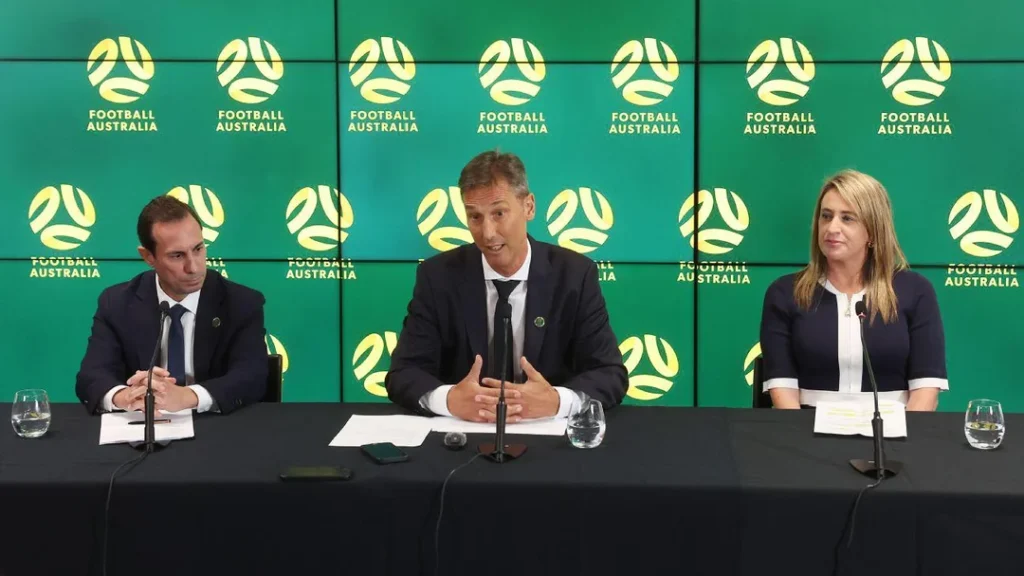
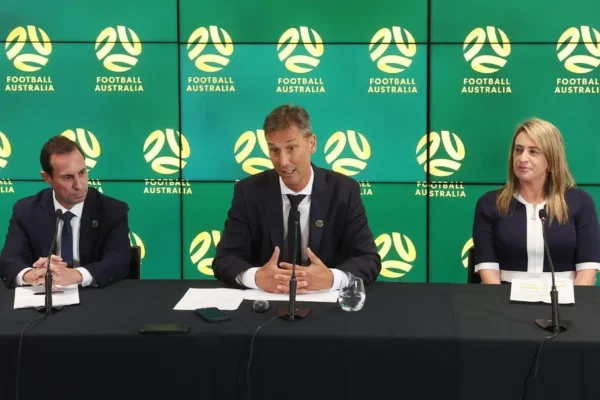
Chief Executive Martin Kugeler has reportedly indicated the governing body’s projected financial losses for 2025 are expected to exceed the organisation’s reported $8.5 million deficit from the previous year. Accompanying the financial outlook are substantial organisational changes, with reporting from Tracey Holmes indicating more than one in five Football Australia employees are expected to lose their positions through restructuring measures.

The figures represent more than a difficult balance sheet. They point toward a significant period of recalibration inside the organisation responsible for overseeing the sport nationally.


Losing the wisdom of existing staff members

For governing bodies, restructures are often framed as strategic necessities for future sustainability. However, workforce changes on this scale also raise broader questions around the challenges of such a transition.

People are often the carriers of knowledge, relationships and long-term strategic understanding. When organisations undergo significant structural change, the effects can extend beyond immediate financial outcomes.


Contradicting timing

The timing is what makes the developments particularly notable.

Football in Australia has spent recent years discussing expansion, growth and long-term opportunity. The conversation surrounding the game has increasingly centred on future potential. Often headlining stronger pathways, larger audiences, infrastructure development and greater visibility.

Against that backdrop, news of deep financial losses and substantial staffing reductions creates a different conversation: one focused not on where the game wants to go, but on what may be required to sustain that journey. Therefore, this announcement points toward stagnancy, rather than growth.

Further detail surrounding Football Australia’s strategy and long-term direction will likely emerge over coming months. For now, the developments serve as a reminder that growth stories are rarely straightforward.

Often, the periods that appear strongest from the outside can also be the moments organisations face their most significant internal tests.

Most Popular Topics

Editor Picks

Send this to a friend