
Unpacking the Biological Maturation Process for Football NSW

Football NSW’s new Biological Maturation Process for the 2025 season outlines a framework that allows players who “Are potentially disadvantaged from a physical perspective, due to later biological maturity” to play in lower age groups.

Players assessed as biologically “late developers” for their chronological age will be approved to play down an age grade provided there are positions available at their club, whereas players assigned as “on-time” or “early developers” are NOT.

It will be applied only for NSW’s girls’ and boys’ Youth Leagues one, two and three from ages 13 to 15.

Only one “late developer” is allowed per age group team and must be registered on their ID as a ‘late developer.’

The test conducted is based on the estimated age at peak height velocity (APHV) measuring differing factors of height and weight. This is then cross-referenced with normative data for boys and girls.

Biological maturity testing will be conducted at Valentine Park on the following dates:

  • Monday, 9 September 2024
  • Monday, 30 September 2024
  • Monday, 25 November 2024 – FINAL DATE

The player must be registered before conducting these tests.

One cannot argue against speed, strength and agility being hallmarks of modern football athletes who are regarded as some of the fittest in the world.

However, football and modern development programs have always advocated that these factors do not only make one a great footballer.

Highly regarded academies such as Barcelona’s La Masia have mainly championed technical ability, hard work and teamwork as routes to success.

Some of the more famous and arguably the best players the world has known have been small or under-developed for their age. Lionel Messi and fellow countryman Diego Maradona, are adored due to their technique and ability, not for their physical prowess.

Even the most physical of positions has had players breaking the stereotypes, Italian centre-back Fabio Cannavaro a World Cup and Ballon-d’Or-winning stands at 6’9.

For a modern example, Manchester United’s Lisandro Martinez 6’9 has proven many critics wrong about his ability to adapt to the physicality of the English Premier League.

Spain’s Aitana Bonmati at 6’3 won the golden ball on these shores in the 2023 FIFA Women’s World Cup. Not to mention is one of the most decorated individual players for a singular season in 2022-23 with Barcelona Feminine, who she captained to a famous treble.

One does not even have to travel overseas to observe this dichotomy, Josh Nisbet who stands at 5’2 was one of the best midfielders in the A-Leagues along with a plethora of players who have broken this stereotype to be successful.

Would these player’s growth as footballers have been stumped by these rules? Would they not have to challenge and adapt their game to play tougher opponents due to their disadvantage? This same physical disadvantage many explained to have been a barrier for them have turned out to be a strength of theirs.

Another topic that’s been championed by many footballers now is the psychological side of sport.

How would it feel for these players in their formative years to be seen as physically underdeveloped and must drop age groups to perform well? How will it be received by other kids or different academy prospects?

There is no shame in finding it difficult or not up to the task. Nor for parents, coaches and technical directors, important figures in these children’s lives, wanting to protect their children and players and give them the best environment to strive.

Now we must accept that the aforementioned players are grown adults who have gone through their bodies’ development.

Maybe a player who has serious development issues or doesn’t show massive quality could do leaps and bounds with this opportunity.

The age group changes are not huge and physical disadvantages have been identified as problems within youth throughout footballing history.

Football NSW also have data and studies to support their decision.

A study from 2020 of Spanish youth football reported that applying biological maturity can diminish the loss of quality in players. On top of this it highlights the need to focus not on competitive results.

Which to Football NSW’s credit they have made a core of their strategies for development but at these age groups specified this focus becomes harder to maintain.

Though the same study around is based centrally around RAE (Relative Age Effect) with people born in the beginning of the year compared to later. Playing down a age group wasn’t an option mentioned, and the psychological effects were still a variable missing a more prevalent analysis.

Is this the forward-thinking that Australian football needs to answer the crucial questions of physical development? This move seems like one that is very possibly going in the right direction.

Maybe it’s old-fashioned to reject this idea, though one cannot help but fear the possibility of holding back young players due to their physical ability or the effect it can have on them psychologically.

Football is a sport for all people no matter what their differences, that’s why it has coined the title ‘The Beautiful Game” and that’s something that shouldn’t be taken lightly.

If you wish to learn more click here.

Previous ArticleNext Article

The A-Leagues Final Series important status also a secret hinderance

The Isuzu A-League finals series is a huge event in the footballing calendar, though its contribution to stagnant attendance numbers in the league is something to be said.

If the 2025/26 finals series follows similar patterns to those before it, it will gather huge traction and strong ticket sales.

It is the largest event for the domestic league, bringing in massive amounts of viewership through media and gate receipts.

Finals series from years past have shown this, with the 2024/25 final, a Melbourne derby, being sold out within 48 hours and gathering significant viewership online.

The idea of a finals series lies within the Australian sporting ethos; the other sporting codes have had this tradition for most of their existence, especially in recent history.

Football, though, is different from the rest of the sporting codes in Australia, unique even. This has historically contributed to its inability to integrate into the same supported status as other codes.

Many in the Australian footballing community, supporter groups, players, coaches, and even the new Director of Football Australia, have voiced concerns over fan numbers in the league competition.

It wouldn’t be absurd to say that maybe, though profitable now, the finals series is actually taking away from the league itself.

Consider the media image: the league winner is called the “minor premiership,” and ticket sales and viewership figures reveal a huge disparity between the two parts of the A-League.

It must be said that an alternative that could work in unison with the league and possibly increase viewership of the league itself would be a great advantage.

It would allow the league to gain more jeopardy and drama, which could build greater interest in attending league games.

One alternative is already here.

No other sporting code in Australia has both a league competition and a cup competition. Football in Australia does.

The Hahn’s Australia Cup is our equivalent to the FA Cup in England or the Copa del Rey in Spain.

These are competitions that offer a finals option in a different competition entirely. They generate huge traction while never diminishing the importance of the league and, therefore, its popularity.

These cup competitions cannot be discussed without acknowledging some obvious differences.

They don’t face the same popularity issues that football does in Australia. It’s obvious the Hahn’s Australia Cup doesn’t yet gain the traction that the finals series does.

However, for a healthy footballing environment with increasing fan numbers, it should.

The idea of elevating the Hahn’s Australia Cup and scaling back the finals series is a complex question, one that is treated like a “no-go zone” by many in the Australian footballing community, and that is understandable.

Though big changes like this might, in the end, be credible options for the future of the sport in this country.

Larger plans must be set in motion, strategies that can be worked towards and refined along the way. It is the process by which all large organisations, business models and even national governments build their strategies.

Such a shift will be scrutinised and pushed back against.

Though with further fine-tuning and smart investment in development, not to mention the introduction of promotion and relegation and the possibility of changing the footballing calendar.

It could replicate the success that these two-competition models already enjoy in other leagues.

The added importance that the premiership would gain, the reality that every game matters, could alongside other strategies entice fans to more games, increase viewership and ticket sales, and create more dedicated fan bases. It works in other nations, very well in fact.

The possibility of two teams lifting a trophy, rather than one single event defining it all, sounds like a strategy that could deliver more engagement over longer periods of time.

Maybe Australian football doesn’t need to answer this question just yet. It is complex, difficult and it would require a great deal of work, including significant investment into the game, which is another issue entirely.

Yet as low attendance numbers persist in the A-League, even alongside increased media viewership, something needs to change for football in Australia.

The rise in popularity of this game and its dedicated community deserves bold ideas and forward thinking.

Ideas like this could eventually begin to change the landscape of the beautiful game in Australia for the better.

AFC Women’s Asian Cup: How do we sustain growth and success?

This year’s AFC Women’s Asian Cup 2026 was not just another tournament. It was a momentum shift for women’s football in Australia. Match quality, crowd numbers and national pride have never been higher – but how do we ensure this success continues after the final whistle?

Financial input and output

Ahead of the tournament, the Australian Government demonstrated their support and commitment through a $15 million investment.

With such significant financial backing behind the Matildas’ pursuit of victory on home soil, the tournament seemed poised to be hugely successful – and it didn’t disappoint.

Projections point towards an overall revenue of over $250 million, with over 24,000 international visitors and 1000 jobs created. It proves that when money is invested into the women’s game, the rewards on and off the pitch are undeniable.

Federal Minister for Sport, Anika Wells, was present at the official announcement of the Australian Government’s funding boost.

“The Tillies and the 2023 Women’s World Cup redefined Australian sport and now the Albanese Government is backing the Matildas again with a $15 million investment for the Women’s Asian Cup,” said Wells.

“Women’s sport is not nice to have or a phase, it is brilliant, nation-stopping, and here to stay.”

With huge revenue numbers and contributions to local economies, this year’s AFC Women’s Asian Cup has demonstrated the financial power and potential of the Matildas, and ultimately of women’s football across Australia.

Attendance numbers skyrocket

Beyond finances, however, the standout factor throughout the tournament was the record-breaking crowd sizes.

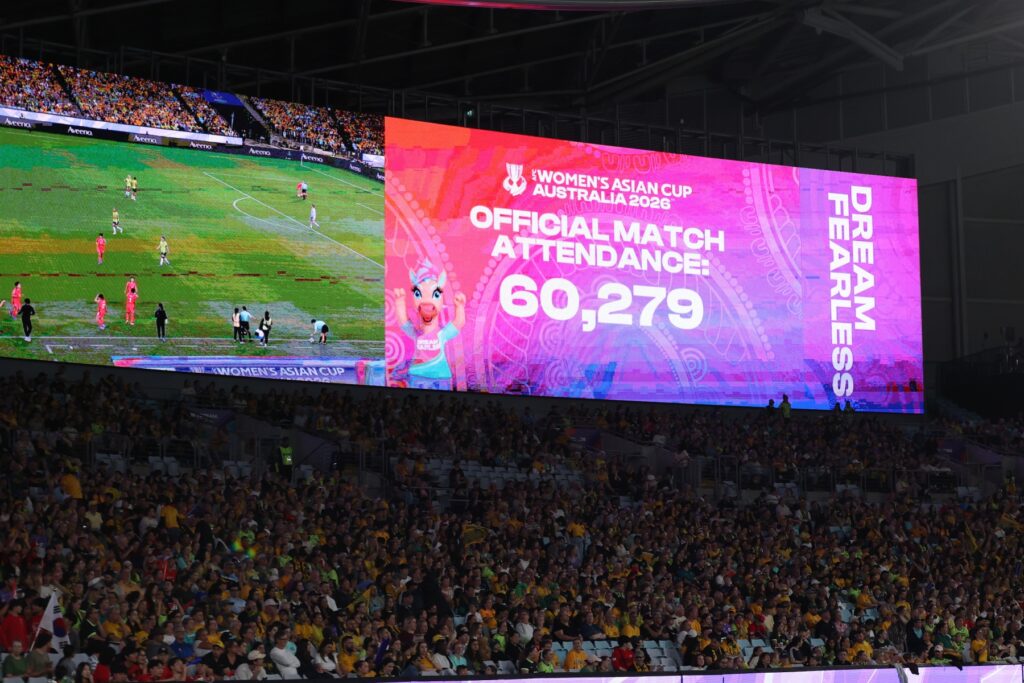
60,279 fans packed into Stadium Australia in Sydney to witness an entertaining 3-3 draw between the Matildas and South Korea, a huge number which was later smashed by Saturday’s final attendance of 74,397.

However, support wasn’t exclusive to the Matildas. At Japan’s semi-final demolition of South Korea, a 17,367 crowd set a record for the highest attendance at a Women’s Asian Cup match between two visiting teams.

Although skeptics will highlight that many games failed to sell out, the crowds attracted during this year’s tournament highlight two decades of immense growth. In 2006, the final brought in little more than 5000 people.

In fact, with 250,000 attendees over three weeks, and ticket sales increasing five-fold from the previous record, the proof of a nationwide buzz is there for all to see.

But creating a buzz is not enough. We must act on it, and sustain it, if we want to see true, long-term development.


Avoiding past mistakes

Following the excitement of the 2023 FIFA Women’s World Cup, women’s football in Australia looked set to launch into a new era of development and expansion.

Although female participation increased in New South Wales by 31% between 2022 and 2025, attendance numbers at ALW matches fell by 26% between the 2023-24 and 2024-25 seasons. The ‘buzz’ – without genuine commitment or backing to sustain it – wore off far too quickly.

This year’s AFC Women’s Asian Cup was a second chance for Australia’s football industry to correct its past mistakes, and ensure that state federations, governments and teams align in their commitment to growing the ALW and women’s football as a whole.

Furthermore, given the on-pitch prowess and off-pitch success over the past few weeks, the Asian Cup could play a major role going forward. It may yet be the catalyst, the long-awaited springboard that can propel women’s football to new heights in years to come, both on the international stage and within Australia.


How do we prolong the buzz?

So, while the success of the Asian Cup can encourage important discussions, the key is to inspire stakeholders and decision makers into taking real action.

On Saturday, Football Australia expressed their commitment to progressing the women’s game in NSW after the tournament ends. Joined by Football NSW and Northern NSW Football, they called upon the NSW government to address facility imbalances over the next decade.

“The growth of women’s football in New South Wales is not a short-term trend – it represents a fundamental shift in participation and expectation across our communities. To sustain this momentum, we must invest in infrastructure that is inclusive, accessible and fit for purpose, ensuring everyone has the opportunity to play, develop and thrive in the game,” said Football NSW CEO, John Tsatsimas.

“We call on the government to invest in the largest participation sport in NSW to bridge the growing facilities gap in NSW which will deliver economic and social long-term benefits through connected communities.”

To this end, a proposed NSW AFC Women’s Asian Cup Australia 2026 Legacy Fund – worth $343 million over a ten-year period – would address several issues at grassroots level. These include:

  • Delivering upgraded community facilities to accommodate growing participation numbers among women and girls
  • Improving accessibility, safety and playing capacity across metro, regional and remote communities
  • Supporting multi-use and multi-sport facilities
  • Strengthening pathways for women and girls across all age groups
  • Continuing the legacy of the AFC Women’s Asian Cup 2026

Should this fund be implemented in NSW over the next ten years, fans and players within the women’s game will be at the heart of a major, long-overdue realignment.

Final thoughts

Despite the bitter disappointment of losing in the final on home soil, there is nevertheless an important reminder to take away: we can’t control results on the field, but we can control intent, attitude and commitment off it.

The AFC Women’s Asian Cup 2026 was a huge success for women’s football in Australia. Matches were of extremely high quality, crowd numbers smashed tournament records, and the nation was united in their support for one of Australia’s most popular sporting outfits.

There may not be silverware to show for it, but the past few weeks have provided something far greater: recognition, respect and a platform to continue growing long after the final whistle. The demand is undeniable, participation and interest is soaring, and the voice of the women’s game can no longer be ignored.

Most Popular Topics

Editor Picks

Send this to a friend