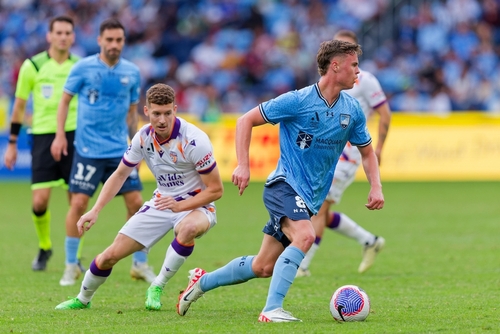

Unite Round: A-League’s Bold Vision Faces Challenges

The second-ever edition of the Unite Round sparked some interesting debates and narratives about whether the A-League can properly host an inclusive event of this scale.

As the contract with Destination NSW expires, the question remains; Is the experiment worth committing to or should it be scrapped?

A potentially unfair comparison would be to NRL’s Magic Round and AFL’s Gather Round who managed to succeed with the concept in its first two seasons. It’s quite simple, the A-League don’t have the wide-ranging committed supporter base to reach those heights just yet.

But will they do so quick enough for this investment to be worth it?

Challenges that undermine Unite Round

It was a weekend that had a few positives, as mentioned in the A-Leagues press release last week but was certainly marred by a slew of negative and/or embarrassing moments.

Whilst match-going fans, who spent the weekend in Sydney, anecdotally seemed to truly enjoy the experience, there simply weren’t enough that flew out to watch their team play.

The 45,000-capacity Allianz Stadium had a rather empty look for most of the games, mirroring Covid lockdown football, and the lack of atmosphere really took away from the experience that was promised when the concept replaced the controversial Sydney Grand Final deal last season.

For a league that has constantly struggled with attendances since the horror 2021-22 season (which saw attendances slashed in half post-covid), the ability to hold a full-scale weekend of football in one city is realistically never going to work, especially in a cost-of-living crisis.

Another issue that is increasingly being brought up in media and fan spaces is the NSW Police releasing a statement before the weekend had started, ensuring that they were going to crackdown on pre-game marches, flares, banners and flags in an attempt to ‘keep everyone safe’.

Baffling for any hardcore fan, it was a truly tone-deaf action that stripped football of its core: intense and passionate tribalism.

Highlights of the weekend

Focusing on the positives, in the A-League press release, they revealed the numbers behind an improvement on last season’s first-ever United Round.

– 33 goals were scored across 12 games between both the Ninja A-League Women and Isuzu UTE A-League Men.

– Attendance was up 50% on the first-ever Unite Round with a cumulative match attendance of more than 71,000 fans. This was certainly helped by an amazing 30,777 crowd to watch the Sydney Derby.

– Over a thousand fans take part in grassroots clinics, tournament and fan zones.

Commenting on the overall feel of Unite Round 2024/25, Nick Garcia, A-Leagues Commissioner, said:

“It was a turbulent build up with a ticketing outage, a change in venue for our six Ninja A-League Women matches and a planned train strike – but we’re really proud to have welcomed 50% more fans from across Australia and New Zealand to Sydney compared to our first-ever Unite Round,” Garcia said in a press release.

“We really believe in the long term potential of this partnership with the NSW Government and Destination NSW, establishing a new tradition and welcoming football fans from across Australia and New Zealand to electrify this incredible city.

“This event really resonates with our young and diverse fanbase and aligns with our drive to unite communities through a shared love of football. It’s the pinnacle weekend of professional football, and we hope this is a tradition that we can continue to build on and grow in the coming years.

“It’s been a really strong start to our 20th season. Crowds have grown by 30% year-on-year across the first four rounds of the Isuzu UTE A-League Men, while the new Saturday night doubleheader on 10 Bold has also increased the free-to-air national audience by 34%. We look forward to continuing this momentum across both leagues as we move into the summer period.”

The path forward for Unite Round

The words from Nick Garcia suggest that the A-League are committed to making this concept work and are hoping the progress made in the last 10 months can be replicated over time.

The direction in which the United Round goes in is still unknown with the expiration of Destination NSW but it also could lead to an innovation that bursts this weekend into life.

Do they try it in New Zealand for a year? Or up in the Gold Coast where people might have more incentive to enjoy a weekend up in the Sunshine Coast?

The chance for experimentation surely has to be attempted considering the trends suggesting that this weekend won’t be considered an outright ‘success’ in the short term.

Conclusion

In the end, the future of the Unite Round hinges on bold experimentation and a commitment to creating a uniquely football-centric spectacle.

Whether it’s exploring new locations like New Zealand or the Gold Coast, or innovating to better engage fans across the country, the A-League has an opportunity to redefine what a national celebration of football can look like.

The league’s struggles with attendance and atmosphere are real, but so too is the potential for growth in a competition that resonates with Australia’s diverse and passionate football community.

The Unite Round has shown glimmers of promise amid its challenges—now it’s up to the A-League to seize that promise and turn it into a tradition worth rallying behind.

Previous ArticleNext Article

Peter Kokotis: South Melbourne Was Never Built to Finish Second

South Melbourne football director, Peter Kokotis, has just one complaint following the club’s historic Australia Cup triumph last Saturday: that the team he has played a primary role in building may not have had due time to take it all in.

As those players – just a week on from becoming the first semi-professionals to win the national Cup – headed to Sydney for their next assignment, Kokotis took a rare moment to himself. Remaining in Melbourne, he reflected on what the achievement meant to the club he started supporting as an eight-year old in 1979, his uncle earlier a signatory to their 1959 establishment.

‘As was common with a lot of young Greek boys, our fathers were of a different generation. My father was in the hospitality industry, always working nights. So that two, three hours with him every second Sunday was gold to me. It was my time with dad,’ Kokotis told Soccerscene Unfiltered.

‘Once we dropped to the State League in 2005 some of us stayed, but a lot left or didn’t come at all, or went off to Melbourne Victory. We went from an NSL powerhouse to a club struggling to compete.

‘The last seven days [as we spoke] haven’t been normal. It’s been an incredible outpouring of emotion, gratitude from all over the community with people reaching out. It’s been really refreshing and lovely to listen to people’s stories of how it’s impacted them.’

From the gloom, South Melbourne now finds itself in its strongest position of the post-NSL era. Once a FIFA-licensed player agent, Kokotis has served as South’s general manager, a board member, and the past two seasons as senior football director – an immense task, given the relentless schedule the club is undertaking.

Off-field, they’re banging at the gates for an A-League license, a status they’ve been denied numerous times over the past 20 years. This time does feel different; with the A-League stagnating and South packing the stands on Cup final night, their top-flight exclusion looks ever-more incongruous with the broader health of the game.

While their preparedness to step up can’t just hinge on a result here or there, Kokotis is aware their on-field showings do supplement their attractiveness as a proposition – significantly.

‘We are evolving as a club, and there are many things we do outside of the senior team that are about cultural connection, the wider community. We’re not just a team that cares about trophies and silverware,’ he says.

‘But South is not a club built on coming second… and [winning] is my area. I feel the responsibility, the legacy and the history of the club, and all the success and great people that have come before us.

‘I feel obligated to maintain the machine and keep it going. This time is unique with what’s going on in the football landscape, and success now is very important.’

Catch the full chat with Peter Kokotis on Soccerscene Unfiltered: from helping Brazilian flair reach Australia and backing the unfancied Sinisa Cohadzic, to the top-down versus bottom-up growth debate, and plenty more…

Australian Sports Group reveals ambitious blueprint for Canberra United

New Canberra United owners, Australian Sports Group, have outlined an ambitious investment blueprint for the future of the club.

The plans centre around strengthening the club’s foundations, establishing elite academy pathways, and the introduction of an A-League Men’s team. More broadly, it aims to create a stronger football ecosystem that connects players, clubs and communities across the Australian Capital Territory.

A key pillar of the strategy is the development of an elite academy. The proposed pathways will create opportunities for emerging talent to progress towards professional football, strengthening the connection between grassroots participation and the elite game. The academy would form an important foundation for the proposed A-League Men’s team. ASG are targeting an entry into the Men’s competition from 2028/29, pending required process.

The introduction of a men’s team would expand the club’s professional offering and create additional opportunities for players, coaches and football staff. It would also give local talent a clearer pathway towards senior football without having to leave the region.

Infrastructure investment is another central component of the blueprint. The group plans to improve football facilities and secure a long-term home for the club. These developments would support the women’s program while laying the groundwork for future expansion.

The strategy also prioritises stronger engagement across the ACT football community. The ownership group plans to work with local stakeholders and government to align the club’s growth with broader priorities for sport and community development.

The immediate focus remains on stabilising the women’s program and building the structures needed for long-term success. This approach provides a foundation for the club to expand its operations while maintaining its existing identity and community connections.

The investment blueprint signals a broader ambition for Canberra United. By combining elite player development, improved infrastructure and the potential introduction of a men’s team, the group aims to establish a sustainable professional football model for the capital. The vision positions Canberra United as a platform for growth across the region, with a pathway to connect grassroots participation, academy development and professional competition.

Most Popular Topics

Editor Picks

Send this to a friend