




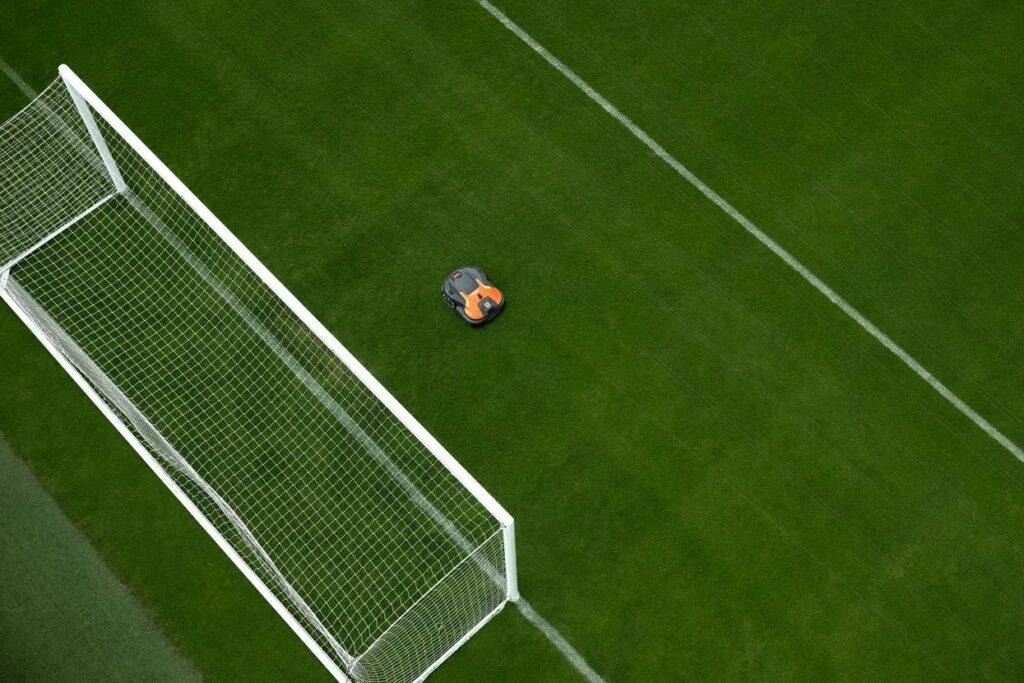
A Cut Above: CBUS Super Stadium and Husqvarna Lead Australia’s Turf Technology Revolution

CBUS Super Stadium has made history by becoming the first stadium in Australia to implement Husqvarna’s state-of-the-art robotic mowing technology, setting a new national benchmark for sustainable turf management.

The fully autonomous, battery-powered mowers represent a major step forward in the future of sports turf care, offering precision, consistency, and environmental benefits that far exceed traditional methods.

Designed to operate quietly and efficiently, the system significantly reduces both fuel consumption and carbon emissions by up to 83% while maintaining the venue’s pristine playing surface to the highest standards.

This innovation positions CBUS Super Stadium alongside some of the world’s most iconic sporting venues, including Liverpool FC’s AXA Training Centre, which has integrated Husqvarna’s robotic technology throughout its non-pitch areas to help maintain elite-level turf quality year-round.

How Robotic Technology Is Transforming Pitch Performance

Pauline Nilsson, Vice President of Sales and Service, Husqvarna Forest and Garden and Pacific Region spoke in detail about the future of turf management with this mower and the environmental benefits of implementing this technology.

Nilsson explained how both the noise and environmental impact play a part in the technology’s beauty.

“The environmental benefits of Husqvarna’s robotic mowing solutions represent a significant advancement for Australian sporting venues. Our commercial robotic mowers produce no direct fumes or CO₂ emissions during operation, which is increasingly important as sporting organisations work toward sustainability targets,” she said to Soccerscene.

“Traditional ride-on mowers consume considerable fuel and require regular refuelling and maintenance. Our robotic mowers are lightweight and battery-driven, significantly reducing the carbon footprint compared to conventional ride-on mowers.

“Beyond direct environmental benefits, the technology is virtually silent, eliminating noise disturbance from traditional landscaping. This allows grounds teams to maintain pitch quality around the clock without disrupting nearby residential areas or training sessions,” she continued.

When asked about how this technology directly affects the fan and player experience at football games, Nilsson explained how important the robotic technology was for a professional sporting environment because of its consistency.

“The technology fundamentally transforms pitch maintenance through precision and consistency. Our robotic mowers use razor-sharp blades that cut almost like scissors, and continuous mowing is crucial for maintaining a healthy pitch,” Nilsson explained.

“Our robotic mowers cut turf daily and automatically recycle the clippings as natural fertiliser, operating rain or shine to ensure fields are always game-day ready.”

For players, this technology delivers several critical advantages:

Safe, consistent playing surfaces – turf is mowed at a consistent height, even in adverse weather conditions, creating an improved playing surface. Important for sports fields where surface consistency affects game play, athlete performance and injury risk.

Improved quality of turf, with denser, healthier grass – the pitch withstands heavy use and recovers more quickly.

Reduced surface compaction – the lightweight mowers cut down on soil compaction that normal mowers create, delivering outstanding cut quality, resulting in better drainage and healthier grass.

Global Success, Big Ambitions for Australian Football

Husqvarna have sizeable ambitions to expand in the Australian sports stadiums market after this CBUS Super Stadium deal, and Nilsson highlighted that their recent partnerships in Europe and the US have ‘proven’ the efficiency of the technology to eventually implement down under.

“Beyond Europe, the technology has proven successful at prestigious venues worldwide. Atlanta Athletic Club utilises both our Automower® and CEORA® systems to maintain their golf course. These are world-class facilities with exacting standards, demonstrating that this technology delivers at the highest level,” Nilsson said.

“Since launching Husqvarna CEORA® in 2021, we’ve experienced double-digit growth in professional robotic lawnmowers annually, and we’re bringing that proven technology and expertise to the Australian market.”

For Australian football venues specifically, the technology addresses several critical challenges:

Climate adaptability – the robotic mowers operate effectively in various weather conditions, crucial for Australia’s diverse climate zones.

Labour efficiency – addressing ongoing skilled groundskeeper shortages by automating routine maintenance.

Sustainability commitments – helping venues meet environmental targets without compromising quality.

Operational cost management – significantly reducing fuel consumption and maintenance expenses.


2032 and Beyond: A Strategic Play for Australian Football

“With the 2032 Olympics approaching and increased focus on football development across Australia, we see significant opportunities across A-League venues, National Premier League grounds, and regional sporting facilities,” she continued.

“We’re in active discussions with several venues, but we’re focused on building genuine partnerships rather than simply deploying equipment. Our goal is to help Australian sporting venues understand that this technology delivers measurable benefits in pitch quality, operational efficiency, and environmental performance backed by proven success at prestigious venues worldwide.”

For CBUS Super Stadium, this move underscores a commitment to sustainability, operational excellence, and player safety which ensures the Gold Coast venue continues to deliver world-class conditions as it attracts a growing list of national and international events.


Previous ArticleNext Article

Marie-Louise Eta makes history as new Union Berlin head coach

In an historic appointment, Eta will take over as head coach of Union Berlin until the end of the season.

History in the making

Previously the first female assistant coach in Bundesliga history with Union Berlin, Eta will now take the reigns of the men’s first team on an interim basis.

Currently, the club sit in 11th place in the Bundesliga table, but with only two wins so far in 2026, relegation appears an all-too-real prospect, and one which the club is desperate to avoid.

“Given the points gap in the lower half of the table, our place in the Bundesliga is not yet secure,” said Eta via official media release.

‘I am delighted that the club has entrusted me with this challenging task. One of Union’s strengths has always been, and remains, the ability to pull together in such situations.”

Eta will begin as Union’s new head coach with immediate effect, and will be in the dugout for the club’s matchup against Wolfsburg this weekend.


A step into an equal future

Eta’s appointment signals a major step towards a more level playing field in the football landscape.

Furthermore, Eta joins other coaches including Sabrinna Wittmann, Hannah Dingley and Corinne Diacre who, in recent years, have blazed a trail for female coaches to step into the men’s game.

Wittmann currently manages FC Ingolstadt in Germany’s third division, and was the first female head coach in Germany’s top three divisions.

In 2023, Dingley became caretaker manager of Forest Green Rovers, and thus the first woman to lead a men’s professional team in England.

Diacre, now head coach of France’s women’s national team, managed Ligue 2’s Clerment Foot between 2014 and 2017.


Final thoughts

The impact therefore, is that Eta’s appointment will show future generations of aspiring female coaches that men’s football is an equally viable and possible pathway as the women’s game.

The time is now to level the playing field.

And while it may be a short-term role, its effect on attitudes towards equality and fair opportunities in the game will hopefully resonate long after the season ends.

“20 Years Ahead”: The System Quietly Reshaping Korean Football

For all its consistency, Korean football has long carried an underlying tension.

On paper, it works. The national teams remain competitive, the player pool is technically sound, and the country continues to produce athletes capable of performing on the continental stage. But beneath that surface-level success, a more uncomfortable question has persisted about whether Korea has been simply maintaining its position while others evolve.

That question has driven the Korea Football Association (KFA) toward one of the most ambitious structural overhauls in modern football development: the Made in Korea (MIK) Project. Rather than focusing on short-term gains or isolated improvements, the initiative attempts to do something far more complex. It is rebuilding the foundations of how football is taught, understood and executed across the entire ecosystem.

Internally, the project has been described as having “brought Korean football 20 years ahead.” Whether that claim ultimately proves accurate remains to be seen, but what is already clear is the scale of the shift taking place.

From talent to system

The starting point was not talent, but structure. For years, concerns had been growing within Korean football circles about a lack of uniqueness in players, inconsistencies in long-term planning and an over-reliance on safe, risk-averse styles of play. The system, while producing disciplined and technically capable footballers, was not consistently producing players equipped to thrive in the most demanding environments. Environments such as Europe, where tempo, decision-making speed and adaptability define success.

Rather than attempting to patch these issues, the KFA chose to reimagine the system itself.

At the core of the MIK Project is the idea that high performance is not the result of individual excellence alone, but of an interconnected structure that allows that excellence to emerge consistently. Coaching, sports science, performance analysis, leadership and education are no longer treated as separate pillars, but as components of a single, integrated system designed to evolve continuously.

A new operating model

This philosophy is most clearly expressed through the project’s adoption of a cell-based operating model. In place of traditional hierarchies, the system is organised into small, cross-functional units, called “cells”. These cells are given autonomy over their work while remaining connected through shared frameworks and objectives. Each unit is responsible not only for delivery, but for learning, adapting and refining its approach on a constant cycle.

The intention is to bring decision-making closer to the pitch, allowing those working directly with players to respond faster and more effectively to the realities of the game. In an environment where marginal gains are often decisive, that speed of adaptation can be critical.

Closing the gap

Yet structure alone is not enough. The project is equally shaped by a clear-eyed assessment of where Korean football currently stands in relation to the world’s elite.

Comparative analysis has highlighted several consistent gaps: technical execution under pressure, the ability to operate at higher game speeds and effectiveness in decisive moments such as one-on-one situations. These are not deficiencies of talent, but of context. Korean players, while highly capable, have often developed within systems that prioritise control and precision over risk and spontaneity.

The consequence is a style that can become predictable under pressure.

Training for reality

To address this, the MIK Project has fundamentally shifted training methodology. Sessions are increasingly designed to replicate the intensity and unpredictability of real matches, placing players in situations where decisions must be made quickly, under pressure, and often in confined spaces. The focus is no longer on rehearsing ideal scenarios, but on preparing players for imperfect ones.

This approach reflects a broader philosophical shift that prioritises adaptability over perfection, and decision-making over repetition.

Evolving the Korean identity

Importantly, this evolution does not come at the expense of Korea’s existing strengths. Discipline, work ethic and technical proficiency remain central to the national identity. What the MIK Project seeks to do is build upon those foundations, combining them with the creativity, speed, and tactical awareness required at the highest level of the game.

It is, in many ways, an attempt to reconcile tradition with modernity.

A global ambition

The ambition underpinning the project is unmistakable. The KFA is not simply aiming to remain competitive within Asia, but to re-establish itself among the world’s leading football nations. That means producing players capable of not only reaching Europe, but succeeding there.

More than a project

What makes the MIK Project particularly compelling is that it does not present itself as a finished solution. Instead, it is designed as a system that evolves, adjusts and refines itself over time. In a sport where trends shift rapidly and competitive edges are constantly eroded, that capacity for continuous development may prove more valuable than any single innovation.

For other football nations, Korea’s approach offers an instructive case study. While many federations continue to debate philosophical direction, the KFA has committed to structural transformation, embedding its ideas not only in theory, but in practice.

Whether the project ultimately delivers on its boldest ambitions will depend on time, execution, and the unpredictable nature of the game itself. But one thing is already evident.

Korean football is no longer standing still.

Most Popular Topics

Editor Picks

Send this to a friend