

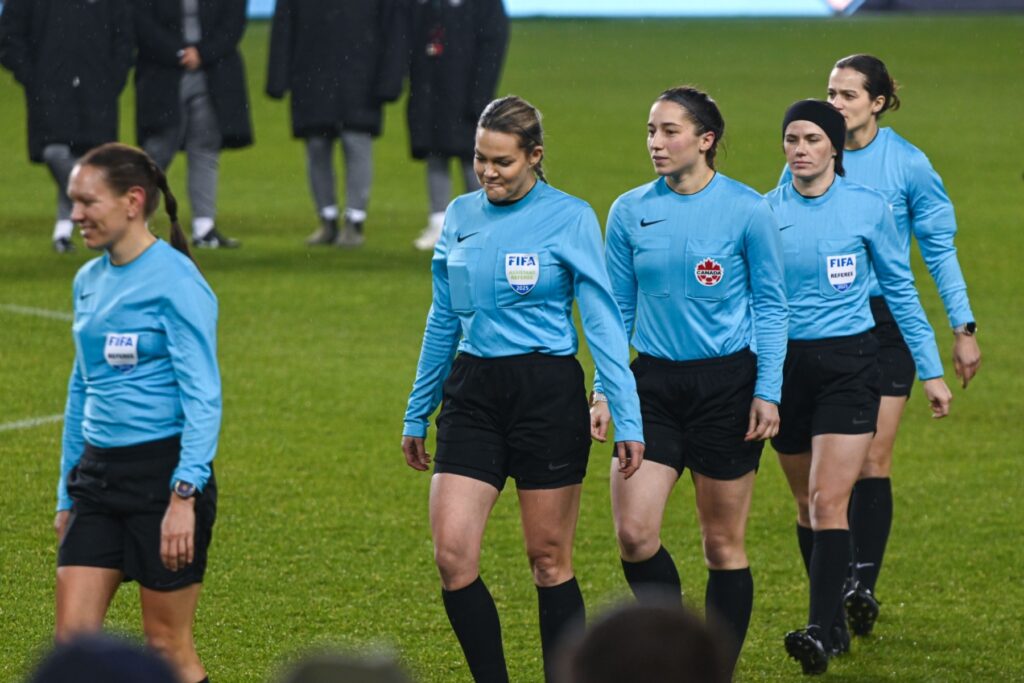
Six women are among the 170 referees, assistant referees and video assistant referees FIFA named to its 2026 World Cup officiating list in April, matching rather than exceeding the number appointed at Qatar in 2022. All six, however, come from countries within Concacaf, a change from four years ago, when the same total was drawn across five separate confederations.
Referees Tori Penso of the United States and Katia Itzel García of Mexico were joined by assistant referees Brooke Mayo and Kathryn Nesbitt, both of the United States, and Mexico’s Sandra Ramírez, along with Nicaragua’s Tatiana Guzmán as video assistant referee.Penso took charge of the Group A match between Czechia and South Africa on 18 June alongside Mayo and Nesbitt, the first all-female on-field trio to officiate a men’s World Cup match, becoming only the second woman to referee at that level, after France’s Stéphanie Frappart at Qatar 2022.García refereed Netherlands against Tunisia in Kansas City on 25 June to become the third woman, and the first Mexican woman, to referee a men’s World Cup match.
By contrast, Qatar’s six women were drawn from UEFA, CAF, AFC, CONMEBOL and Concacaf: Frappart of France, Rwanda’s Salima Mukansanga and Japan’s Yoshimi Yamashita as referees, and Brazil’s Neuza Back, Mexico’s Karen Díaz Medina and the United States’ Kathryn Nesbitt as assistants.
A pathway built through Concacaf’s development system
FIFA Chief Refereeing Officer Pierluigi Collina described the 2026 appointments as drawn from the largest group of World Cup match officials in the tournament’s history, the product of three years of monitoring, seminars and assessment, with selection based, in his words, on officials being “the very best in the world.”
Penso’s own record illustrates how that system has worked for Concacaf officials specifically. She joined the FIFA international panel in 2021, the same year she became the first woman to lead an all-female team in a men’s competition organised by Concacaf, refereeing a World Cup qualifier.She had already become the first woman in two decades to referee a regular-season Major League Soccer match, in 2020, and went on to take charge of the 2023 Women’s World Cup final, the first World Cup final overseen by an American referee.García’s path ran through Liga MX, where she became the first woman in more than 20 years to referee a men’s match in March 2024.
Australia’s own contingent at the tournament, referee Alireza Faghani and assistant referees Andrew Lindsay and George Lakrindis, along with video match official Shaun Evans, does not include a woman among its four officials,positioning the current pipeline into men’s World Cup officiating as one running through a narrower set of confederations than the sport’s broader referee development system overall.
Research on performance shows a mixed but instructive picture
The appointments sit alongside a growing body of research testing assumptions about female officials in men’s football. A study in the Journal of Human Sport and Exercise, examining five seasons of the Maurice Revello Tournament, found female referees were not weaker than their male counterparts in adjudicating men’s matches.Separate research by Atılgan and Tükel, cited in a 2025 study of fan perceptions of referees, found women outperformed men specifically at the decision-making stage, with men showing greater hesitation and avoidance.
Findings on physical output are less uniform. A systematic review of physical demands in high-level matches found male and female referees covered broadly comparable ground, averaging 10.5 and 9.9 kilometres respectively, with similar volumes of high-intensity running.A separate comparison of Spanish first and second division referees found male officials produced higher peak-intensity output than female referees across the shortest, most demanding windows of match play, a gap researchers linked to aerobic capacity and flagged as requiring further study at international level specifically.Academic research published this year estimates women still make up roughly one in ten of the world’s accredited match officials across all levels of the game.
FIFA’s next major appointment cycle for women’s officiating is already under way, with match officials named this year for the 2026 FIFA U-20 and U-17 Women’s World Cups as part of preparations for the 2027 Women’s World Cup in Brazil.