


Phil Moss: Australian football coaches deserve better

Phil Moss

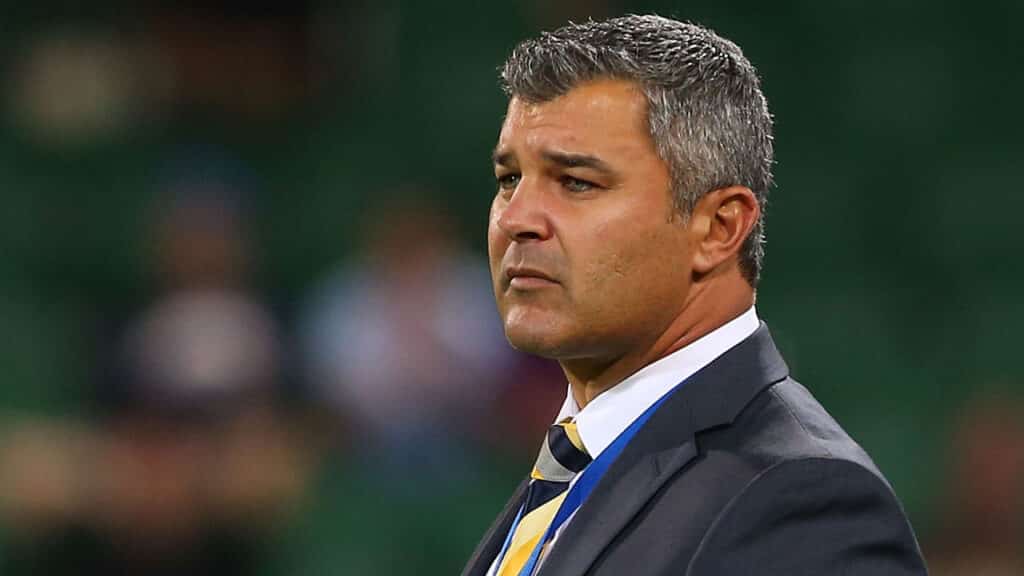
Former Central Coast Mariners coach Phil Moss claims football coaches in Australia deserve more respect and a higher level of support.

Speaking exclusively to Soccerscene, the former A-League coach claimed associations such as Football Coaches Australia (FCA), which he is currently president of, will improve the conditions and reputation of coaches in Australia.

“I think the main aim (of FCA) is to wrap coaches with a support mechanism, give them a collective voice and really drive towards a level of respect for coaches that we haven’t seen in this country,” he said.

“We’re always the easy option when things go wrong.

“There’s an old saying, when the team’s going well the players are great, but when the team’s losing it’s because the coach doesn’t know what he is doing.”

Moss had various coaching stints in his career at Dee Why FC, Northern Spirit youth (assistant), Manly United and the Olyroos (assistant) before moving to the Mariners in 2010.

He took over from Graham Arnold after being an assistant coach for the club in the three years prior, which included a championship winning season in 2012-2013.

Moss led the Mariners to a third placed finish in his first season as head coach in 2013-14.

However, he was eventually sacked near the end of his second season in charge after disagreements with the owner.

“We had a fantastic first season, we had a lot of success, we missed the grand final by one game,” Moss said.

“We also missed out on the second round of the ACL by a point and then we sold a lot of players. In the January transfer window of the following season, I think I lost six players in that period and that proved to be really tough.

“Things spiralled out a bit from there and the owner and I fell out. There was only going to be one winner in that situation.”

Moss believes a lack of appropriate professional support at the time of his removal, planted the seeds for his eventual involvement in FCA.

Central Coast ended up compensating Moss in the region of around $500,000 according to The Daily Telegraph, after his case for wrongful dismissal was settled before a court date. (Moss would go on to be an assistant coach at Sydney FC in 2017).

“I had my family, my closest friends, my mobile phone and a pretty good lawyer and that was it. That’s where FCA sort of morphed from.

“My mantra is to make sure no Australian coach is ever in the same situation I was in. Plenty of others before me were in (that situation) with no real support.”

Steps in the right direction have been taken to improve the employment conditions and general well-being of coaches through work driven by the association.

FCA recently released the findings of a study completed by the University of Queensland on these factors.

The report showcases data which highlights the need for contractual guidelines to be implemented, as well as standardising grievance and dispute resolution procedures, among other things.

FCA hopes to address these issues and move quickly into a process to fix them.

“We’re fighting for better conditions for coaches and probably a bit more uniformity,” claimed Moss.

“We are working hard on a well-being program for coaches, to support coaches in and out of jobs and in that transition into a job and out of a job. So, all those things are really important to us.”

The association was also in contact with the FFA and A-League clubs, before the start of this A-League season.

Greg O’Rourke and the FFA were kind enough to give us a slot during their agenda with the coaches.

“That was an opportunity for us to ask the coaches what their issues were, going into the season.

“We’re in the process of sharing that information with FFA and working through that, and not just with the FFA but obviously the new operating company of the independent A-league.”

The organisation has a seat at the table in the discussion for the introduction of a national second division, thanks to FFA Board member Remo Nogarotto.

Nogarotto is the current chair of the National Second Division Working Group.

Moss is thankful for FCA’s inclusion in the conversation, in what will provide elite Australian coaches with more job opportunities in the future.

“Full credit to Remo and his working group, for seeing it fit to include coaches.

“At the end of the day, coaches are responsible for the happiness and the satisfaction of four key stakeholders, the ownership and boards, the dressing room, the fans and the media.

“So, when you’ve got that sort of vested interest in the game, holistically, it seems really illogical not to have coaches part of the discussion and part of the decision-making process around the game.”

After being formally elected as president of FCA in July 2018, Moss was re-elected at an AGM in August of this year, in what was a proud moment for him.

Speaking about the privilege of leading FCA, Moss said: “It’s a massive honour. Probably aside from coaching in the A-League as a head coach, it’s right up there.”
Previous ArticleNext Article

More Than One in Five Football Australia Staff to Lose Jobs Amid Growing Financial Losses

Australian football finds itself in a curious position.

From the outside, the game appears to be riding a wave of momentum. Attendances, visibility and public interest have all experienced significant uplift in recent years, while major international tournaments and growing discussion around football’s future continue to place the sport firmly within the national conversation.

Yet behind that momentum, Football Australia is now confronting a far more challenging internal reality.


A compounding deficit

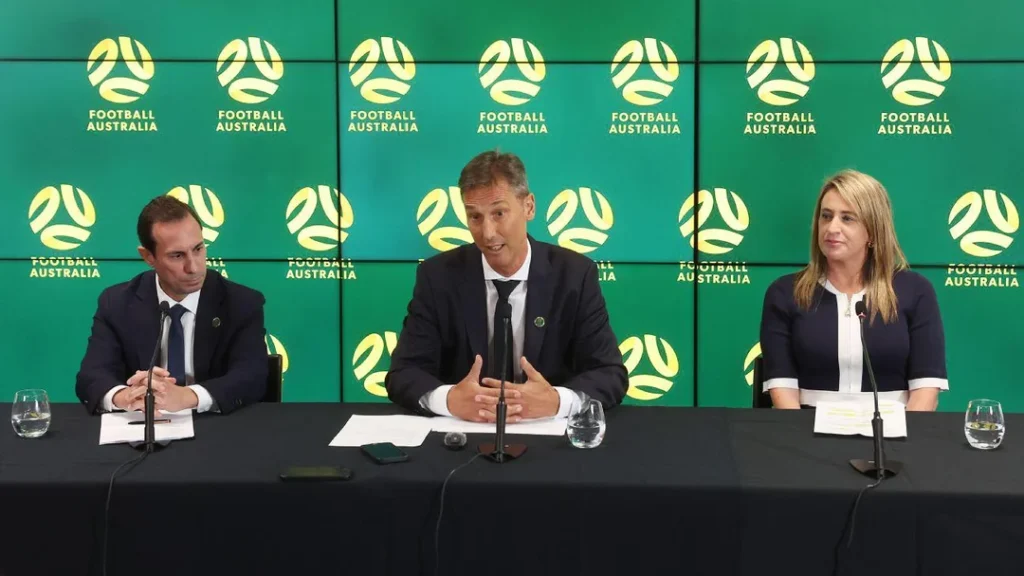
Chief Executive Martin Kugeler has reportedly indicated the governing body’s projected financial losses for 2025 are expected to exceed the organisation’s reported $8.5 million deficit from the previous year. Accompanying the financial outlook are substantial organisational changes, with reporting from Tracey Holmes indicating more than one in five Football Australia employees are expected to lose their positions through restructuring measures.

The figures represent more than a difficult balance sheet. They point toward a significant period of recalibration inside the organisation responsible for overseeing the sport nationally.


Losing the wisdom of existing staff members

For governing bodies, restructures are often framed as strategic necessities for future sustainability. However, workforce changes on this scale also raise broader questions around the challenges of such a transition.

People are often the carriers of knowledge, relationships and long-term strategic understanding. When organisations undergo significant structural change, the effects can extend beyond immediate financial outcomes.


Contradicting timing

The timing is what makes the developments particularly notable.

Football in Australia has spent recent years discussing expansion, growth and long-term opportunity. The conversation surrounding the game has increasingly centred on future potential. Often headlining stronger pathways, larger audiences, infrastructure development and greater visibility.

Against that backdrop, news of deep financial losses and substantial staffing reductions creates a different conversation: one focused not on where the game wants to go, but on what may be required to sustain that journey. Therefore, this announcement points toward stagnancy, rather than growth.

Further detail surrounding Football Australia’s strategy and long-term direction will likely emerge over coming months. For now, the developments serve as a reminder that growth stories are rarely straightforward.

Often, the periods that appear strongest from the outside can also be the moments organisations face their most significant internal tests.

Heidelberg United denied qualification to AFC UCL 2

In an announcement made yesterday, Football Australia revealed that, in place of Heidelberg United, Melbourne Victory will now take the AFC UCL 2 spot.

A premature ending

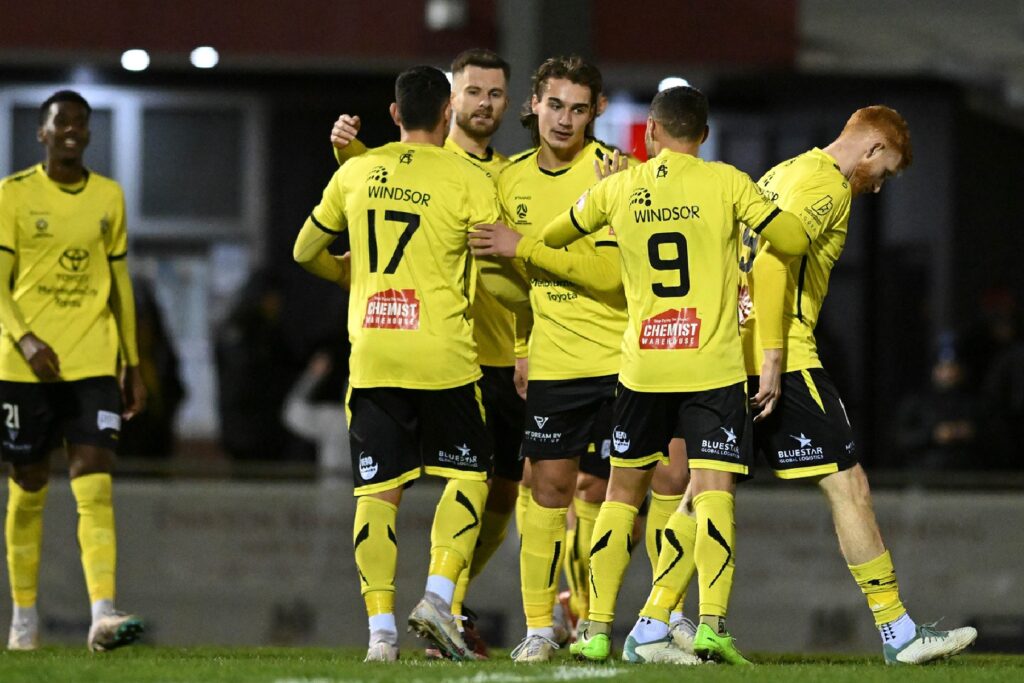
In what is sure to be a disappointing verdict for Heidelberg’s fans, staff and supporters, the NPL VIC side will no longer compete in next season’s AFC CL 2.

The decision comes despite Heidelberg meeting the necessary criteria outlined in Football Australia’s National Club Licensing Regulations.

“We understand that this will be a disappointing outcome for everyone connected to Heidelberg United FC,” said FA Executive Director of Football, Heather Garriock, via press release.

“The club earned enormous respect through its performances this season and should be proud of what it achieved both on and off the pitch.”

Indeed, through defeating several A-League outfits en-route to the Australia Cup Final against Newcastle Jets, Heidelberg did earn widespread respect and admiration across the landscape. Football Australia also strongly advocated for the side’s place in the AFC CL 2 following Newcastle’s qualification to the AFC CL Elite.

But despite the determined efforts of the club’s board to meet all necessary criteria, the Asian Football Confederation (AFC) ruled the side ineligible to compete.


Victory emerge as replacements

Filling the now-vacant position in next season’s competition is Melbourne Victory, who finished 4th in the A-League this year.

As 3rd-place Auckland FC are based in New Zealand, thus falling under the Oceania Football Confederation (OFC), they are also ineligible to compete.

So while the AFC CL 2 will still be arriving in Melbourne next season, fixtures will no longer be built on the underdog success story of Heidelberg’s immense rise from NPL to AFC CL matchdays.

The club, however, will appeal the decision, and has written to Football Australia for further clarity on the Appeals Process.

It remains uncertain whether the appeal will be successful or not, but Heidelberg will undoubtedly enjoy the backing not just of its own staff and supporters, but of the entire Australian grassroots community.

Most Popular Topics

Editor Picks

Send this to a friend