


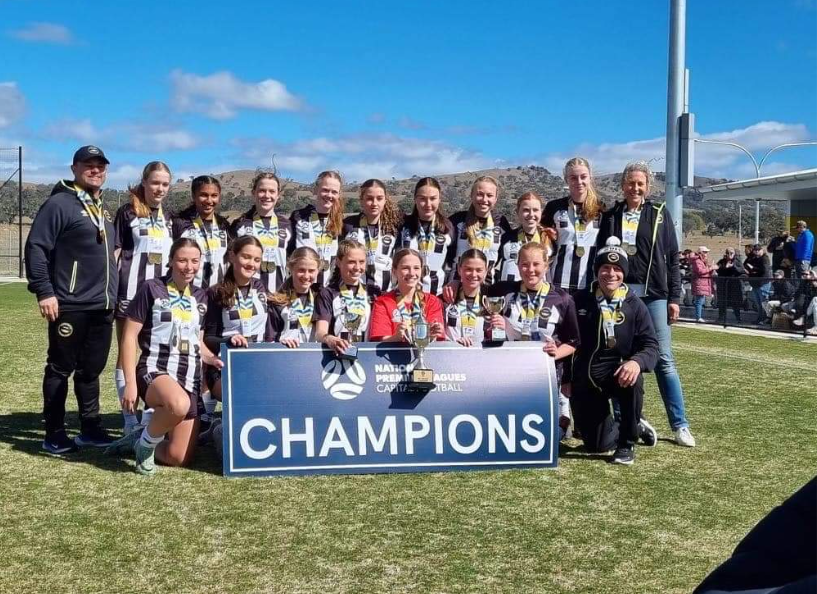
Gungahlin United FC Announce Insolvency, Surprising Club Families

Gungahlin United Football Club has this week announced its insolvency due to poor financial management and governance control by members of the previous administration.

The NPL football club reportedly owes ACT Government and numerous creditors approximately $550,000 in total, exceeding the estimated $200,000 from the club’s previous financial forecast submitted to Capital Football.

In a club statement posted on Facebook on the 18th of October, Gungahlin United FC stated the club will “cease to operate” as a registered association under the Association Incorporation Act 1991 (ACT) and have begun the process to allow club members time to trial with other teams.

“It is deeply saddening that the actions and mismanagement of a few individuals have now resulted in the displacement of over 2,000 players plus the coaches, volunteers, and families,” they said.

“The Club had significantly overspent within the NPL Men’s program and operated without the necessary checks and balances to ensure financial and operational accountability.

“This mismanagement directly contributed to the Club’s deteriorating financial position and its inability to meet key obligations.”

Capital Football confirmed that the football club was informed in 2024 about their NPL licence, which was issued with conditions requiring repayment of outstanding debts owed to both Capital Football and the ACT Government.

“Capital Football regrets that financial mismanagement has led to a situation in which a club believes it can no longer continue operations,” they said via press release.

“The immediate priority for Capital Football is to ensure that all players affiliated with GUFC, particularly the participants in community competitions, are provided with opportunities to continue playing football within the ACT region.

“Capital Football encourages the broader football community to show respect and support for GUFC players, families and volunteers during this challenging time.”

The Future For GUFC Members

A second Gungahlin United club statement released on the 20th confirmed the club has found it legally and ethically improper to operate while insolvent and to trade in the state.

Gungahlin United Football Club players, volunteers, coaches, and other members of the club are now looking at their future in the sport within ACT after being informed of the insolvency this week.

However, families of the club’s younger players have been hit the most by the news since the club is a social place for the community to exist in during the football seasons, as well as the fact their local football club is disappearing.

A large number of families are now looking for the next appropriate NPL club that is open for new players for next year’s season, but not every young player can simply transfer into a new club, which has been one of the major disruptions experienced by GUFC families.

However, if young players are not able to enter into an NPL club affiliation team by next year, the next option is signing up for recreational teams in the state.

Gungahlin United FC are currently in the process of refunding players who paid towards program funds.

Previous ArticleNext Article

Football West’s NAIDOC ball competition turns Indigenous art into a road safety message, and a rare form of representation

Football West has opened its 2027 NAIDOC Ball Design competition, inviting members of Western Australia’s Aboriginal and Torres Strait Islander communities to submit artwork that will end up printed on 500 footballs and distributed to schools, clubs and communities across the state. It is a small competition with a modest prize, a $1,000 voucher and a set of ten footballs for the winner. But what it is actually doing sits somewhere more significant than a design contest.

The 2027 edition is a joint initiative between Football West, the Insurance Commission of Western Australia and, for the first time, Football Futures Foundation. The winning design will carry the Insurance Commission’s Belt Up road safety message alongside the artwork, with the footballs distributed during NAIDOC Week, which runs from 4 to 11 July next year.

Football Futures Foundation CEO Michael Kerr framed the partnership as an extension of work the Foundation already runs across the state.

“Through programs such as Dreamtime Spirit and Yilkari, supported by former Matildas goalkeeper Lydia Williams, we are working alongside Aboriginal and Torres Strait Islander communities to create football opportunities that are culturally safe, community-led and built around genuine belonging,” Kerr said.

A message that travels further in a football

Road trauma in Australia isn’t evenly distributed. Indigenous Australians are consistently found in national research to be two to three times more likely to be killed in a road transport crash than non-Indigenous Australians, a disparity driven in part by higher rates of pedestrian and passenger injury and compounded by the realities of remote and regional life, longer travel distances, older vehicles, and limited access to emergency care when something goes wrong. Seatbelt non-use remains one of the most consistent contributing factors in that gap.

The Insurance Commission has invested more than 2 million dollars in the Belt Up campaign over its seven years, and its Chief Investment Officer, Steve McKenna, has been explicit about who the message is aimed at.

“About 170 people die on the road each year in Western Australia,” McKenna said. “About 60 per cent of those are male. Of that total, 17 per cent aren’t wearing seatbelts when they die.”

Generic road safety advertising struggles to reach communities where trust in government messaging is not automatic and where the delivery channel matters as much as the message itself. A football, carrying artwork made by a member of the community it is meant to reach, distributed through a sport that already has deep informal roots in many Aboriginal communities, moves in a way a billboard cannot. That is not incidental to the campaign. It is the entire design logic.

Whose stories get told

Jarnda Councillor-Barns, the Ellenbrook artist who won the 2026 competition, used the colours of the Aboriginal and Torres Strait Islander flags in her design, with circular patterns representing gatherings and connecting pathways representing the journeys, knowledge and skills each player carries.

“I really wanted to amplify the stories that are in the Football West community, whether you’re based metro or rural like I was, and how everyone in a team comes with their own stories,” Councillor-Barns said.

Her own football story reflects exactly the kind of informal, community-rooted participation the competition is built to recognise. She grew up in Broome playing social games whenever she could, and has family connections to the Jambinu team, a regional Indigenous women’s side based in Geraldton, despite never being formally registered with a club herself.

“Soccer is a sport that brings people from all walks of life together, creating a larger family built on respect, teamwork and shared passion,” she said.

Football West’s David Williams, a former Socceroo who now heads the National Indigenous Boys Under-16s program, said initiatives like this had value beyond the artwork itself.

“For the creativity of artists to be involved with sport goes a long way,” Williams said. “The more initiatives we have with this kind of stuff, the better.”

That is a modest way of describing what is, functionally, a form of representation that Indigenous communities in Australian sport have not always had. Governing bodies commission Indigenous rounds, jerseys and acknowledgements regularly. Fewer hand the creative authorship, and a public platform for it, directly to community members with no requirement that they already hold a formal position within the sport.

Insurance Commission Chief Investment Officer Steve McKenna, reflecting on the 2026 winning design at its unveiling, saw something in it that spoke to the broader purpose of the exercise.

“You see the Socceroos playing, and look across the team, and a ball like this, the designs, it reflects what Australia’s all about,” McKenna said.

In the meantime, five hundred footballs carrying a community-made design and a road safety message will reach further into regional and remote Western Australia than most government campaigns manage on their own. Whether that message changes behaviour on the roads that data suggests still needs the most attention is the harder, longer question the competition cannot answer by itself.

Chelsea FC partners with Strava in landmark lifestyle partnership

The London-based giants announced the launch this week, marking a first-of-its-kind partnership for both the Premier League and Women’s Super League (WSL).

Connecting with fans

As clubs across the world look to find new and exciting ways of connecting with fans, Chelsea are showing that the answer – more often than not – already exists.

Strava is a running and fitness platform with over 195 million users across the globe. But the app represents more than just tracking speed – it is a social and lifestyle symbol through which users can connect.

And with presence in 185 countries, the app has the power to unite users from all over the world, making it a perfect fit for the globally-followed Blues.

“We are always looking at ways we can use our global brand to bring people together, often in unexpected ways,” said Brand Director for Chelsea Football Club, Scott Fenton.

“By working with Strava and becoming the first Premier League and BWSL teams to establish an official presence on Strava, we can lean into participation culture, understand where our fans are while offering new experiences for them and strengthen the bonds that unite our global community.”

Two brands with a huge international presence. One partnership which promises to encourage community, movement and healthy-living.


The intersection between sport and lifestyle

At first glance, Chelsea FC and Strava appear an unconventional partnership. Indeed, it is the first time a club has established an official presence on the app.

But at its core, the two organisations serve similar purposes: uniting people with a common passion for sport.

At its beginnings in 2009, Strava promised to replicate the feeling of team sports and unlocking new achievements, making a deal with Chelsea FC – one of the world’s most successful teams in recent years – a true full-circle moment.

“Chelsea FC joining Strava as the first Premier League and BWSL team to establish a global club on the platform is a powerful demonstration of how brands are engaging with their communities,” explained Director of Athlete and Community Partnerships at Strava, Mel Jarrett.

“We believe shared passion for movement creates real connections, and this collaboration brings that to life for Chelsea’s global fanbase.”

Most Popular Topics

Editor Picks

Send this to a friend