

How Patrick Spagnolo has revolutionised sporting apparel in Australia with OneSports

Patrick Spagnolo has really changed the game in the local footballing world in how to best go about the time-consuming task of customising kits, combining customer care and his huge passion for design to create OneSports that Box Hill United have managed to collaborate with for the current season.

Spagnolo boasts 35 years’ experience in the apparel industry, including a role with CK working with some big name retailers in Australia and abroad, fostering expertise crucial to OneSports’ success. His burning passion for both customer care and design excellence has led to the company being involved with some fantastic clubs in Victoria like Melbourne City and Avondale FC.

Patrick Spagnolo discussed the origins of OneSports and outlined what services the company offers for its many partners.

“OneSports was all about providing quality teamwear and that’s why we partnered with PUMA around 12 years ago. The company basically offers an end-to-end service so from design of the kits right through to the dispatch with all in-house production,” he explained.

“The key with an end-to-end service is partnership with our customers and really understanding what their requirements are. With that information we can collaborate and create a product they are really looking for.”

Whilst Spagnolo doesn’t quite have a football background himself, it was his kids early involvement in the sport that sparked the OneSports idea to partner with local clubs.

Luke Pickett in front of the Wembley Park stand.

He also touched on his wealth of experience in the apparel industry and the previous bigger roles he was involved in that guided him to early success with OneSports.

“My background is 35 years in the apparel industry, worked as a general manager for CK for 15 years and worked with big box retailers like Myer and Target as well as big retailers in the UK,” he mentioned.

“I’ve got a vast experience in the apparel industry and also come from a design background anyway so then built on that through OneSports from a marketing perspective as well.

“I’ve got an AFL background funny enough, but it started when my kids were playing soccer and what I could see was that all these clubs were struggling with supply, and they were quite unreliable.”

There is a reason why OneSports was able to succeed almost instantly with a partner like PUMA getting onboard. The company offers outstanding design and production services but also takes away the huge hassle for football clubs which is customizing their kits.

Spagnolo expanded on the company’s main point of difference in the competitive apparel market and why so many local clubs are partnering with the company in recent years.

“The point of difference with One Sports is the design element of it, on understanding what the DNA and the identity of each of our customers are and working back on their history to come up with a design that leads us towards success,” he said.

“I saw that there was an opportunity there, but I didn’t just want a no name brand or made up brand, we wanted a premium brand and that’s why we presented the business model to PUMA which ended up being a success.

“Being able to draw on PUMA’s vast library of designs and European influences that we’re able to give the latest trend of sports apparel but more specific teamwear.”

“PUMA has a brand sells itself, it’s probably one of the best football brands in the world which makes it all a lot easier,” he concluded.

Spagnolo’s experience in the industry has led to a big change in the way a supplier communicates with the clubs, searching a lot more in-depth into each club’s history and drawing inspiration from that to create a layered piece of teamwear.

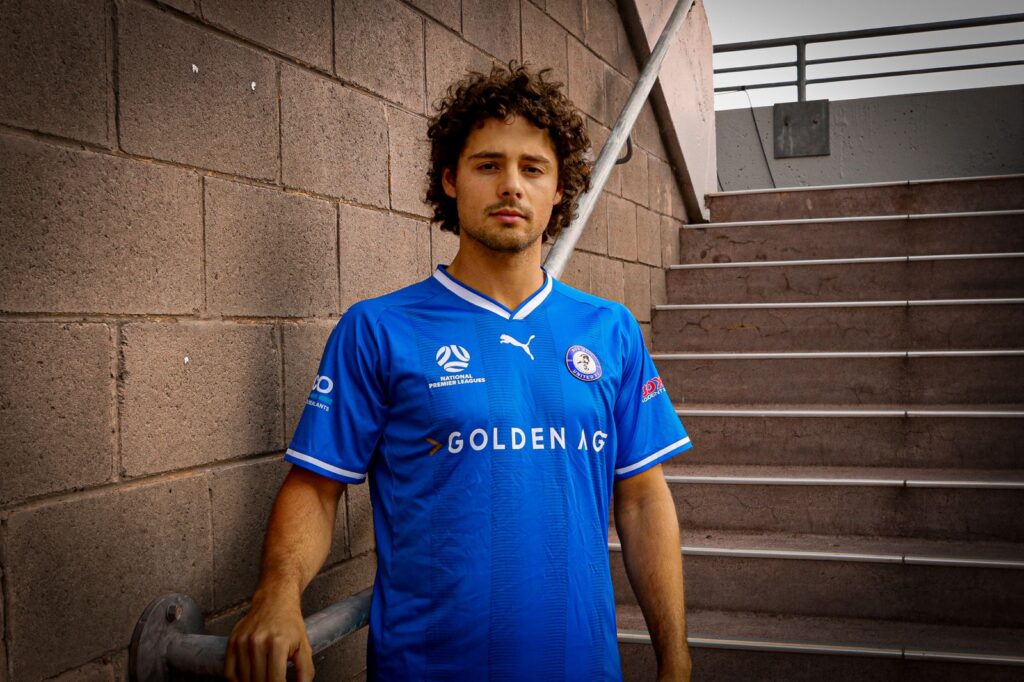
In 2024, OneSports collaborated with Box Hill United to create two unique designs for its home and away kits that are an ode to the over century long history of the club and modernising it with some European inspirations.

Box Hill United’s training shirt for the 2024 season.

He discussed the exact process the company took in designing each of the kits and what the apparel means to the club on a deeper level.

“When we come in the point of design concepts for clubs, we give each of them 4-6 design concepts that look at what the trends are looking like and finding an identity,” he explained.

“The Box Hill home kit was drawn off Manchester City’s 2023/24 home kit design and we combined it with Box Hill’s history which predominantly had a striped jersey and also a cheval jersey back in the day.

“Being an over 100-year club, we used the old kit with the cheval to draw the inspiration for the away kit with a modern twist to it, and the key is keeping it trendy and modern,” he continued.

“The stripe on the home kit is like a shadow stripe so it was based on Man City’s look with a mixture of Box Hill’s original home kits that had the striped looks. The away kit recognises the club’s past with the cheval look and modernises it to make it look more presentable for this upcoming season.”

The Under 16’s recently showcased their new ‘Vista’ Royal Blue home kits designed by OneSports. This was inspired by AC Milan’s 2020/21 away kit, adding to it a collar and cuff design showcasing the colours of Box Hill, Blue, White and Black.

The goalkeeper kit comes in all black with a feature of ‘Ice break’ on the sleeves and side mesh, adding a subtle yet powerful touch to the kit.

Luke Del Vecchio in the black goalkeeper kit. Image credit: Passion Creations.

Spagnolo talked about OneSports’ ambitions in the future as a company that is currently focused on the local and domestic game but is potentially looking at expanding further. 

“OneSports is not really looking at moving away from partnering with local clubs mostly because of PUMA’s values,” he said.

“There is an ulterior motive there from PUMA because their belief is if the kids are wearing ‘the cat’, they will be more inclined to buy more PUMA products because you become loyal to a brand so grabbing them at a young age is important.”

Spagnolo mentioned the time-consuming nature of catering to every club’s needs and how that is important to the relationship with partners but also the integrity of OneSports.

“We are big on brand integrity, we’re not just out there to flog garments, we are invested in all our club partners no matter how big or small they are,” he said.

“We care and that use of the word ‘care’ is sincere and authentic because we don’t miss delivery dates and collaborate closely with clubs like Box Hill United now.”

OneSports’ partnership with Box Hill United exemplifies its commitment to honouring clubs’ histories. With just over a century of the club’s history and an important 40-year milestone for the women’s team this season, the innovative designs have given the club an array of kits that really represent the values of the club and successes of the past.

Previous ArticleNext Article

The A-League’s Mover and Shaker: Can Steve Rosich Kickstart Football’s Next Chapter?

Could Steve Rosich be the mover and shaker Australian football has been waiting for? From leading the Melbourne Cup to transforming elite sporting clubs, Rosich now takes the reins of the A-Leagues with a powerhouse network of sponsors, a Chartered Accountant’s discipline, and a proven record of turning sports into commercial gold. Is this finally the game-changer football needs to kickstart its next chapter?

When the Australian Professional Leagues confirmed Steve Rosich as the new CEO of the A-Leagues, the football community couldn’t help but ask: Is this the mover and shaker who can finally kickstart the next chapter of our game? Curiosity, cautious optimism, and genuine hope are natural reactions. But after examining his résumé, leadership pedigree, and proven ability to transform sporting organisations into commercial powerhouses, one thing is clear: Steve Rosich has the potential to be exactly what Australian football needs right now.

If we are honest with ourselves, the A-Leagues are not short of passion. They are short of penetration. Football has the numbers, the multicultural breadth, the participation base and the long-term demographic wind behind it. What it has lacked is commercial conviction. This role requires a central figure who can mobilise investment, convince networks, and turn football from the ‘nearly product’ into a genuine entertainment powerhouse.

That is why Rosich’s appointment matters.

A Leader Forged in High Pressure Environments

Rosich does not arrive at the A-Leagues as an experimental project. His leadership record is built across three different elite sporting sectors, each requiring different forms of authority and strategic thinking.

At the Fremantle Dockers, he spent 11 years steering cultural shifts, long-term commercial planning, and stakeholder management in one of the most pressured environments in Australian sport, the AFL. You do not last a decade in that seat unless you can manage ego, media, board tensions, and commercial growth simultaneously.

Then came the Victoria Racing Club, custodian of the Melbourne Cup Carnival, The Race That Stops a Nation. That event is not a sporting fixture. It is a cultural institution. Rosich guided that organisation through pandemic disruption, shrinking tourism, shifting public sentiment, and operational uncertainty. Yet the Melbourne Cup retained its brand, its commercial partners and its relevance. That alone suggests a steady hand and a strategic head.

People forget he also stepped briefly into the medical technology sector with BrainEye, an unusual move but one that shows intellectual range, not a narrow sporting silo. Now he returns to football as CEO of the APL, stepping into the role officially in January 2026.

None of this is theory. It is hard-earned leadership.

The Commercial Rolodex That Matters

Elite sport grows on broadcast relevance, corporate investment, and scalable storytelling. It requires deal-making, not hope.

Rosich brings a corporate phonebook that can activate capital quickly. His longstanding relationships with brands such as Lexus (Toyota Australia), Crown, Kirin Beer, TCL and Howden are not superficial handshakes. They are built on years of commercial execution. If the A-Leagues are serious about revitalising sponsorship, broadcast engagement and experiential entertainment, then having a CEO capable of making the right calls to the right people is half the battle won.

Football does not just need ‘partners.’ It needs investors, activators and cultural amplifiers. Rosich has dealt with those brands before. He understands their expectations. He knows how to pitch ambition in commercial language, not sporting desperation.

If he can even convert a fraction of those relationships into aligned investment, the A-Leagues’ commercial landscape changes overnight.

Professional Discipline Not Just Passion

There is another aspect of Rosich’s appointment that deserves attention: his professional discipline. Rosich is a Chartered Accountant and at Soccerscene, we take that qualification seriously. We have been vocal in calling for Australian football administrators to adopt structured CPD frameworks, including professional standards and continuing education.

He is not a practising accountant, but he continues to uphold his membership by completing his CPD requirements and ongoing training. That signals accountability, standards, governance literacy and a commitment to continuous improvement.

We cannot demand a more professional football industry while accepting outdated administrative habits. Rosich represents the opposite, someone who keeps sharpening the tools rather than dining out on old achievements.

This is what modern sport requires.

The Strategic Assignment Waiting for Him

The football landscape Rosich inherits is not broken, but it is underleveraged.

The next two to three years must focus on:

• Commercial rebirth
• Fan-first narrative building
• Broadcast evolution
• International relevance
• Club alignment and industry unity

This requires a CEO who can think beyond short-term firefighting. Rosich has overseen environments where stakeholder diplomacy decides survival. He knows how to run a league as both an economic organism and a cultural asset.

And importantly, he understands that football cannot win hearts without winning the market.

A-League Football Needs a Catalyst Not a Caretaker

For too long, we have accepted incrementalism in football. Growth that is “good enough.” Strategic plans that tick boxes rather than punch holes through barriers.

The next chapter requires a catalyst, someone comfortable being a lightning rod for change.

Rosich does not need to pretend to be a lifelong football romantic. What he needs to be, and what his track record suggests he is, is a sports entertainment strategist. A deal-maker. A leader who knows how to change the expectation curve.

If he digs deep into his contact book, leverages his credibility and builds a unifying narrative around the game, then investment can return, broadcast value can lift, and the A-Leagues can finally behave like the entertainment product Australia keeps saying it wants.

A Final Assessment

Steve Rosich arrives with pressure on his shoulders. Great leaders need pressure.

He arrives with expectations. Football has waited long enough.

Most importantly, he arrives with the capacity to change the commercial gravity of the code.

If Australian football is serious about unlocking its next era, then we should back a leader who has already turned major sporting properties into economic brands.

In short, Rosich might be the right person at exactly the right time, and for a code that has spent decades asking for belief, that is a very encouraging starting point.

Como 1907: From Bankruptcy to Industry Innovators in 10 Years

The Lombardy-based club, currently among the best-performing in Serie A this season, has revolutionised what it means to be a football club. 

Under the ownership of the Hartono brothers, the richest owners in Italian football, Como 1907 has experienced a meteoric rise both on and off the pitch. So how did the club go from bankruptcy to business giants in just under 10 years? 

A Unique Business Model

Located among the scenic views of Lake Como, the club offers a unique experience in which luxury travel meets the adrenaline of live football. 

With 1.4 million visitors annually, the region already possesses the fame and attraction needed for a successful business. So when Mirwan Suwarso, Robert Budi Hartono and Michael Bambang Hartono came to the helm in 2019, they saw its potential not just as a holiday destination, but as a leading hub of football tourism. 

Throughout the Covid-19 pandemic, Como helped re-establish itself as a credible presence in the local community, helping to pay for vaccinations and establishing grassroots initiatives. In the years since, the club has formed a huge variety of partnerships, allowing for multiple revenue streams to open up and cement Como 1907’s reputation as a luxury brand. 

Commercial Collaboration

Como have worked to solidify their brand aesthetic by working with partners across fashion, media, hospitality and education. 

Earlier this year, Italian luxury brand, Brioni, announced a new partnership with the club by designing a line of suits to be worn by the men’s team. Sport giants, Adidas, and streetwear brand, Rhude, also form the main sponsors helping to curate and design the expanding brand of Como 1907. 

The club has also invested in a brand of silk-filtered beer called La Comasca. Given that the beer seems hard to find anywhere else besides the club’s home ground, ‘the Sinigaglia’, its rarity helps fans and celebrity spectators feel that they are part of a football experience unlike any other in Europe. 

High Risk, High Reward? 

Of course, despite the glamour of fashion partnerships and ambitious projects, it is no guarantee that a business model of this nature will always lead to success both on and off the pitch. 

For Venezia FC, a club who threaded sleek venetian aesthetics into team kits and commercial branding, turning cultural richness into footballing success was a significant challenge. After a disappointing campaign with only five league wins, the club was relegated to Serie B. 

Como 1907, on the other hand, has proven to be an exceptional case. Since the new ownership took over in 2019, the club’s backroom staff has increased from a team of 5 to 45 people. The off-pitch team helps to manage various branches of the club’s operations including media, communications, retail and facilities. Furthermore, by partnering with over 350 affiliate stores across Lake Como, the club has grown their retail revenue from AUD 57,000 to AUD 5.5 million. 

The progress seen in recent years demonstrates that lucrative results can be achieved not only through international strategic partnerships, but by working with local businesses and pre-existing infrastructures to inspire growth. 

Off-Pitch Structure, On-Pitch Success

Alongside the brand deals and partnerships upholding Como’s expansion in recent years, the team has also grown to be formidable opponents in the Serie A. 

Led by formal Arsenal and Barcelona midfielder, Cesc Fabregas, the team finished 10th last season. Currently sitting in 6th place and only three points off a Champions League spot, Fabregas has instilled confidence and a clear strategy into the players. 

As with clubs such as Barcelona and the famous ‘tiki-taka’ style, having a defined way of playing, a footballing culture, can be extremely beneficial in creating not just a team, but a footballing institution.

What Can A-League Clubs Learn From Como 1907?

As the A-League looks to expand its presence across Australia and invest in the game for future generations, there are plenty of lessons to be learned from Como’s off-pitch development. 

Tourism numbers across major cities in Australia point to several opportunities for investment for the A-League Men and A-League Women. According to Domestic Tourism Statistics (DoTS) and International Visitor Survey (IVS), Sydney attracted 16.3 million tourists in the June quarter 2025, 15.5 million of which were domestic. 

With an expenditure of $7 billion, there is huge potential for clubs like Sydney FC and Western Sydney Wanderers to harness the number of visitors and create an experience in which the city’s fame merges with the excitement of live sport. 

In Queensland, tapping into an image of leisure and business could be a possibility to grow attendance and revenue numbers in the A-League. In the year ending June 2024, Brisbane saw a record-breaking $10.7 billion spent by visitors. With the Olympics due to be held in the city in 2032, clubs like Brisbane Roar may look to create a brand founded on leisure, travel, and sporting prowess. 

Most Popular Topics

Editor Picks

Send this to a friend