

Joe Mirabella: Melbourne Victory on my mind

Melbourne Victory shareholder, Joe Mirabella, was introduced to football at an early age when he was taken by his father to watch his beloved Juventus in the Victorian State League.

Following a playing career where he reached reserve grade status, Mirabella became president of the club in 1990, served on the board of Football Victoria in 1991 and 1992 and became a shareholder of Melbourne Victory when the A-League commenced in 2005.

He is one person who puts his money where his mouth is, through his highly successful trading company, Mirabella International, which currently has a 12.5% shareholding in Melbourne Victory after it was diluted from 19% when 777 acquired its majority interest in the club.

Mirabella’s motivation to see football succeed in Australia is clear for all to see but he is also realistic there are many challenges facing the game.

In this interview with Roger Sleeman, Mirabella discusses all things A-League, the proposed National Second Tier competition, the future of Melbourne Victory and his hopes for the progress of the game.

ROGER SLEEMAN

What motivated you to seek a financial stake in the A-League?

JOE MIRABELLA

There’s a family connection here as we put our money into the State League and N.S.L. and it was my late father who encouraged  us to buy shares in Victory at the start of the A-League.

He was a true believer in Frank Lowy who was tough but craved success for the game so it was a natural process for me to be involved at Victory when Lowy came back to the game at the start of the A- League.

Personally, I have a love affair with the game and it’s my dream the game will reach its true potential in the not too distant future.

R.S.

The A-League experienced many years of success.

In hindsight, was it a wise move to unbundle the League from the F.A.?

J.M.

It was a big mistake by the owners of the A-League clubs and the removal of Steven Lowy was catastrophic.

The Lowy family had the ability to negotiate with government and keep the League on a good financial footing so they should never have been removed from power.

My statements supporting  this view are recorded in the Melbourne Victory records.

R.S.

What was your reaction to the removal of over forty employees from the APL in January?

J.M.

It had to happen because the league was bleeding money with clubs facing insolvency.

Critically, there should never have been so many employed in the first place.

R.S.

Are you confident in the current executive management overseeing the APL?

J.M.

Not impressed at all and they’re doing nothing except talking since Stephen Conroy came to power as Independent Chairman.

When Conroy took up his position, he had three tasks to perform.

(1) Advise the clubs that none of them could be directors  of the APL and an independent board would be installed for the benefit of the game.

(2) An enquiry be undertaken to account how the $140 million from Silver Lake was spent, e.g.$40 million to Keepup and subsidies for Perth Glory to stave off bankruptcy.

(3) A comprehensive review of the television deal with Ten and Paramount.

None of these tasks have been achieved.

R.S.

What was your take on the reduction of funding to the A-League clubs from $2 million to $530,000 per season announced in May?

J.M.

I knew it was coming and told Stephen Conroy he should go back to basics like the NSL model.

I suggested no levy or licence fee should be charged even if it meant the $530,000 contribution to the clubs was reduced.

Also, that prize money should be allocated for the minor premiership and end of season playoffs and the salary cap removed.

There should also be an increase in the League to sixteen teams to create economies of scale  and the clubs should be encouraged to build their asset base to provide income streams and consequent financial stability.

Joe Mirabella with his two sons & Keisuke Honda, at Melbourne Victory’s Round 14 match with Wellington Phoenix on January 20, 2019.

R.S.

What is your opinion of the proposed National Second Tier competition?

J.M.

I can’t see it going ahead and believe the FA always knew this under the current plan.

If it goes ahead, they’ll send the clubs bankrupt.

Without promotion and relegation it’s not sustainable because without this carrot there’s no incentive for the clubs.

R.S.

What is your view of the current Paramount television deal?

J.M.

It’s not successful with subscriptions right down, and with revenue to the clubs only paid on pro rata subscriptions, it’s not an ideal situation.

R.S.

Melbourne Victory was always a flag bearer of Australian football.

Where do you see it now, and in the future?

J.M.

We have to look at the financial situation first because there’s no olive tree in the backyard.

The deal for 777 to buy out the club within five years doesn’t look promising because the club doesn’t have sufficient assets to make a wholesale purchase attractive.

The company also has the weight of the Bonza airline liquidation to contend with and recently their proposed purchase of Everton F.C. has failed.

Consequently, 777’s ability to buy the balance of Victory’s shares which will cost them $40 million seems remote.

Therefore, the only way Victory can stay afloat in the long term is for bank finance to be raised.

However, the question is without sufficient asset backing, who is going to guarantee the bank loans because the existing shareholders certainly won’t.

Jim Christo, Anthony Di Pietro & Joe Mirabella with his two sons at the A-League Men semi-final in Sydney on April 28, 2018.

R.S.

How do you see the future of the A-League?

J.M.

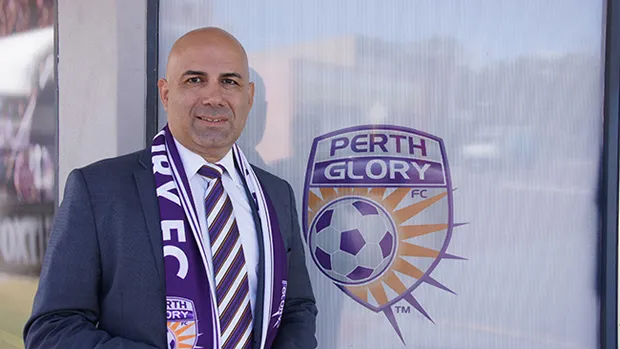
Most of the clubs, except for the Wanderers and Sydney FC, have financial constraints but with new ownership at Perth Glory and Newcastle there is hope on the horizon.

All clubs need is to increase their asset backing and diversify their revenue streams so they can live within their means.

Promotion of the league is also tantamount to its long term stability.
Previous ArticleNext Article

Pignata’s OAM Signals a New Era for Football Administration

In the Australian sporting landscape, administrative longevity is a rare commodity. The burnout rate for executives in the A-Leagues and state federations is notoriously high. It’s driven by the unique friction between commercial imperatives and grassroots politics. Consequently, the awarding of a Medal of the Order of Australia (OAM) to Football Tasmania CEO Tony Pignata is symbolic of more than individual recognition.

Pignata joins PFA founder Brendan Schwab, former Soccer Australia CEO Ian Holmes, and Alen Stajcic on this year’s Australia Day honour roll. However, Pignata offers a distinct blueprint for the modern sports executive. His trajectory moves from the banking sector to the Football Victoria boardroom, through high-pressure A-League franchises, and finally to the developing frontier of Tasmania.

A “Turnaround” Specialist

To understand Pignata’s executive philosophy, observers must look past the A-League. The mechanics of the Victorian Soccer Federation (VSF) in the mid-2000s tell the real story. Following the sudden departure of Damien Bown in 2004, Pignata inherited an organisation in crisis. Then-Chairman Manny Galanos described the body as being “on our hands and knees financially.”

Pignata leveraged a 17-year background in legacy financial institutions including NAB, AXA Australia, and HSBC. He applied corporate discipline to a chaotic sporting balance sheet. His tenure at the VSF (now Football Victoria) restored solvency and aggressively pursued commercial assets.

Pignata’s transition to the A-League demonstrated that these fundamental business principles could scale. His tenure across three clubs showed adaptability to different market conditions. Yet, his legacy remains inextricably linked to a singular, market-shifting transaction: the signing of Alessandro Del Piero.

In 2012, the A-League faced a relevance crisis. At its helm, Pignata executed a high-risk strategy that fundamentally altered the competition’s valuation. The Del Piero acquisition proved the league’s capacity to attract global brand equity. Pignata demonstrated that commercial viability requires bold capital investment backed by operational stability.

Bridging the “Old Soccer” Divide

Crucially, the OAM citation acknowledges a contribution that bridges the often-toxic divide between the “old soccer” NPL system and the “new football” professional era. Pignata is not a corporate outsider. His journey began as a junior at Salesian College and a player for Westall Inter and Box Hill Inter. He featured in the Reserves as the club ascended to the Premier League.

This “proximal” relationship with the grassroots gave him a unique license to operate. Long before the ubiquity of social media, Pignata engaged directly with stakeholders on public fan forums. He understood the importance of monitoring the digital pulse of its supporters when most administrators relied on press releases.

His unique ability to speak the language of both volunteer committee and corporate board drove organisational reforms in Victoria. He oversaw the rebranding to Football Federation Victoria and streamlined the V-League Academy by recruiting Eric Hollingsworth. His move to admit the Australian Institute of Sport (AIS) into the Premier League ensured elite youth talent had a vehicle for competitive match minutes. He prioritised technical development over short-term club politics.

The Tasmanian Mandate

Now 61, Pignata shows no signs of slowing down. His move to Football Tasmania in September 2023 signals a shift in the state’s ambition. Tasmania currently sits at a critical juncture, aggressively lobbying for A-League expansion and the requisite stadium infrastructure.

By appointing Pignata, Football Tasmania signalled to government partners that they are operationally ready for professionalisation. His presence de-risks the expansion proposition. He knows what a viable A-League licence looks like because he’s ran three of them.

His current focus on “high-performance pathways” addresses the state’s most pressing structural deficit: the talent drain to the mainland. Pignata’s mandate is to build an ecosystem where a Tasmanian junior sees a clear line of sight to professional football without leaving the state.

Ultimately, the OAM recognises a career defined by resilience and ROI. Pignata navigated the transition from the semi-pro era to the corporate demands of the A-League. He consistently delivered commercial growth and organisational stability.

“Football is more than a sport… it is a community, a pathway and a powerful connector,” Pignata said upon receiving the honour.

For the industry, Tony Pignata’s OAM is a benchmark. It rewards the “business of winning” off the pitch just as highly as the results on it. As he steers Football Tasmania toward a potential A-League future, the industry watches with interest. The “Pignata Effect” may yet deliver one final, historic expansion victory.

Two CEOs, One Code: Why Alignment Between Football Australia and the A-Leagues Matters More Than Ever

The NSL didn’t fail because of football. It failed because of structure, money and misalignment. With new CEOs at Football Australia and the A-Leagues, the sport now stands at a crossroads it has faced before.

Australian football finds itself at a rare inflection point. Not because of a single appointment, but because of two. With Martin Kugeler set to commence as CEO of Football Australia on 16 February 2026, and Steve Rosich now installed as CEO of the Australian Professional Leagues, the code has, perhaps for the first time in a long while, a genuine opportunity to align governance, commercial ambition and strategic execution across its two most powerful institutions.

This moment matters. Not symbolically, but structurally.

Kugeler arrives at Football Australia with a background that is markedly different from many of his predecessors. As former CEO of Stan and a senior leader across finance and strategy roles, he brings a media-native, commercially fluent mindset into a federation grappling with modern realities. Football Australia’s most recent financials tell a complex story: record revenues of $124 million, alongside a record $8.5 million loss. Chair Anter Isaac has been clear that grassroots programs and national teams will not be impacted, and projections suggest a return to surplus by 2026. But the message beneath the numbers is unmistakable: football can no longer rely on participation alone to sustain its future.

This is where Kugeler’s skillset becomes relevant. His mandate is not simply to steady the ship, but to modernise how Football Australia thinks about audiences, digital platforms, commercial partnerships and long-term value creation. Increasing commercial revenue, improving digital engagement and strengthening the federation’s market relevance are not optional objectives; they are existential ones.

Crucially, Kugeler does not inherit Football Australia in isolation. His tenure begins alongside Steve Rosich’s leadership of the A-Leagues, and that duality could become Australian football’s greatest advantage, if handled correctly.

Rosich, as previously outlined in my last CEO opinion, is not a caretaker. He is a commercial operator forged in high-pressure environments: the AFL, the Melbourne Cup Carnival and elite corporate sport. He understands sponsorship activation, broadcast value, governance discipline and the language of major brands. Where Kugeler brings media and platform intelligence, Rosich brings commercial deal-making and entertainment-led strategy.Together, they represent something Australian football has often lacked: complementary leadership at the federation and league level.


View this post on Instagram


A post shared by Soccerscene (@soccerscene.au)

For too long, the relationship between governing bodies and professional leagues has oscillated between tension and tolerance.

The recent Football Australia AGM made clear that, at least publicly, the relationship with the APL is currently characterised by “complete cooperation and collaboration.”

That sentiment must now be operationalised, not merely stated.

The $4.1 million expected credit loss linked largely to monies owed by the APL is a reminder that financial alignment, transparency and shared accountability are not abstract governance ideals. They are practical necessities. Disagreements over historical balances cannot be allowed to morph into structural dysfunction. Kugeler and Rosich must treat alignment not as diplomacy, but as strategy.

The real test of that alignment may arrive sooner than expected in the form of the Australian Championship.

The inception of a national second-tier competition is, in principle, a positive and necessary evolution for the game. But early signs should concern anyone paying attention. Clubs have already borne the brunt of operational and travel costs. Broadcast timings have been questionable, with examples such as Heidelberg United playing 1pm Sunday matches that clash directly with family and community priorities. There has been no major commercial sponsor announced, no broadcast-led narrative strategy, and no licensed merchandise program attached to the competition.

This is not sustainable.

Australian football has lived this movie before. The National Soccer League did not fail because of a lack of passion or history. It failed because of structure, economics and misaligned responsibility. The Crawford Report in 2003 was unequivocal in its findings: when Soccer Australia directly controlled the NSL’s operations, funding and commercial arrangements, inherent conflicts emerged. The governing body lacked the specialist commercial expertise to run a financially viable league, while the league itself became a financial burden that distracted from core responsibilities such as governance, development and national teams.

The solution then was clear: a licensed, semi-independent league model, aligned but not controlled. The A-Leagues were born from that logic.

The Australian Championship must not drift into the same structural grey zone that doomed the NSL. Kugeler will need to assess, early and decisively, where this competition sits within the ecosystem. Who carries the commercial risk? Who controls broadcast strategy? How are clubs protected from cost blowouts? And critically, where does the revenue model come from?

This is where alignment with Rosich becomes essential. Football Australia should not be attempting to commercialise a national competition in isolation, just as the APL should not be expected to absorb costs without strategic clarity. Joint sponsorship frameworks, coordinated broadcast planning and shared commercial storytelling are not nice-to-haves. They are safeguards against repeating history.

More broadly, the opportunity for knowledge-sharing between Kugeler and Rosich extends well beyond one competition. Both bring deep corporate networks. Both understand boardrooms, not just dressing rooms. Both speak the language of partners who expect return on investment, not goodwill.

If leveraged properly, this dual leadership can reshape how football presents itself to government, broadcasters, sponsors and global stakeholders ahead of the 2026 World Cup cycle. It can also restore confidence internally, among clubs, administrators and fans who have grown weary of fragmented strategy and reactive decision-making.

The warning is simple: alignment must be intentional. History shows that Australian football suffers most when roles blur, responsibilities overlap and commercial logic is secondary to sentiment. The promise, however, is equally clear. With Kugeler focusing Football Australia on governance, national teams and commercial modernisation, and Rosich driving the A-Leagues as a serious entertainment product, the code finally has the chance to operate as a coordinated system rather than competing silos.

Two CEOs. Two institutions. One code.

If they learn from the past, share expertise openly and resist the temptation to repeat structural mistakes, this period could mark not just a reset, but a genuine maturation of Australian football.

The opportunity is there. The question now is whether the game is ready to take it.

Most Popular Topics

Editor Picks

Send this to a friend